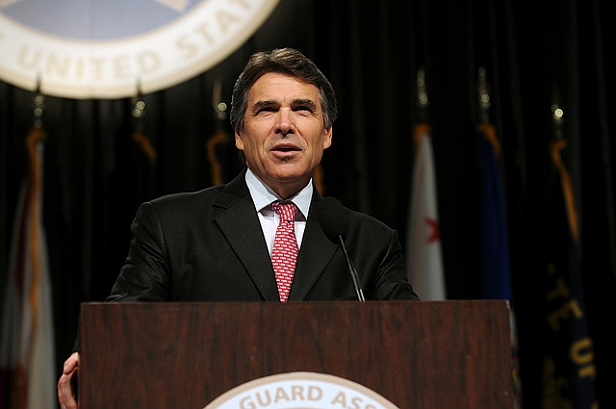
 Rick PerryPhoto: Jim GreenhillThis week, I spoke with Texas governor candidate Bill White (D) about his vision for energy, transportation, and livability in the state. Now I’m taking a look at the record of his Republican opponent, Gov. Rick Perry. (I asked Perry’s campaign for an interview, but didn’t get a response.)
Perry relishes his role as a foe of national climate action. He lambasted the climate bill that passed the House last year as an “economic disaster.” He is suing the EPA to block it from regulating greenhouse gas pollution. (White was unclear in his opinion of this.) Perry is “not convinced” climate change is a threat, according to his policy analyst. And he tried to fast-track permits for 11 new coal plants — a campaign that White helped defeat when he was mayor of Houston.
Perry called the Gulf of Mexico oil blowout “an act of God,” dismissing claims of BP’s negligence by saying he had “full confidence” in the company’s response. He has also rejected federal relief funds for unemployed Texans and raised the question of Texas secession, so he doesn’t reserve all of his excitable words for the environment.
Quite a record. But Perry also oversaw one of the more impressive clean-energy success stories of the past decade: the Texas wind industry. The state generates far more wind power than any other — nearly triple the output of Iowa, its closest rival. The state set a renewable energy standard before Perry took office in 2000, met it four years ahead of schedule, and set a more ambitious standard in 2005 — which Perry signed. It reached that goal — 5,880 megawatts of new renewable generation by 2015 — ahead of schedule too, in 2009. (States tend to find it’s far easier to meet renewable benchmarks than expected. Congress, are you listening?)
“Wind is working so well that we don’t even have to really continue to have mandates,” said Environmental Defense Fund’s Jim Marston, a veteran energy watchdog in the state.
What the state does need is transmission lines, since there’s more wind in the western half of the state and more people in the east. Perry has generally supported transmission expansion plans while respecting the interests of private property owners — which Texans don’t take lightly.
Marston figured Perry and White were both “probably supportive” of helping the wind industry resolve transmission constraints.
Solar energy has been slower to take hold in Texas, despite its sunny climate, and Perry has not supported the non-wind renewable standard that solar companies are seeking. “[Perry] was OK with a very modest rebate program, but would not publicly support the renewable standard that worked so well for wind,” said Marston. (White told me that he would support a solar-specific standard.)
The candidates also part ways on land-use and transportation policy. The 13 million-plus people in the “Texas Triangle” of Houston, Dallas-Fort Worth, Austin, and San Antonio make a promising high-speed rail market, yet Perry did not compete for federal rail funds — which White calls a mistake. (A private, Japanese-owned bullet train might connect Dallas and Houston before a public project does.)
Perry has kept state transportation funds directed almost exclusively toward roads. White isn’t asking Texans to give up their trucks, but he says local leaders should have more say over how they spend transportation money, which would give them the freedom to invest in mass transit.
Last year, Perry vetoed a smart-growth bill that passed the Republican-controlled state legislature (unanimously in the Senate), saying it would “centralize” growth planning in Austin. But the bill [PDF] expressly avoided shifting power from local leaders to the state; instead, it was a “silo-breaking” bill that directed a dozen state agencies to talk together about planning and growth and return to the legislature with recommendations.
David Crossley, president of the livability group Houston Tomorrow, said Perry’s distrust revealed an ideological opposition to walkable urbanism. “He vetoed it because it had the words ‘smart growth’ in it, which the governor took to mean forcing local communities to do things,” he said. “The bill said it was all about local communities deciding what to do themselves.”