Grist’s Feeding the City series began by exploring how the history of urban agriculture should inspire its future, then went on to spotlight the farms, governments, businesses, and people who’re skillfully planting new ideas alongside the old. Here, as the series draws to a close, planner Daniel Nairn untangles how smart growth can include city farming.
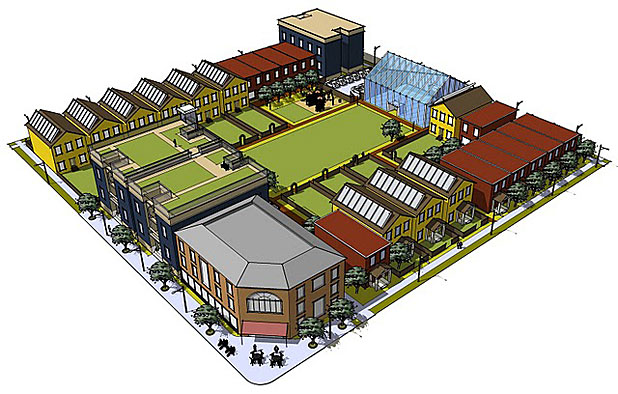
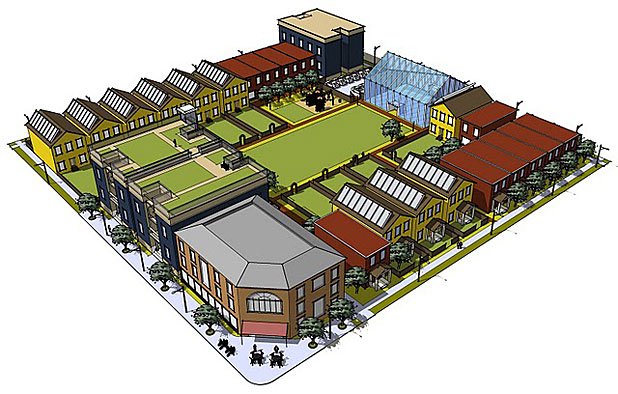 The ’garden block’ concept embeds pockets of food growing within the urban fabric.Rendering: Daniel Nairn
Urban agriculture is a movement in transition. And it’s happening fast. Just a couple of years ago, we started hearing about Detroit’s guerrilla gardeners, reclaiming patches of vacant land in the name of fresh food, and now some of those same parcels are being assembled into large, commercially viable farming ventures. (See “Three projects that are watering Detroit’s food deserts.”) We’ve long had community gardens enriching neighborhoods, and now some architects and developers have their sights on large-scale developments centered on food production. On the zoning front, the major challenge was once just obtaining the legal right to grow vegetables and raise a chicken or two in your yard. Now some planners are pondering whole new agricultural districts within city limits.
Whenever any movement ratchets up to the next level, there’s a chance to take the message mainstream and get some powerful results. Big players who were cautiously watching the trends are now willing to put money or political capital on the table. There’s nothing wrong with seizing the moment while enthusiasm is high, but just as important is some careful and sober reflection on where it is all going. Land use is an incredibly complex arena, and no one answer is ever right in every situation. There are pitfalls to watch out for.
Strange fruit choices
Kaid Benfield, director of Smart Growth for the Natural Resources Defense Council, has long praised compact and vibrant urban neighborhoods as an antidote for chewing up more farmland on the exurban fringes. Thinking regionally, it just makes more sense to concentrate the dense network of human connections closer to the center of metro areas and to leave the natural systems in place at the edges. Benfield doesn’t hesitate to ask difficult questions about the experiments in agricultural urbanism that reverse this order.
He points to two examples on opposite sides of the spectrum — a close-in site perfectly suited for the intensive uses being proposed for agriculture, and a farmland site on the far reaches of a metropolitan area being proposed for a village — all in the name of marrying the urban and the rural.
He’s blogged about the first case, a plot of land near Logan Square in the heart of Chicago. Despite its pedestrian-oriented location on a major street, mere hundreds of feet from a Chicago El transit stop, some advocates would like to use the recently cleared land for an orchard.
Making the most of the transit system and the dense patchwork of mixed uses along the street means condensing as much human activity as possible into one place. Benfield rightly asks whether an urban farm makes the most sense in this context. “I love the idea of the orchard in concept, but its proponents may be seizing the most opportunistic space rather than the best one for their project,” he says. “My instinct is that the residents of Chicago should have their orchard, but not on a potentially busy commercial strip so close to a transit station.”
The other case is Southlands, a proposed subdivision that would add thousands of homes into an existing agricultural landscape at the very outer fringes of Vancouver’s metro area. On paper, it’s an impressively designed village nestled into farmland and open space, with the laudable goal of enhancing residents’ recognition of and participation in growing their own food. This is probably why the jury at the Congress for New Urbanism selected it for a 2010 Charter Award.
But Benfield is concerned with how this would all play out. The proposed gross density is so low that residents will inevitably fire up their car engines for the 17-mile trip into Vancouver. Extending all of the water and sewer pipes to a previously undeveloped site is also inefficient. Once the land is fragmented, it’s harder for farmers to use it effectively.
Finally, development begets development. What happens when residents start asking for a shopping center or an office park nearby? Benfield wonders whether the project, however attractively packaged, could simply be “agri-spawl.”
It’s worth noting that the Vancouver Metro government has designated the Southlands site as a Green Zone, set aside exclusively for agriculture and open space. It’s part of an urban growth boundary that has been doggedly defended since the early ’90s. There’s no getting around the fact that the development would involve a rewrite of the earlier sustainability goals.
A marriage of equals
The modern notion of merging the urban and the rural can be traced back to the visionary utopianist Ebenezer Howard, author of Garden Cities of To-morrow. To explain this novel concept, he liked to use the analogy of a marriage. The verdant countryside and the vibrant city would join together to become one, combining their incomplete virtues into a robust whole.
As nice as this may sound, anyone in a relationship knows that you still need your own personal identity. Some difference is good.
A few decades after Howard’s ideas had taken hold around the world, another equally passionate British planner wished the “garden city” had never been born. Taking stock of the now half-rural, half-urban modern English landscape, Thomas Sharp lamented,
The one age-long certainty, the antithesis of town and country, is already breaking down. Two diametrically opposed, dramatically contrasting, inevitable types of beauty are being displaced by one drab, revolting neutrality. Rural influences neutralize the town. Urban influences neutralize the country. In a few years all will be neutrality.
What Sharp was actually looking at was the tattered remains of Howard’s proposal, after the meticulous sense of scale, communitarian land ownership scheme, and green belt had been compromised away. All that remained was the awkward marriage acted out on individual homes in individual yards as far as the eye could see. Every suburban household was supposed to use their yard to grow their own food, at least in Howard’s vision, but it never really worked out that way.
Planning for the best of both worlds can leave you with little of either.
Dancing about architecture
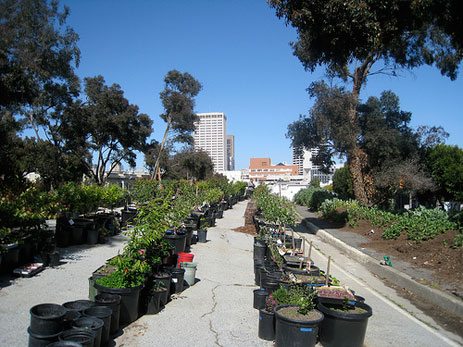 Projects like Hayes Valley Farm, an urban agriculture education and research project located on San Francisco city-owned lots, are popping up all over America.Photo: EdibleOfficeAgriculture, no doubt, has a vital role to play in cities, and it can be done in a way that keeps the urban fabric intact. There’s no shame in thriving on the margins: the odd scraps of leftover land, rooftops, traffic islands and medians, the interiors of blocks, and, of course, the millions of back yards (and front yards) with a layer of grass waiting to be turned over. Azby Brown has written a beautiful description in The Atlantic of traditional Japanese urban farmers who have managed to fit a wide variety of produce into some serious density. Filling in these tucked-away spaces scattered throughout the city with green enriches food awareness and quality of life for entire communities. Wherever there’s constraint there’s innovation, and surely many deliciously ingenious opportunities are only awaiting discovery.
There’s also plenty more room on the margins of time. Jason King shows off an armful of what he calls “ephemeral urban gardens” on his blog Landscape+Urbanism.
“Landbanking” is the practice of holding on to vacant parcels, waiting for the market to make redevelopment possible. Often this empty space just gets co-opted into parking lots, which add little to a neighborhood and only encourage motoring behavior. What if these thousands of waiting parcels were farmed instead? Cities are always in flux, just like the changes in growing seasons. Maybe they could be taught to dance in rhythm.
Yet the potential to lose the “urban” in “urban farming” remains. Growing on these urban margins will honestly never produce enough to feed the city. The urge to stretch out into larger parcels and achieve some permanence in the face of redevelopment pressure is understandable, but we don’t want to get smart growth backward.
There’s nothing wrong with farmers breaking ground on the outskirts and taking the old farm-to-market road into town early Saturday morning. Achieving a 100-mile diet would be an amazing accomplishment. Fighting for a 10-mile diet misunderstands how regions work.