People are always lamenting the lack of small-scale, practical legislation that can address climate change without getting mired in polarized culture wars. Problem is, when legislators introduce bills like that, they're often completely ignored. It's the sexy, controversial stuff that gets attention.
So, in the name of bucking that trend, let me call out a bill just introduced by California Rep. Scott Peters (D). It's called the Super Pollutant Emissions Reduction Act, or SUPER Act. It's not particularly earth-shattering, but it is smart, and well-targeted. Basically, it would create a new federal task force to track, coordinate, and rationalize the various scattered efforts underway to reduce so-called "super pollutants."
What are super pollutants, you ask? They are greenhouse gases that produce much more warming, molecule-for-molecule, than carbon dioxide. However, unlike CO2, they have a short atmospheric lifecycle. When emitted, they hang out up there for anywhere from a few days to a few years and then drop back to earth. They include: black carbon, tropospheric ozone, methane, and hydrofluorocarbons (HFCs). Think of them as the Fast & Furious of the greenhouse-gas world.
Appalachian activists gather outside the Washington, D.C., Environmental Protection Agency office to demand an end to mountaintop removal coal mining. Elaine Tanner and her partner Jimmy Hall have both experienced, up close and personal, the destruction caused by mountaintop removal coal mining. The Kentucky natives are fighting a coal company they claim poisoned their well water. One of the company's mountaintop removal sites is right next to their home in Letcher County. "They destroyed our water," said Jimmy. "The Kentucky Department of Water tested the water of many wells in our area and found a toxic soup. They said the …
Should the federal government regulate where oil dispersants can be used and how much can be dumped into waterways following oil spills?
“Nah,” says the EPA.
Environmental groups filed suit last year seeking to force the agency to improve its oversight of the use of dispersants. But a federal judge this week tossed out the lawsuit after oil industry attorneys helped EPA win on a technicality.
Bumblebee biologist Dave Goulson might be the pesticide industry's worst enemy -- and therefore a bee's best friend. A professor at Scotland's University of Stirling, he was part of the team whose 2012 Science paper called out the effects of neonicotinoid pesticides, which pose a considerable threat to fauna large and small. They've proven especially lethal to bees.
Exposure to the chemicals reduces the production of queen bees and thus reduces a colony’s chances of surviving the winter (queens are the only bees alive in that season, and they birth a new team of workers when spring arrives). Bumblebees, like honeybees, are critically important to modern agriculture, pollinating everything from canola to watermelon, but their population throughout most of the world has plummeted in recent years.
The ideas pollinated by Goulson and other neonicotinoid researchers recently bore fruit, in the form of a two-year partial ban on the pesticides by the European Union. Having recently released A Sting in the Tale, an autobiographical history of his own research, Goulson spoke with Grist about nature writing, the implications of the E.U. ban, and why farmers keep using pesticides despite the lack of evidence in their favor.
Q.You spend much of the book discussing how you became a researcher, and various adventures you’ve undergone in the name of science. Why write a work of half-memoir, half-biology in the first place?
A. In Britain, scientists are spectacularly poorly understood. People -- even our own students at university -- don’t always know how science really happens, or what academic work actually looks like. So I tried to explain what I do.
Q.And you discuss your failed experiments as well! I don’t see that in many science books.
A. Of course, that’s mostly how it goes! People don’t really understand the process of designing experiments, or that you’ll be horribly wrong the first time, perhaps the second and third time as well. I tried to humanize scientists a bit; we’re often seen as these eccentric people wearing white coats and doing dark magic in a lab somewhere, when we’re really just ordinary bumblers like everyone else.
Q.There was a concerted effort by agrochemical companies to stop the E.U.’s neonicotinoid ban, and even the U.K.’s chief scientific adviser came out against it. How did it succeed despite all that?
Goulson's new book, A Sting in the Tale.
A. As far as I can tell, the first major influence was the European Food Standards Agency (EFSA) coming out against [neonicotinoids] a few years ago. They were asked by the European Commission to assess the safety of neonicotinoids with regard to bees, and they came to the conclusion, quite clearly, that neonicotinoids posed a whole host of clearly quantified risks. They didn’t come out and say they should be banned, but that was the clear message.
I didn't set out to spend all week endorsing Jonathan Chait posts, but he's got a follow-up to the cover story he wrote last week and, well, I endorse it. Like Chait, I continue to believe that Obama's EPA will issue CO2 standards on existing power plants. At the very least, there's no dispositive evidence that it won't. And I too believe that those standards are the most important piece of Obama's climate legacy, if not his overall legacy.
But Chait passes over a key fact that, to my eternal puzzlement, plays little role in the discussion about EPA rules. Quite simply, EPA is legally obligated to issue these rules.
Throughout most of human existence, population growth has been so slow as to be imperceptible within a single generation. Reaching a global population of 1 billion in 1804 required the entire time since modern humans appeared on the scene. To add the second billion, it took until 1927, just over a century. Thirty-three years later, in 1960, world population reached 3 billion. Then the pace sped up, as we added another billion every 13 years or so until we hit 7 billion in late 2011. One of the consequences of this explosive growth in human numbers is that human demands …
Over 100 people, primarily Appalachia residents, took action today at the headquarters of the Environmental Protection Agency in Washington, D.C., calling for the EPA to use its powers to end mountaintop removal. 15 people, including a couple of youth no older than 10, risked arrest by sitting in front of a main entrance to EPA. They sat next to about 75 one-gallon containers of dirty and toxic water brought to DC by Appalachian residents, the kind of water produced by mountaintop removal operations. Appalachia Rising, the coalition of groups which organized the action, demanded that the EPA “sign for our …
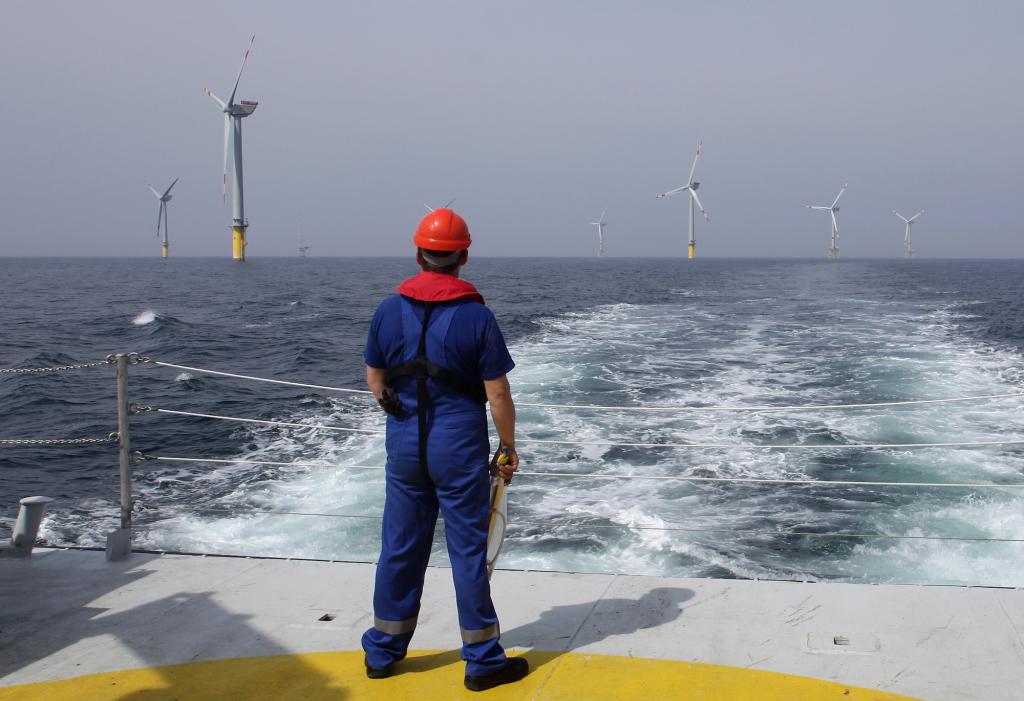
ShutterstockWind turbines in Ontario, where a Canuck conspiracy to discriminate against Japanese and Europeans was foiled by the WTO.
It's great to go green and it's laudable to go local. But don't you dare try to do both at once.
That's the message the World Trade Organization sent this week went it ruled -- again -- that Ontario’s Green Energy Act illegally discriminated against international renewable energy companies. Similar green jobs programs in other countries might also have to be disbanded following the ruling.
The Green Energy Act aims to reduce greenhouse gas emissions while encouraging energy conservation and fostering a jobs-rich renewable energy sector. Under the controversial elements of the act, electricity suppliers could charge premium prices for clean energy, but only if they produced that electricity using a certain amount of locally manufactured equipment like solar panels.
The European Union and Japan protested to the international trade body, claiming that the program illegally discriminated against their manufacturers. The WTO sided with the E.U. and Japan in a November ruling. Ontario appealed against that ruling, and on Monday the WTO rejected the appeal [PDF] while making some minor tweaks to its earlier ruling. From the Toronto Star:
If the definition of insanity is making the same mistakes over and over, then many cities have taken a certifiable approach to securing their water supplies -- and they need some radical therapy before taking the big economic, ecological, and human hits that come with a permanent state of thirst.
Susie Cagle
That’s the conclusion from a new study in the journal Water Policy, whose authors compared the water supply histories of four cities -- San Diego, Phoenix, San Antonio, and Adelaide, Australia. Among the lessons learned? Urban water conservation, recycling, and desalination aren't silver bullets. In fact, the best solution may lie upstream with farmers -- saving just 5-10 percent of agricultural irrigation in upstream watersheds could satisfy a city’s entire water needs.
But the time to act is now, argues Brian Richter, a senior freshwater scientist at The Nature Conservancy and the study’s lead author -- he says a global urban water crisis is already here. Below, Richter tells us more about what cities need to do to say on the right side of dry.
Q.Many cities take a similar pattern of water development, according to your research -- going from exhausting local surface and groundwater supplies to importing water to implementing water conservation to finally recycling water or desalination. Why is this pattern unsustainable?
A. When we overuse a freshwater source, we set ourselves up for disaster. Each of the cities we reviewed in our study has contributed to the drying of a major river or important groundwater spring. That has obvious ecological impacts and social consequences -- it affects livelihoods and human health by compromising fish production, concentrating pollution, or curtailing recreational activities.
Our research is revealing that water scarcity also causes severe economic losses by limiting or disrupting agricultural, industrial, and energy production. Texas lost nearly $8 billion in agriculture last year due to water shortages; electricity generation from hydropower dams on the Colorado River in 2010 dropped by 20 percent due to water shortages. Some estimates suggest that China may be losing $39 billion each year due to crop damage and lessened industrial production, and hundreds of thousands of people around the globe are being forced to move due to water shortages.
Because these impacts are so pervasive and damaging, we need to begin investing in water supply approaches that don’t just minimize these adverse impacts but instead begin to reverse them.
CAL FIREJerry Brown tells journalists what's what on Monday.
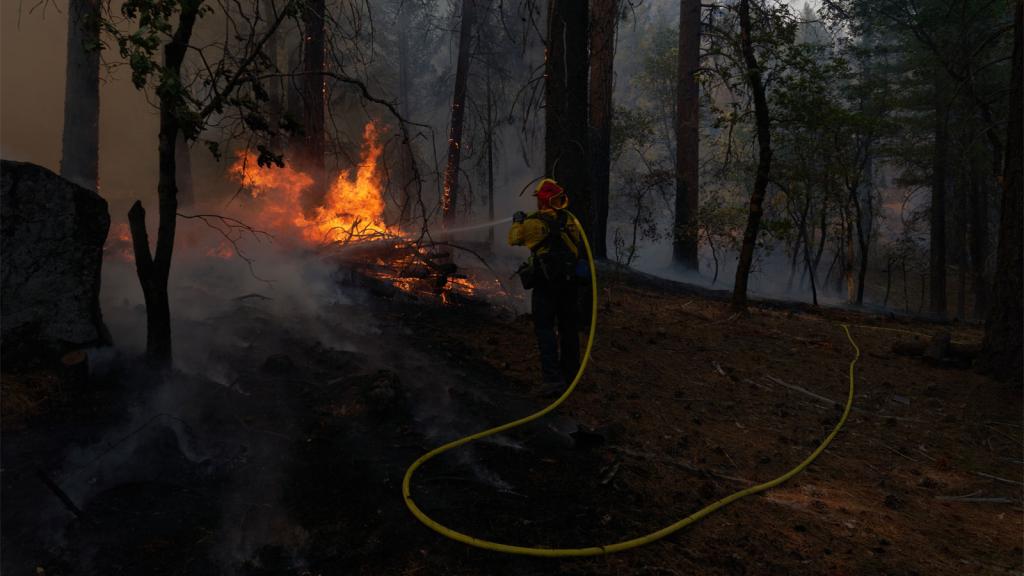
California's governor was quick to blame climate change for the early-season wildfires that are already wreaking havoc in his state.
Gov. Jerry Brown (D) has been an advocate for climate action and a fiery critic of climate deniers. On Monday, he visited the state fire department's aviation management unit as firefighters battled the remains of what a couple days earlier had been a raging blaze in the Santa Monica Mountains. While he was there, he shared some choice words with reporters about the causes and consequences of a fire season that's shaping up to be a big one. From the Los Angeles Times: