Eric de Place's posts RSS feed


Comments

The carbon consequences of Northwest coal exports

A version of this article originally appeared on Sightline Daily.

There are at present six proposals to export coal from Northwest ports. If all of these proposals are built, and if all of them operate at full capacity, the Northwest would be shipping 145 million tons of per coal year.

When burned, that coal will produce roughly 262 million tons of carbon dioxide per year. It’s such a staggering figure that it’s a little hard to grasp. So here’s some context:


The coal export proposals are, in other words, a disaster for the climate. In aggregate, they are actually far worse than the Keystone XL pipeline.

this story continues
Read more: Coal
 

Comments

Picturing international coal trends

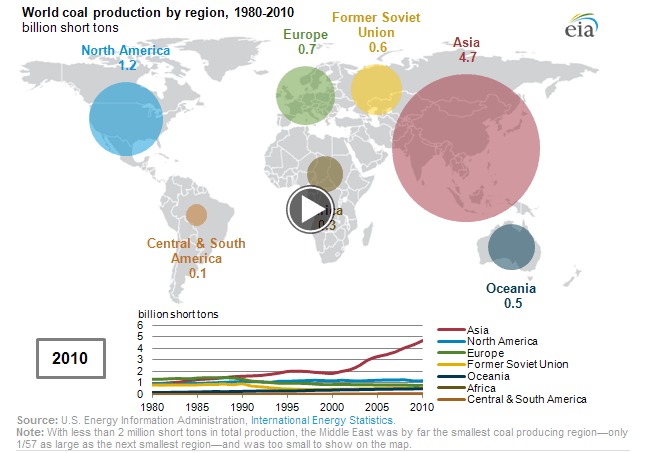
Cross-posted from Sightline Daily. In the course of looking into some larger questions about the global coal trade, I stumbled upon several fascinating pictures of world coal production and consumption during the last three decades. Here’s what global coal “production” (i.e. mining) looked like in 2010: I wasn’t able to embed the animated image, but you can watch 30 years of coal production play out here. Now here’s a closer look at trends within Asia, the world’s dominant coal producer: Watch the animated version here. That’s the production side. The other side of the coin, of course, is coal consumption. So, let’s …

this story continues
Read more: Coal
 

Comments

Why railroads care about coal exports

Cross-posted from Sightline Daily. Here are three pictures that help explain why American railways seem to be supporting coal export proposals in the Northwest. It's because railways are very closely connected to the coal industry. Consider: Coal so dwarfs every other rail-hauled commodity that it is almost as important as all the other commodities combined. (Note: This picture excludes "intermodal" freight.) But while coal is a huge component of rail freight, it declined noticeably in 2009 and 2010: Presumably, a good deal of the recent decline is related to a lousy economy and the attendant reduction in demand for electrical power and industrial uses of coal. …

this story continues
Read more: Climate & Energy, Coal
 

Comments

Coal exports are a bigger threat than the tar-sands pipeline

This post originally appeared on Sightline Daily.

The planned Keystone XL oil pipeline has earned major national attention for the damage it would do to the climate. At the same time, another climate drama is playing out with much less attention as coal companies make plans to export huge quantities to Asia by way of Pacific Northwest ports. It's pretty clear that both projects are environmental horror stories, but I've been wondering: Which one is worse?

So, from the King Kong versus Godzilla files, here's my analysis of their carbon impacts.

Chart.

The result surprised me: Coal exports look to be an even bigger climate disaster than the pipeline. There are, in fact, quite a bit more direct emissions from burning the coal than from the oil. That's true even when one counts the energy-intensive tar-sands extraction and processing -- and, of course, there are plenty of upstream emissions associated with coal mining that I've left out of the equation here. (In order to make a roughly direct comparison, I also omitted emissions associated with both products' mining, refining, transportation, and so forth.) Clearly we can ill afford either one of these projects, but until we have a clear energy policy that respects climate science we'll be wrestling with these kind of killer projects one at a time.

Now, for all the energy and math geeks out there, here's the methodology I used to generate these numbers.

this story continues
 

Comments

More coal in the U.S. means more pollution for China

A young coal worker in Linfen, Shanxi, China.Photo: Andi808 Cross-posted from Sightline Daily. One of the nation's most respected resource economists, Dr. Thomas M. Power, just released a new white paper [PDF] showing that coal exports to China will increase that country's coal burning and pollution, and decrease investments in energy efficiency. In a nutshell, Power demonstrates that the planned coal export facilities in the Northwest would add to the supply of coal to China, thereby pushing down the cost of burning it. And because China is highly cost sensitive, even relatively small changes in price could result in significant changes …

this story continues
Read more: Climate & Energy, Coal
 

Comments

Race, class, and the demographics of cycling

This post original appeared on Sightline's Daily Score blog. If you're reading this, then the phrase "interesting demographic data" probably doesn't sound like an oxymoron to you. That's a good thing, because you'll find a heap of it in a new analytical report out on bicycling. Among other things, we get a clearer view of the race and income components of U.S. bicycling. Here's a look at bike trips broken out by racial and ethnic categories: Two big things stand out here for me: 1) white people remain somewhat overrepresented; but 2) bicycling appears to be trending toward racial parity. …

this story continues
Read more: Biking, Cities
 

Comments

Regional cap-and-trade saves jobs and money

This post originally appeared at Sightline's Daily Score blog. I'm not big on parroting press releases, but I'm going to make an exception for Regional Greenhouse Gas Initiative (RGGI), the Northeast's carbon cap-and-trade program. RGGI is quietly demonstrating that carbon markets can work wonderfully. So it's too bad no one seems to be paying attention any longer. Last week, RGGI's most recent auction netted $83 million, for a lifetime total of nearly $861 million. The vast majority of that money is channeled into energy efficiency and job creation with immediate and tangible results. For example: Maine is investing a portion of its …

this story continues
 

Comments

E.U. carbon fraud: Could it happen here?

Cross-posted from Sightline's Daily Score blog. Europe's Emission Trading Scheme (ETS) cap-and-trade system has taken a somewhat undeserved drubbing in the press. Overall, it has functioned reliably and reasonably efficiently. Most of the alleged "Carbon Fraud!" you hear about in some quarters was really just easily fixable design flaws (like an initial over-allocation of allowances); tax payment scams that were wholly unrelated to the integrity of the carbon-reduction program (like the recent value-added tax scam); or a lousy offset program that is a potentially serious flaw, but that is also fixable as well as a threat to any carbon reduction plan.  But the latest revelation …

this story continues
 

Comments

The 'War on Cars': A brief history of a rhetorical device

Photo: Craig WebbCross-posted from Sightline's Daily Score blog. Back in October, I started noticing the accusation that Seattle is waging a "war on cars" was popping up an awful lot in the local press, and in suspicious ways. On its face, the charge that Seattle is waging a war on cars is pretty silly. After all, that the bulk of the city’s political leaders support two car-centric megaprojects -- the 520 bridge and the Alaskan Way tunnel -- that will cost in the range of $7 billion, depending on how you do the counting. And the evidence marshaled in support …

this story continues
Read more: Cities, Politics
 

Comments

Regional cap-and-trade advances

I know everyone is supposed to be dour and disheartened about the prospects for climate policy right now. And while I can't say that I'm thrilled with where we are, it's useful to take stock of what's happening because it's not insignificant: California: Next week, regulators are expected to approve a cap-and-trade program for the Golden State. It should be a slam dunk given that Proposition 23 -- the oil company funded gutting of the state's climate laws -- got hammered at the ballot box. And now, new poll results from the Field Research Corp show that fully 64 percent …

this story continues

Eric de Place RSS feed

Eric de Place is a senior researcher at Sightline Institute, a Seattle-based sustainability think tank, working on promoting smart policy decisions for the Pacific Northwest. Visit http://daily.sightline.org/blog/ to read more on Sightline's blog.

Advertisement
Advertisement
advertising