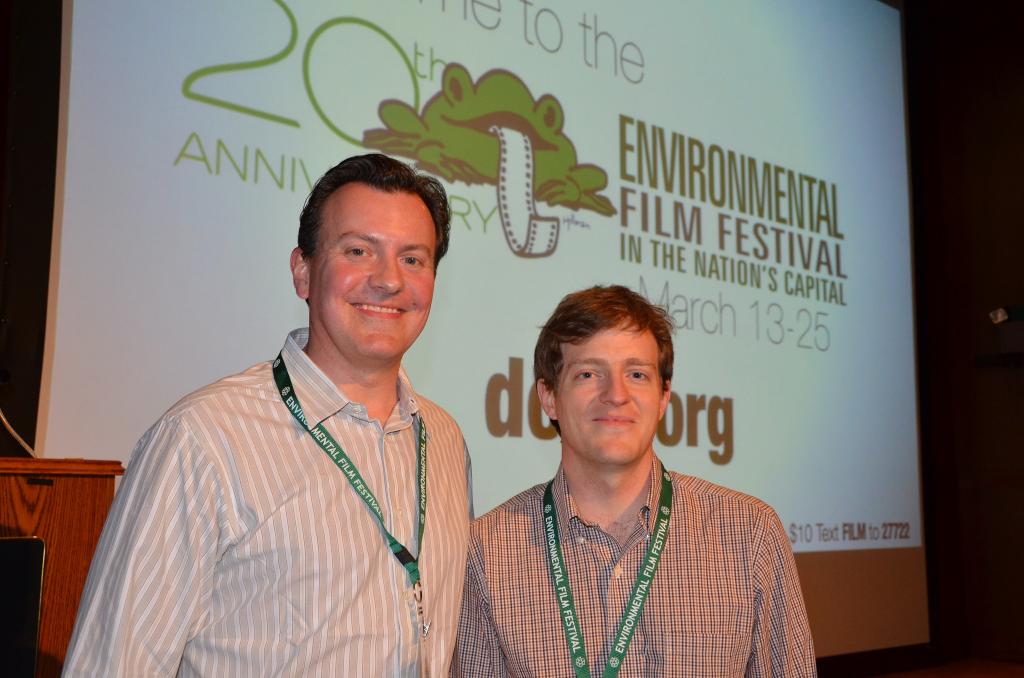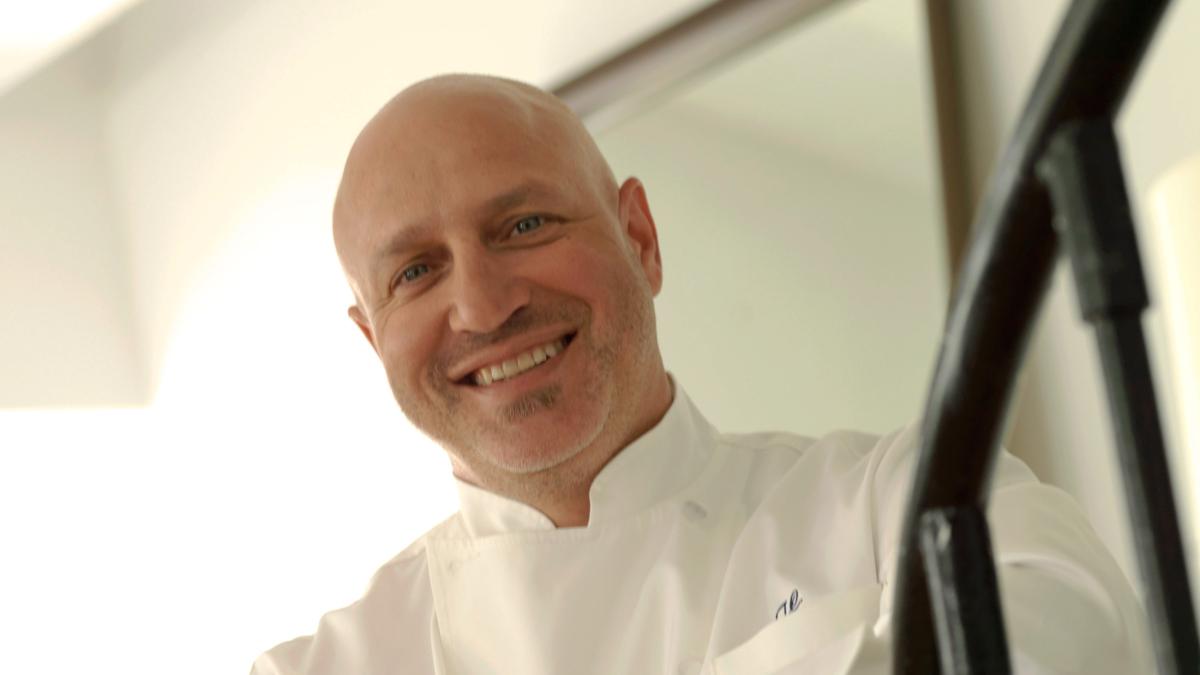
The twenty-first annual Environmental Film Festival in the Nation’s Capital kicks off this week in Washington, DC. The event, which runs from March 12 – 24, will screen 190 films that celebrate our connection with the natural world—from an exploration of the Amazon to a kayaking trip down the infamous Los Angeles River. I caught up with Peter O’Brien, the Festival’s executive director, who answered a few questions via e-mail. The 2012 Festival was one of the most ambitious to date—over a hundred films were screened—but this year’s event looks even bigger. What are some of the highlights? The 2013 …
Erik Hoffner's Posts
Five questions for DC Environmental Film Festival Director Peter O’Brien
Local food a growing trend for land trusts
When a land trust in Grayslake, Illinois, made a strategic decision in 2005 to include farmland in its list of property types to preserve, it joined scores of traditional ‘woods and waters’ trusts across the U.S. which are increasingly preserving agricultural lands and building local food systems.
While it made sense strategically, since much of the county’s remaining forested and open land has already been conserved, it was also right on mission for Conserve Lake County (CLC). As they got into it, the CLC leadership realized that they didn’t want to convert purchased farms to natural uses, though, but rather to keep them in farming.

Yet the conventional corn and soybean farming practiced widely in the region was not on-mission, given the known impacts of those practices. “That sent us searching for a different kind of farming more in keeping with our mission of improving land and water health,” explained Steve Barg, CLC’s Executive Director. Because their preserved agricultural lands are farmed more sustainably, they were then pulled into the nascent food system conversation in the county and are now leading efforts to develop its local food economy.
While land trusts that specialize in farmland, like American Farmland Trust, have been around a long time, this trend of conventional land trusts wading into food systems work is much newer, and it’s growing. Statistics shared by the Land Trust Alliance (LTA), found that of 912 member trusts surveyed in 2010, 22% reported that farm and ranch preservation was “very important,” and 39% said it was “extremely important.” Well over half of the LTA members, then, are strongly invested in this work (for more stats, see American Farmland Trust’s 2012 survey of land trusts that specifically work to preserve farms and ranches).
When asked about the interest, Rob Aldrich, Director of Communications for the LTA, said he’s been watching it trend steadily upward since the early 2000s, and sees land trusts getting involved all along the spectrum of activities within the new food movement. One of his favorite examples is Massachusetts Audubon, “…a land conservation organization dedicated to saving bird habitat, which is now doing community gardening in some of their sanctuaries. Why? Because that’s what their communities need, and they want to use their resources to address community needs that also blend with their mission.”

And Mass Audubon isn’t alone: the biggest and oldest land trust in the state, The Trustees of Reservations, employs an Agriculture Program Director to manage its ag-strategy and farm-holdings. The LTA’s Aldrich plans a special feature on the whole topic of land trusts in the food system for the summer issue of his organization’s member magazine, Saving Land.
Back in Illinois, the most visible example of CLC’s efforts, beside Prairie Crossing (a 669-acre Chicago subdivision that devotes 100 acres to food production: see “Farming the ‘burbs”) and the fact that around 25% of its portfolio is now agricultural land, is the nascent Casey Farm Center for Land Health, a 34-acre farm CLC also now owns. It will use part of the farmhouse for educational purposes and lease the rest to a young couple for raising chickens and produce. A renovation of the 140 year-old dairy barn to make it friendly for food processing is just being finished.
Sea sick: Another virus crashes Canada’s salmon farms
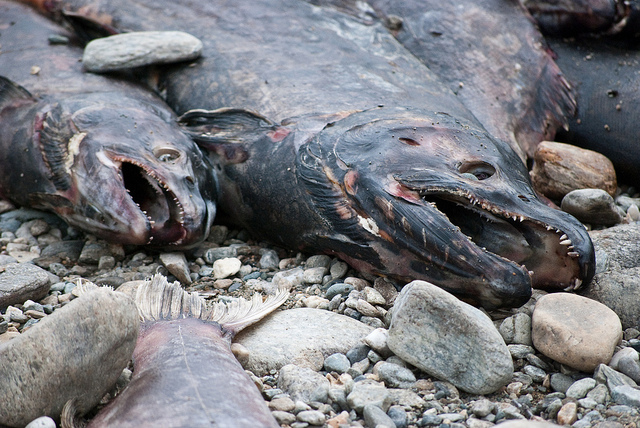
Dead salmon in British Columbia (these ones died from natural causes). (Photo by Carol Browne.)Last month a virus broke out in an open water salmon farm in British Columbia that has the region’s fish farm owners scrambling to mitigate their losses. Called infectious hematopoietic necrosis (IHN), the rabies-like virus was found among salmon in floating net pens belonging to Mainstream Canada, the biggest producer in the region. As a result, the B.C. farm culled over 500,000 fish infected with IHN, which spreads rapidly and can kill up to 100 percent of a fish farm’s population. And this is just the latest disease scandal to hit the province’s salmon farming industry.
Critics of the industry say that the farms should have seen this coming. Their own alarm bells have been ringing ever since Rick Routledge, a professor at Simon Fraser University, claimed that wild sockeye tested by his lab in 2011 showed that another more serious virus, one that causes infectious salmon anemia (ISA), was present in B.C. waters. The government seized his samples and declared through their own testing that the virus was not present (since a verified case of the disease would be treated like other serious outbreaks such as mad cow disease under international convention, this would be devastating to the industry. In 2007, ISA caused a $2 billion loss to the Chilean salmon farming industry, and was found to be imported on Atlantic salmon eggs shipped from Norway).
Diseases like these are suspected by First Nations, activists, and fishing groups to be one cause of the drastic declines among some wild salmon populations that the province has witnessed in recent years. Home to some of the biggest wild salmon runs in the world, B.C.’s provincial government has also welcomed the salmon farming industry eagerly over the years, allowing 100 farms to be established in its waters (59 are currently in use). But activists charge that the open water pens are often located directly on the migration routes of wild salmon, where, as in the case of Chile, exotic diseases imported with the Atlantic salmon could multiply and spread into surrounding waters.
Green screen: 20 years of environmental films
Lucy Walker's Oscar-nominated film The Tsunami and the Cherry Blossom will screen at EFF this year.While creating public programs at the American Museum of Natural History in New York City for 15 years, Flo Stone learned that movies were a great draw. Film is one of the most effective means to reach people on complex environmental issues, so after moving to Washington, D.C., she applied that knowledge to her green streak and established the Environmental Film Festival in the Nation’s Capital (EFF), which since that time has premiered almost 700 films, including world premieres of important titles like A Sea Change (2009), Carbon Nation (2010), and Planeat (2011). This year it celebrates its 20th event from March 13 to 25, during which 180 films (and 93 premieres) will be shown in 64 venues. Its founder took a minute to answer our questions before the excitement begins.
Ride the line: What one activist learned biking the Keystone XL route
Tom Weis with his rocket trike.Tom Weis, the "renewable rider," biked the 2,150 miles of the U.S. portion of the proposed Keystone XL pipeline route over two months late this fall, from the U.S./Canada border to Port Arthur, Texas. He steered his "rocket trike" through many small towns along the way, raising awareness, talking to reporters, and recording scores of interviews with a wide variety of people. He’s just returned to his home in Colorado with a good sense of the prevailing opinions of the project in America's rural West.
Eco-shocking the airwaves
Alex Smith.Photo: Philip SmeltzerAlex Smith has been a back-to-the-lander, a private investigator, a print journalist, and a researcher, and he now combines those experiences to find and interview authors, scientists, and activists (many of whom you'll never hear from anywhere else), for his indispensible radio program and podcast about the climate crisis, Radio Ecoshock. Produced from a home studio in Vancouver, B.C., and broadcast on a growing list of college and community radio stations (50 at last count) in the U.S., Canada, the U.K., and Australia, I thought it a good time to ask a few questions of him, for …
Fishing for change
Teeg Stouffer fishes blue ribbon waters in Colorado.Photo: Recycled FishTeeg Stouffer is a lifelong fisher with a lot of hooks in his tackle box. Verbal hooks, that is, that challenge his fellow anglers to consider how they can do right by the environment while enjoying their favorite pastime. Based in Nebraska City, Neb., and traveling widely to fishing events, his nonprofit Recycled Fish is greening the average fisher, with the happy effect of improving water quality nationwide. He's also a host of the popular Fish Shtick podcast, where I first encountered his work. Q. How many people fish recreationally in …
Natural gas, war of words
These bumper stickers have proliferated on cars of those opposed to LNG terminals on Passamaquoddy Bay in Maine.Photo: Erik HoffnerA dramatic environmental justice and cultural survival campaign led by a band of Passamaquoddy tribal elders and members in northern Maine ended in 2010 in favor of indigenous activists. A massive liquefied natural gas (LNG) import terminal, proposed for this coastal reservation by an Oklahoma energy company encouraged by the Cheney Energy Task Force's bullish policy pushing this fuel, was defeated, but only after a five year battle revealed the inadvisability of Quoddy Bay LNG on economic, technical, and legal grounds. …
New green zone spreads in Iraq
Abandoned boat in Iraq.Photos: Stephen Foote. Photos courtesy of PBS Nature's "Braving Iraq." A new green zone is sprouting in Iraq, but it's not the kind you think. It's a grassroots one pushed by a new culture of conservationists whose currency is reeds. The recent environmental history of Iraq is a tale of two men. Saddam Hussein had a horrific impact on the ecology of the country, principally by ordering the draining of the Mesopotamian Marshes in the 1990s in order to collectively punish communities where resistance to his regime persisted. The incredible cultural and biological loss of the marshes …
How to queer ecology and the environmental movement
Alex Johnson exploring riotous, unpredictable Nature.Missoula-based writer Alex Johnson believes we need to queer the concept of ecology, and I'm inclined to agree. After enjoying his feature "How to Queer Ecology: One Goose at a Time" in the current issue of Orion magazine, I asked him to expand on some of his ideas. Q. You propose the queering of ecology. What does that mean to you? A. Queering ecology means hosing out the pigeonholes. The queer movement bravely claims that humans are inherently capable of a much wider range of behaviors than the powers-that-be give us credit for. Queer ecology …