This post originally appeared on Energy Self-Reliant States, a resource of the Institute for Local Self-Reliance's New Rules Project. Have wind developers hit a financial sweet spot above which more turbines results in disproportionate land acquisition and lease costs? Are crane and construction economies of scale no greater? Are NIMBY concerns mitigated with a smaller number of turbines? Wind generation may be growing rapidly in the United States, but the size of wind farms -- measured by the number of turbines -- is not. Rather, wind farm capacity grows largely because of increasing turbine size. The reason is unclear, but …
John Farrell's Posts
Solar gardens to bring small-d democratic solar power to Colorado
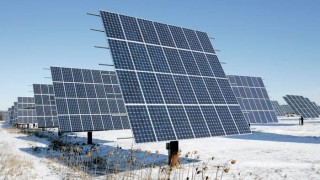
Colorado is the first U.S. state to follow in Canada's footsteps democratizing solar power.This post originally appeared on Energy Self-Reliant States, a resource of the Institute for Local Self-Reliance's New Rules Project. Want to go solar but you have a shady roof? You rent? You don't have $40,000? Last year, Colorado passed the first state law to create "community solar gardens" and the recent release of draft rules for Community Solar Gardens may open the floodgates, turning distributed solar power into democratic solar power. A solar garden is a 2 megawatt or smaller solar photovoltaic (PV) project with 10 or …
Solar is contagious
This post originally appeared on Energy Self-Reliant States, a resource of the Institute for Local Self-Reliance's New Rules Project. Adam Browning of Vote Solar wrote about a recent study of the peer pressure effect of solar photovoltaic (PV) adoption. The study [PDF] notes that for every 1 percent increase in the number of installations in a single ZIP code, there's a commensurate 1 percent decrease in the amount of time until the next solar installation. As he writes, "solar is contagious!" I'm a data lover, so I thought it would be interesting to see what this looks like over time. …
Like a magnifying glass to ants, concentrating PV a cost-effective distributed solar option
This post originally appeared on Energy Self-Reliant States, a resource of the Institute for Local Self-Reliance's New Rules Project. Concentrating solar typical fills people energy nerds with visions of large fields of mirrors focusing sunlight to make heat/steam/electricity, but concentration technology is also available for photovoltaics (PV). In fact, using lenses to focus sun onto PV cells – concentrated PV or CPV – may prove to be a more cost-effective (and compact) strategy of doing solar power than either concentrating solar thermal power or traditional solar PV. For this analysis, we compared a real-life, 1 megawatt (MW) concentrated PV installation …
Solar could save Minnesota schools millions
This post originally appeared on Energy Self-Reliant States, a resource of the Institute for Local Self-Reliance's New Rules Project. Currently, Minnesota's public schools spend approximately $84 million per year on electricity costs, money diverted from the classroom. But a bill to make clean, local energy accessible now (CLEAN) could help the state’s public schools use solar to zero out their electricity bills and add $193 million per year to their operating budgets. The proposed bill would create a CLEAN Contract for public entities in Minnesota, requiring local utilities to buy electricity from solar photovoltaics (PV) systems on public property on …
Solving solar's variability with more solar
This post originally appeared on Energy Self-Reliant States, a resource of the Institute for Local Self-Reliance's New Rules Project. The solution to the variability of solar power is more solar. It’s true that individual solar power plants can experience significant variation in power output, especially on days with mixed sun and clouds. "Output of multi-MW PV plants in the Southwest U.S., for example, are reported to change by more than 70% in five to ten minutes on partly-cloudy days," notes a 2010 NREL study of solar variability [PDF]. A story on Greentechmedia has an powerful illustration (see right). But while …
Cost, not Japan crisis, should scrub nuclear power
Please ignore this image.Photo: GlobovisionThe plumes of smoke rising from Japan's Fukushima Daiichi nuclear reactor create a visceral reaction. But the crisis should not persuade Americans to abandon nuclear power. Instead, Americans should abandon nuclear power for its prohibitive and uncompetitive costs. The wildly escalting costs of nuclear plants under construction in the U.S. are a perfect example. A pair of proposed nuclear power plants in Florida have "overnight" costs of $3,800 per kilowatt, but since nuclear power plants actually take eight years to construct, the total estimated project costs are closer to $6,800 per kilowatt (kW) of capacity. This …
Solar permitting can increase residential solar prices by nearly 20 percent
This post originally appeared on Energy Self-Reliant States, a resource of the Institute for Local Self-Reliance's New Rules Project. A new report from SunRun recently revealed that permitting can significantly increase the cost of residential solar PV projects, adding as much as 20 percent to total project costs. One large solar installer in California has two full-time “runners” whose entire job is dedicated to taking solar permit applications to city offices that require an in-person submission. The problem of permit costs looms ever larger as solar module and installation costs fall, making permitting an even larger portion of project costs. …
Is the Bloom Box cheaper than solar?
This is part of a series on distributed renewable energy posted to Grist. It originally appeared on Energy Self-Reliant States, a resource of the Institute for Local Self-Reliance's New Rules Project. The Bloom Box has received a lot of media attention for its plug-and-play approach to electricity from fuel cells. The 100 kilowatt boxes generate electricity from natural gas, with lower carbon emissions than traditional natural gas-fired power plants, and they can be connected right into the grid alongside commercial and industrial buildings. But will this well-marketed, distributed fuel cell make economic sense? Compared to retail electricity prices in a few …
Can states keep clean energy jobs at home?
Photo: GreenforallCan a state with a renewable energy mandate require green jobs to stay at home? Litigation has made states into tepid defenders of their job rights, but states have the legal ground to go great lengths to keep more of the economic development from their renewable energy industry inside their borders. No renewable energy mandate passed a state legislature without the promise of thousands of new jobs, but many states have shared the recent experience of Massachusetts: the state’s largest solar manufacturing plant announced that it is moving production to China. Evergreen Solar is moving despite the state’s commitment …

Spared by climate change: 10 best cities to ride out hot times
This pedal-powered contraption can run a computer or churn butter
Zen and the art of bridge maintenance