There's a lot of talk these days about the need to become more resilient and ruggedize our systems in order to better cope in a climate-changed world. It's nice to actually see a little action on this front -- in Texas, of all places.
Jay PhaganTexas' first "hurricane dome" in Woodsboro will do double duty as a gym and a shelter. We expect it'll look more appealing once the gale-force winds start blowing.
Most of the time, the windowless building with the dome-shaped roof will be a typical high school gymnasium filled with cheering fans watching basketball and volleyball games.
But come hurricane season, the structure that resembles a miniature version of the famed Astrodome will double as a hurricane shelter, part of an ambitious storm-defense system that is taking shape along hundreds of miles of the Texas Gulf Coast.
The green movement has too few visionary leaders and too few women leaders and too few leaders under the age of 40. Tragically, this week it lost one leader who stood out in all three categories.
On Dec. 26, Rebecca Tarbotton, executive director of the Rainforest Action Network, died while vacationing along the west coast of Mexico, north of Puerto Vallarta. In a freak accident at the beach, she got tossed around in rough surf, took too much water into her lungs, and asphyxiated. She was 39 years old.
Tarbotton had been at the helm of RAN since August 2010, and had worked with the organization for almost six years. Under her leadership, RAN has focused on the intersections between forests, fossil fuels, and climate change, and run aggressive campaigns pushing corporations to change the way they do business. Most recently, Tarbotton helped convince entertainment giant Disney to adopt a major new policy that will eliminate the use of paper connected to the destruction of endangered forests.
Seattle Mayor Mike McGinn is no fan of fossil fuels.
Student groups at 192 colleges and universities are calling on their schools' endowments to sell off stocks in fossil-fuel companies, inspired by a 350.org campaign that we've reported on before. Now that campaign is spreading from campus to city hall, as Climate Progress reports:
Seattle Mayor Mike McGinn is now calling on his city to strip fossil fuels from its two main pension funds. According to the city’s finance director, Seattle has $17.6 million invested in Chevron and ExxonMobil, as well as smaller investments in other oil and gas companies. Mayor McGinn sent a letter to the city’s pension fund managers on Friday calling for them to move their money elsewhere.
McGinn is the first municipal leader to get on board with 350's campaign. As the mayor explains on his blog, he doesn't control the investment of pension funds, but he and his staff want to work with the city council and the pension board to help move toward divestment.
McGinn, a local Sierra Club leader before he was elected mayor in 2009, has also recently criticized proposals to send coal trains through Seattle to ports on Washington's coast. He's commissioning a study on the potential economic impacts of the trains and coal-export plans. “I’m not sure very many jobs are being created in Seattle, compared to impacts,” he said earlier this month.
ShutterstockOMG, I just saved way more energy than you.
Continuing its long tradition of reporting on trends long after they've become trendy, The New York Times has a big story today on gamification: "a business trend — some would say fad — that aims to infuse otherwise mundane activities with the excitement and instant feedback of video games."
[D]igital technologies like smartphones and cheap sensors have taken the phenomenon to a new level, especially among adults. Now, game concepts like points, badges and leader boards are so mainstream that they have become powerful motivators in many settings, even some incongruous ones. At a time when games are becoming ever more realistic, reality is becoming more gamelike.
A lot of gamification is aimed at getting us to buy junk. The BBC quotes one critic within the gaming industry:
Ian Bogost, co-founder of the game design company Persuasive Games, ... calls Gamification a “marketing gimmick”. And, in another blog post, took his critique one step further, describing it as "exploitationware" and “bullshit, invented by consultants as a means to capture the wild, coveted beast that is videogames and to domesticate it for use in the grey, hopeless wasteland of big business ..."
But some people are trying to harness the trend for good instead of evil. From the Times:
We've written before about the environmental damage done by marijuana growers -- massive energy consumption, indiscriminate pesticide use, dead little forest critters, both cute and uncute. Now the L.A. Times reports that pot growers in California are also undermining salmon recovery efforts, poisoning bears, and even threatening our BFFs: dogs.
The marijuana boom that came with the sudden rise of medical cannabis in California has wreaked havoc on the fragile habitats of the North Coast and other parts of California. With little or no oversight, farmers have illegally mowed down timber, graded mountaintops flat for sprawling greenhouses, dispersed poisons and pesticides, drained streams and polluted watersheds.
Because marijuana is unregulated in California and illegal under federal law, most growers still operate in the shadows, and scientists have little hard data on their collective effect. But they are getting ever more ugly snapshots.
If Sen. John Kerry (D-Mass.) becomes secretary of state, as is expected, he'll be the most ardent climate hawk ever to hold the office. But how much will that matter?
Kerry has been pushing for national and international solutions to climate change for two decades, and he understands that it's a geopolitical problem, not just an environmental one. "Global climate change is a security issue on a planetary scale," Kerry told Grist in 2007. In a speech on the Senate floor this past June, he said, "Climate change is one of two or three of the most serious threats our country now faces, if not the most serious, and the silence that has enveloped a once robust debate is staggering for its irresponsibility." Just this week, Kerry introduced a bill that would help communities become more resilient so they can better withstand the weather disasters brought about by climate change.
Richard Cizik has a knack for irritating right-wing evangelicals. He knows just how to do it, being an evangelical himself, though no longer one with standard right-wing political views.
Cizik's latest campaign is sure to push right-wingers' buttons: He is advocating contraception as a means to combat climate change (as well as achieve lots of other worthy goals). "Family planning is a green technology," he told me during a recent conversation.
But though some conservative Christians will surely recoil in horror, Cizik believes he can convince open-minded evangelicals and other Christians of the rightness of his cause.
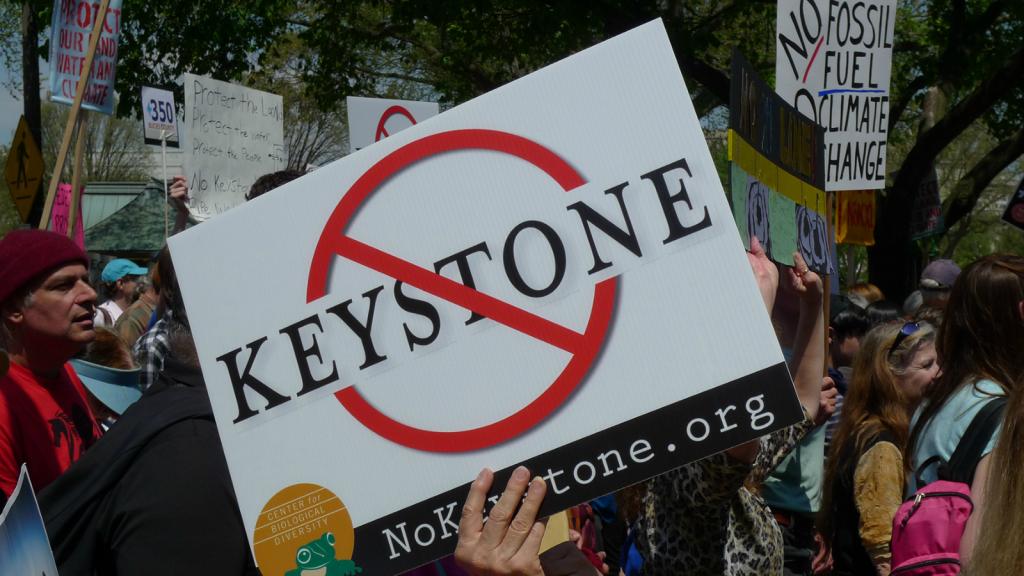
It looks like Keystone pipeline protesters are having an unintended impact. Thanks in part to anti-pipeline activism, oil in North America is increasingly being shipped by train. So far this trend has been little noticed by the environmental community, but it's big news in the rail world. From Railway Age:
“Railroads are booming, and [the reason] is oil,” reports the well-known and highly respected stock market news and financial analysis website Seeking Alpha. “Railroad stocks are ready to leap on booming oil transportation.”
The boom started in January, when President Obama denied approval for pipeline operator TransCanada’s proposed $7 billion Keystone XL pipeline, which would carry oil from Canada’s oil sands to U.S. Gulf Coast refineries. ...
The U.S. Energy Information Administration (EIA) says rail deliveries of oil and petroleum rose almost 40% in this year’s first half. BNSF, the biggest railway mover of crude in the U.S., posted an increase of 60% in carloads of crude oil and petroleum products during that period.
He hasn't even gotten his foot in the door of the mansion yet and already Jay Inslee is being touted as the nation's greenest governor -- and being pushed to live up to that reputation.
Inslee, a Democrat, won election in Washington state earlier this month after getting unprecedented support from state and national environmental groups. They're counting on him to keep up the advocacy for climate action and clean energy that he demonstrated during more than 15 years in Congress.
But on one critical environmental topic, Inslee has been largely silent: coal trains and coal export terminals. During the campaign, he, like his Republican opponent, stayed neutral. In a June debate, he said, "My view is we need to evaluate all of the jobs prospects, both plus or minus, before we make a decision." That sort of hedging prompted the Seattle alt-weekly The Stranger to make this demand the day after the election:
[S]tep away from your hedged position on those mile-long, toxic-dust-spewing coal trains from Montana that Big Coal wants to run through our state—and the city of Seattle—and then onward to Western Washington ports that will ship it off to energy-hungry China. The county that elected you needs you to get off the fence, stop talking about more studies, and start tangling in an effective, direct way with the coal-train pushers.
Tired of all those election maps? Here's a new map to look at:
This one shows grades given to the 50 states for their progressiveness (or regressiveness) on reproductive health and rights. A report card put out by the Population Institute ranks states on availability of birth control, rates of unintended and teen pregnancy, access to emergency contraception and abortion, and sex-ed policy.
The worst state in the union? That would be Mississippi, which scores an F-. Eight other states failed too: Arizona, Florida, Louisiana, Nebraska, Nevada, North Dakota, South Dakota, and Tennessee.
On the bright side: Go left coast! Washington state wins top honors with the only A+ in the union, while California and Oregon get straight-up A's. (Not that the West Coast states are perfect. Looks like there's some grading on a curve here.)