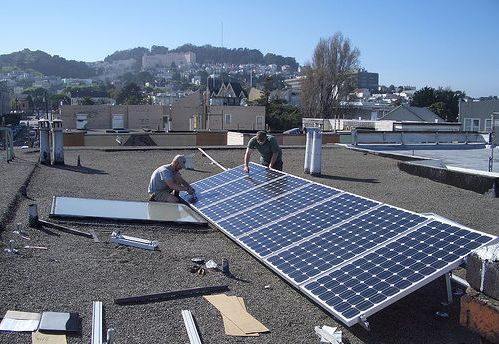
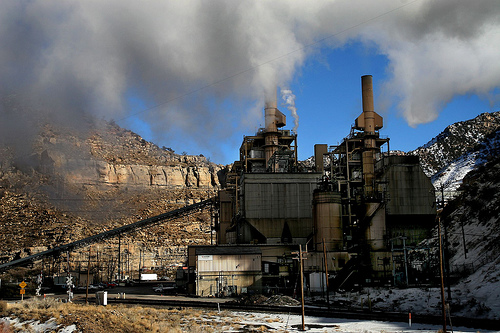
I think this one's got it! There is a belief that with the Democratic shift in Congress, we finally have the votes to get a national renewable portfolio system (RPS). I don't buy it. As I pointed out here, a "pure" wind-and-solar-only RPS means a wealth transfer from Eastern to Western U.S., and no political party is inclined to vote against their state's economic interests. The basic electoral math of the Senate makes such an RPS impossible. Many in the environmental community still don't get this, but in my experience, Congress does. Perhaps not universally, but as a collective body, …
Sean Casten's Posts
Survey says: Americans concerned about global warming, want policy change, like money
An interesting report out today from Public Agenda, entitled "The Energy Learning Curve." They report on a survey that is both heartening with respect to the public perceptions of global warming (and needs for policy response thereto) and frustrating for what they suggest about the policy conversation in Washington. The Good The good news is that there is overwhelming support for rather major changes in our energy policy and infrastructure: 86% believe that investing in alternative energy will create jobs 84% support investment in fuel efficient railways Solid majorities support policies that transfer wealth to individuals and businesses who invest …
Shoddy economics at The New York Times
Joe Romm has done a pretty thorough trashing of Matt Wald's recent New York Times piece. Herein, I pile on. This is a shoddy enough piece of journalism to deserve it. Like Joe, I've talked to Matt Wald before, and generally I find him to be a good writer on energy. He's capable of much better reporting than this. That said, my larger beef is not with Wald nor the NYT per se, but rather with the analytical errors that are innate to his analysis, which are far too common in most journalism of this "what is the cost of …
If it walks like a tax and quacks like a tax … then it’s called cap-and-trade?
In an otherwise solid post, David said something that made me cringe: In a cap-and-trade system where the pollution permits are auctioned, the money goes to gov't, and the gov't decides what to do with it. Poorly paraphrasing James Joyce: no and my heart was beating like mad and no I said no I NO. That's not at all what cap-and-trade does. If you got pissed off when the Bush administration stuck "Clear Skies" labels on their environmental programs, you should be no less fidgety when the phrase "cap-and-trade" is being comparably misused. The phrase has been twisted and muddled …
Don’t make too much of current energy prices; they are disconnected from fundamentals
There is a fair amount of hand-wringing over the recent collapse in energy prices which -- while academically interesting -- is largely irrelevant to larger macro forces. Here then a quick observation that is critically important and horribly misunderstood throughout our current energy, environmental, and economic conversation: current energy prices have very little to do with energy fundamentals. This is a critical point, lost in the pop-economics that pervades most public discussion -- which always tends to implicitly assume perfect markets where price is a function only of supply and demand. (No less true of those who claim that we …
AEP wants rate increase to make up for revenue loss
Remember when Mike Morris, CEO of American Electric Power, said this? [he] said "I'm not a decoupler. If my revenues go down, they go down." The West Virginia arm of his utility is now asking for a series of rapid rate increases: 18.5 percent this year, 14.5 percent next year and 13.2 percent in 2011. Why, pray tell? In part, because: The company had predicted it would sell $248.5 million in power to other electric utilities between July 2008 and this June, but those sales have almost disappeared. Revenue generated from those sales -- electricity unused by AEP customers -- …
Why electric utilities like coupling
Writing from the Eco:nomics conference last week, David noted that at least one utility CEO is pretty down on decoupling: Michael Morris, CEO of American Electric Power ... said "I'm not a decoupler. If my revenues go down, they go down." David appropriately questioned whether AEP is really so agnostic with respect to falling revenues. But Morris does raise a larger, quite accurate point. Namely, many electric utilities aren't decouplers. Given the prominence that decoupling has come to play in many state and federal policies, it's worth taking the time to understand why. Decoupling is often framed as a way …
Carbon pricing does not necessarily cause high energy prices
E&E Daily reports ($ub. req'd) today on efforts in the House to try and determine how to minimize the economic pain of CO2 pricing. They note: Government studies conclude that for a new U.S. climate law to work, it must stem the demand for carbon-based energy by increasing prices -- not exactly the most politically popular thing to do during an economic crisis that is being compared to the Great Depression. All the logical failing of our CO2 policy discussion is nested in this paragraph. For climate law to work, it must put a price on CO2 emissions. But there …
Duke University's study on the intersection of green jobs and rust belt manufacturing
Check out this report [PDF] from Duke University, completed in conjunction with Environmental Defense Fund and a coalition of labor unions. It is on the economic benefits of energy recycling. This is Chapter 7 of an on-going series on Manufacturing Climate Solutions that is focused specifically on those green technologies that can benefit the U.S. manufacturing sector. Green jobs, to be sure, but not in the Van Jones sense where the green pulls the job, but in the sense that businesses who seek to be green can boost their profitability and protect existing jobs. To be sure, there's a fair …
South Carolina misses an opportunity for energy efficiency with Duke's Save-A-Watt program
I recently interviewed a guy who explained his approach to long-term contracting to me as follows: "always structure your contracts to ensure that your counter-party makes money, and you'll never have a bad contract negotiation." It's a great point, too often lost by those who are convinced that all negotiations are zero-sum games. Lest one think that hard-nosed, selfish negotiating is limited to greedy financial types, I bring you this story from South Carolina, where a change in utility regulation to incentivize energy efficiency was blocked by environmentalists and consumer advocates on the grounds that it would give too much …

Macklemore credits Seattle parks with launching his rap career
What the frack do we know? (Not much)
Holland is better than we are at everything