No one has worked longer at the intersection of environmental science, evangelical ethics, and practical activism than Calvin DeWitt.
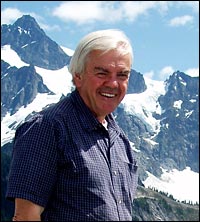
Calvin DeWitt.
A respected scientist with advanced degrees in biology and zoology, DeWitt spent over 25 years as director of the Au Sable Institute of Environmental Studies, where he worked to help college students learn the principles of Christian environmental stewardship alongside hard science. He’s been one of the prime movers behind almost every significant collaboration between evangelicals, scientists, and politicians, including the much-discussed Evangelical Climate Initiative, a statement from high-profile evangelicals calling for concerted action to battle global warming.
Today, DeWitt lives in a home nestled in wetlands south of Madison, where he teaches environmental studies at the University of Wisconsin. I reached him by phone for a chat about evangelical politics, environmental conversion, and creation care.
Do you think green evangelicals are going to move into the political realm, and possibly threaten the Republican coalition between conservative religion and industry?
It is happening, and it’s going to increasingly happen. Maybe the best illustration of that, from a specific case, is Boise Vineyard Church — one of these megachurches in Boise, Idaho. The pastor there, Tri Robinson, is an interesting example of a present-day evangelical. He is, No. 1, strongly Republican. He has said, “The last election was the last in which I will be forced to chose between individual rights and the rights of creation. From now on, both of them have to be together, and the politicians should be listening.” His church’s recycling center is the only one in all of Boise. His people go up high in the mountains and restore trails. They have a food pantry, and they serve 26 other food pantries. They have a campus, and they are seeing it as a major launching pad for environmental efforts.
The interesting thing about evangelicals is that they don’t have the traditional structure you find in the mainline denominations. There’s no central governing board. No one’s in charge. That means that if there is a doctrine they have inadvertently picked up, or subconsciously picked up, and it seems to be wrong, they just discard it. You couldn’t do that in Lutheranism or Presbyterianism. You’d be tangling with stuff that was established hundreds of years ago, and you’d have to have committees and reports and probably nothing would change. Evangelicals can change at the drop of a hat. What is their guide? It’s the Bible.
I’ve heard from a number of people about these sudden, wholesale conversions.
Early in the 1970s, I worked on world hunger issues. I could come into a congregation and they would say, “The poor you always have with you,” as an excuse for not dealing with world-hunger issues. And by the time we’d presented the case, the whole congregation would turn around; they’d be joining Bread for the World. That’s rapid conversion, but that’s part of their life. If you did it in a Lutheran Church, it would take two to three years, and it would come from the top. What happens in these Bible-based churches is, they have no one to answer to other than the Bible. So if the Bible says it, they do it.
The Bible is an ecological handbook. I shock some of these evangelical congregations by saying Jesus almost always taught on field trips. They’re thinking of him all dressed up and standing behind a pulpit in the church. Jesus was earthy. What has happened in this kind of free-wheeling evangelicalism is, he has been overly spiritualized and cleansed from his dirty hands as a carpenter and gardener. The Amish know that very well, and the evangelicals are just discovering it. And that’s where the great turn is, because they are used to conversion. They turn on a dime.
Is there any softening of feelings among evangelicals toward environmentalists?
The idea of environmentalism is not well received. What environmentalism conjures up in people’s minds is that it’s only the environment that’s important, not what is sometimes called in Christian circles eco-justice: that the community and the environment have to be looked at together.
So when an indigenous community is dependent on their water supply, and you say, well, we’re going to clean up the water supply by moving out the people, that’s not what they call a holistic ministry. You don’t clean up the environment by putting a fence around a preserve in Congo or Zaire. What you do is try to figure out why people are degrading it. I think you correct the social problems, so they also become stewards.
The evangelical approach is, these people have to be transformed. They have to be taught the value of creation. They have to become stewards of creation rather than exploiters; they have to be transformed from victims of whatever economic structures may be driving them to being poor stewards, to being enabled by whatever economic world they live in to become stewards.
How powerful can [environmentalism] be if you have two communities with overlapping goals, working on the same things, but this hostility between them?
I’m privy to a few interesting things that are happening. There are meetings being held between Friends of the Earth and evangelical leaders. It’s a bit uneasy, but there’s a welcoming discussion. E.O. Wilson, for example, is interested in talking with evangelicals. There are a lot of these conversations starting now. I think the common ground is going to be established. The idea that’s being expressed within evangelical Christianity is, we don’t have to agree on all aspects of why we do what we do, we all just have to be doing the same thing.
So I don’t think they’re that far apart. I think they’re very close together.
Another thing to keep in mind is, often times we find ourselves pitting Christians against Christians, but we don’t know it. I think 40 percent of the Sierra Club is Christian. Larry Schweiger, president of the National Wildlife Federation, is an evangelical. A lot of environmental organizations have evangelicals in them, but they’ve been quiet about it. It’s all opening up now.
What’s the history behind green evangelical Christianity?
In 1978 and ’79, a number of things came about simultaneously. One was that the Moral Majority was established, and it lasted for 10 years. It was produced because a lot of evangelicals felt like they didn’t have a voice in politics.
As it was emerging, I was surprised and disturbed by the fact that there was no mention made about caring for the environment, caring for creation. This was in the 1970s, the principal decade in the U.S. for major groundbreaking legislation like the Clean Water Act, the Endangered Species Act, and a host of others.
The other thing that happened in 1979 was the development of Au Sable Institute. I was asked to consult, and used the occasion to connect evangelical Christian colleges and universities, to bring Christian environmental stewardship into their programs, courses, and curricula.
It was almost two decades later that the John Ray Initiative started in England. This put Sir John T. Houghton into a visible spot. He was chairman of the JRI board and co-chair of Working Group One of IPCC. Subsequent to our discovering each other, Sir John and I formed Forum 2002 at Oxford. Our primary focus was to bring conservative political leaders and conservative religious leaders in direct contact with the world’s leading climate scientists, so they could evaluate the science, but also so scientists could become acquainted with these leaders. That resulted in the Oxford Declaration on Climate Change. And that turned out to be seminal to all this other work.
There was also the formation of the Evangelical Environmental Network, of which I was cofounder, and that linked very soon with the National Religious Partnership for the Environment, headed up by Paul Gorman. It was through NRPE that EEN got the funding necessary to send strategic packets on bringing environmental values into the congregation to 30,000 evangelical congregations across America.
The prevalent idea at that time, at least the one that received the most publicity, was that all we have to do is occupy the earth and wait for the Lord to come, and forget about the environment. This effort by EEN began a reversal of that stereotypical evangelical view. At that time there was a popular song sung in churches: “This world is not my home. I’m just passing through. … If heaven’s not my home, then Lord what will I do?”
What is the scriptural basis for creation care?
There are very strong Biblical directives to care for God’s earth. Articles and theological treatises [on creation care] were often prefaced by the statement, “the Earth is the Lord’s.” It comes from Psalm 24:1, “The Earth is the Lord’s and the fullness thereof; the fullness and everything it contains.”
Most of the Biblical teachings [on creation care] have to do with three principles: earth-keeping, fruitfulness, and Sabbath.
The idea of earth-keeping was from Genesis, the first three books, that people are charged with keeping the Earth. It comes mainly from Genesis 2:15, where Adam is asked to serve and protect the garden. That’s the base for earth-keeping, the emergence of the idea that we have responsibility.
The fruitfulness principle says that we may take hold of the fruit of creation, but we may not destroy its capacity to produce fruit. Genesis 6-9, which is the story of Noah and the ark, became the centerpiece for that, and is called in many places the “World’s First Endangered Species Act.” This Noah story, which was up until then used as an interesting children’s story in Sunday School, became rather essential to the whole idea of fruitfulness — that the lineages of the creatures are to be preserved, or, under modern terms, that the species must be preserved.
Aldo Leopold, back in the early part of the 20th century, cites Ezekiel the prophet, chapter 34:18, saying, “Is it not enough for you to feed on the green pastures? Must you also trample the rest with your feet? Is it not enough for you to drink pure water? Must you also muddy the rest with your feet?”
The third principle — Sabbath, everything has to have its time of rest — had been embedded into early Christian society in America by setting Sunday aside as a day of rest. But the Biblical mandate is also: you have to do that for the land. The land has to rest every seventh year. This took on prominence. It was not only practiced directly by farmers, but it was seen as a metaphor for how we have to take care of our rivers, our lakes, streams, soil. Everything should have its time for rest, and not be relentlessly pressed.
So those three principles have taken hold. They’re widely taught across evangelical Christendom now.
The focus on the individual, the focus on the family, while it was initially attractive because it addressed regaining an evangelical voice in U.S. government and U.S. policy … if you’re only focusing on the family, to the neglect of your wider community, which is eventually the whole of the biosphere and the whole of creation, you can actually do yourself in by taking too narrow of a focus. We’re moving from a focus on ourselves, which was part of the individualistic lifestyle we had been developing in America, to incorporating the whole household of life, the whole biosphere, the whole creation, without which family and individuals really can’t function at all.