 Photo: TakverIn the late ’90s, environmental activist and author Bill McKibben wrote a book about his and his wife’s decision to have only one child, connecting their personal choice to global issues of population growth and sustainability.
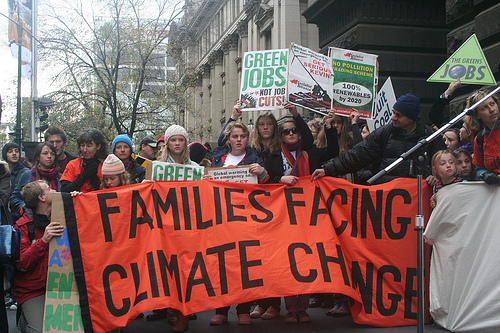
These days, McKibben is intently focused on fighting climate change, kick-starting a clean energy revolution, and, as a means to both ends, stopping the proposed Keystone XL pipeline that would carry tar-sands crude 1,700 miles down the middle of the U.S.
In an interview earlier this month, Leo Hickman of The Guardian asked him about all of these issues. Here’s what McKibben had to say about population:
In climate terms, population is not the biggest problem going forward. Most of the population growth we will see over the next four decades will use very little energy so that it doesn’t matter that much. The average American family uses as much energy between the stroke of midnight on New Year’s Eve and dinner on the 2nd of January [as] a Tanzanian family uses across a whole year. In global warming terms, Tanzanians become almost a rounding error in terms of emissions growth. Most of the emissions growth is coming from relatively stable populations with rapidly growing consumption. We’ve done a fairly remarkable job as a species in lowering fertility rates. We’ve figured out how to do that: educate and empower women. But we don’t really know yet what the answer for consumption is beyond putting the real price on carbon.
I talked to McKibben about population myself earlier this year, while interviewing him for a piece about only children. “A new problem has arisen that’s even more pressing: climate,” he told me. Still, he said, “We should keep working very hard on population issues.”
He reiterated those points in an op-ed last week in the San Jose Mercury News, cowritten with Kavita Ramdas.
[C]limate change mostly stems from high and growing rates of emissions in places with relatively stable populations. But clearly, over the long run, smaller populations make it more possible to imagine a sustainable, equitable planet.
As McKibben and Ramdas point out, making family-planning tools available to women everywhere is, in the big scheme of things, “incredibly inexpensive” — not something you can say about many of the steps we need to take to stave off catastrophic climate change.
Read more on population. Check out our series 7 Billion: What to expect when you're expanding
Making sure poor women of the world can control the number of children they have might only help a little on the climate front in the next decade or so, but it would lead to so many other positive outcomes — “a huge increase in human well-being,” healthier moms and kids, lower health-care costs — that, hot damn, it’s just “a no-brainer.”
McKibben makes a good case: We need to keep our eyes on the Big Issue of Our Times, climate change. But improving access to family planning is a step in the right direction on that front. And, from a human-rights perspective, it’s simply the right thing to do.
Bill McKibben is a member of Grist’s board of directors.