CNBC host Joe Kernen marked the one-year anniversary of Superstorm Sandy by questioning the wisdom of investing to protect utility customers from extreme weather. In an October 24 interview with Steve Holliday, the CEO of utility company National Grid, Kernen cited Bjorn Lomborg’s recent global warming denial op-ed in the Washington Post, “Don’t Blame Climate Change for Extreme Weather.”
Kernen’s repeated dismissal of global warming and attacks on climate scientists and activists as the “eco-taliban” have spurred a 45,000-signature petition drive organized by climate accountability group Forecast the Facts.
Reading from Lomborg’s op-ed, Kernen rebuked Holliday for investing in resilience to damages from extreme weather, which have been rapidly rising. In particular, both extreme precipitation and sea level are increasing in the Northeast, both due to fossil-fueled global warming. Holliday’s National Grid is a British-based utility company with customers in the U.S. Northeast. Kernen claimed that his dismissal of the well-known connection between global warming and extreme weather was backed by prominent climate scientist Gavin Schmidt, of NASA’s Goddard Institute for Space Studies.
I contacted Dr. Schmidt about Kernen’s use of his words, which he called a “red herring.”
“My statement in no way implies that no extremes are changing,” Dr. Schmidt retorted, “and certainly not that electricity companies shouldn’t invest in increased resilience, which, as Holliday rightly notes, is prudent regardless.”
How did Kernen’s confabulation come to pass? It’s a classic example of the climate-denial machine’s manipulation of the journalistic infrastructure. About a month ago, E&E News interviewed Dr. Schmidt about a paper that found that increases in weather extremes are concentrated in North America and Europe:
The study noted that the greatest recent year-to-year changes have occurred in much of North America and Europe, something confirmed by a separate study last year. The result, according to several scientists, is a misperception across the West that the weather extremes occurring there are occurring everywhere. . . . “General statements about extremes are almost nowhere to be found in the literature but seem to abound in the popular media,” Schmidt said. “It’s this popular perception that global warming means all extremes have to increase all the time, even though if anyone thinks about that for 10 seconds they realize that’s nonsense.”
Bjorn Lomborg then misleadingly contrasted Dr. Schmidt’s quotation with comments from President Obama, in his Washington Post op-ed approved by editor Fred Hiatt:
President Obama has explicitly linked a warming climate to “more extreme droughts, floods, wildfires and hurricanes.” The White House warned this summer of “increasingly frequent and severe extreme weather events that come with climate change.” Yet this is not supported by science. “General statements about extremes are almost nowhere to be found in the literature but seem to abound in the popular media,” climate scientist Gavin Schmidt of the NASA Goddard Institute for Space Studies said last month. “It’s this popular perception that global warming means all extremes have to increase all the time, even though if anyone thinks about that for 10 seconds they realize that’s nonsense.”
Kernen then used Lomborg’s article to argue that climate change has no influence on extreme weather:
I’m looking at a Washington Post piece, Steve. It’s the Washington Post. “Don’t blame climate change for extreme weather.” It goes on to say that in popular — um — well, you see that is in the popular media, but the science does not support it at all. . . . Gavin Schmidt of NASA Goddard Institute: “General statements about extremes are almost nowhere to be found in actual scientific literature but abound in popular media. It’s a popular perception that global warming means that all extremes have increased although anyone who thinks about that for ten seconds realizes is nonsense.”
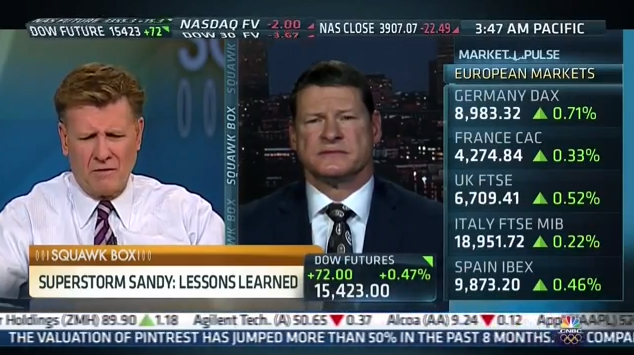
Kernen’s comments ironically appeared with the chyron “SUPERSTORM SANDY: LESSONS LEARNED.”
Join over 45,000 people in protest of Kernen’s global warming denial.
Transcript:
KERNEN: I’m looking at a Washington Post piece, Steve. It’s the Washington Post. “Don’t blame climate change for extreme weather.” It goes on to say that in popular — um — well, you see that is in the popular media, but the science does not support it at all. He’s quoting people from — you’re just — is it a given for you now that climate change is—you’re taking corporate actions based on more extreme weather based on climate change?
HOLLIDAY: I would not get into the scientific debate — I’m not qualified to do that.
KERNEN: But you used to work at Exxon. You used to be in the hydrocarbon industry. You caused all this global warming at some point, didn’t you, when you worked for Exxon? Now you’re preparing for that. You’re getting it coming and going, Steve.
HOLLIDAY: Let’s put the science just to one side. It is crystal clear to me in my company that we have to prepare to protect our customers with their energy supplies, with the expectation that we’re going to have more storms, more frequently, of higher intensity.
KERNEN: Why?
HOLLIDAY: That would be the prudent and sensible thing to do. What’s causing those storms is slightly, in this discussion, irrelevant. They are clearly here, and we need to protect against them. So that’s why we’re making investments we’re making. We’re making $2 billion of investment of hardening our systems, replacing old infrastructure in the US this year. That’s crucial to make sure that we have the reliability of energy supplies we need.
KERNEN: Gavin Schmidt of NASA Goddard Institute: “General statements about extremes are almost nowhere to be found in actual scientific literature but abound in popular media. It’s a popular perception that global warming means that all extremes have increased although anyone who thinks about that for ten seconds realizes is nonsense.” Anyway, we appreciate it. I don’t want you to be doing all this stuff for your company if it’s not necessary.
A message from
Your support keeps our climate news free.
Grist is the only award-winning newsroom focused on exploring equitable solutions to climate change. It’s vital reporting made entirely possible by loyal readers like you.
At Grist, we don’t believe in paywalls. Instead, we rely on our readers to pitch in what they can so that we can continue bringing you our solution-based climate news. Donate today to keep our site free.