Climate Politics
All Stories
-
![]()
![]()
Oil drills getting closer than ever to the Arctic Refuge
The future of the Arctic Refuge? “The threat to the Arctic National Wildlife Refuge has never been greater than it is today,” according to Brian Moore, legislative director for the Alaska Wilderness League. And, though the battle over the refuge has a Groundhog Day quality to it — haven’t we heard this same alarm sounding […]
-
O Tidings of Comfort and Anti-Enjoyment
Latest national-parks policy draft drops worst of proposed revisions The Bush administration has released its proposed revision of National Park Service management policies for 90 days of public comment. An earlier draft, written by Deputy Assistant Interior Secretary Paul Hoffman and leaked to the press in August, would have required park managers to prove an […]
-
Oh No You Mittn’t
Mass. governor may weaken power-plant rules as winter approaches Massachusetts Gov. Mitt Romney (R) is the latest lawmaker looking to sacrifice environmental protections in the face of sky-high energy prices and what looks to be a frigid winter. He’s considering weakening some air-emissions restrictions on oil-burning power plants in his state, saying it may allow […]
-
Junket in the Trunk
ESA foe Pombo took two trips paid for by anti-animal-welfare foundation The ever-widening net of Republican-corruption busting may have snared a green bête noire: Rep. Richard Pombo (R-Calif.). It seems Pombo took two trips, to New Zealand in 2000 and Japan in 2002, underwritten by a nonprofit foundation notable for opposition to environmental and animal-welfare […]
-
The Ballast’s in Your Court
Enviro-backed Great Lakes bill stalls, industry-backed bill advances Following this summer’s massive Detroit News series on threats to the Great Lakes, a key protection measure is … wait for it … stalled in Congress. Officials from Great Lakes states and conservationists back the National Aquatic Invasive Species Act, which would force shippers to use stronger […]
-
And the Land Played On
Judge rules Oregon’s Measure 37 unconstitutional Oregon’s voter-approved Measure 37, which would mandate that private landowners be compensated for changes in their property value brought about by state land-use decisions, has been ruled unconstitutional by Marion County Circuit Judge Mary James. Oregon was widely seen as a national model in land-use planning, pushing new development […]
-
Wet, Me Worry?
Wetlands protection has gone downhill under Bush administration The Bush administration has radically curtailed protection of wetlands and waterways in the past four years, according to a new report by the Government Accountability Office. It found that prior to 2001, the U.S. Army Corps of Engineers asserted its jurisdiction over most waters if migratory birds […]
-
![]()
![]()
Senate’s stab at energy legislation may be more moderate than House bill
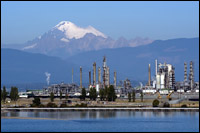
A refinery at Anacortes, Wash. “Shame, shame, shame, shame!” That’s the furious chant that erupted from the Democratic section of the House of Representatives last Friday after Rep. Joe Barton (R-Texas) managed to eke out a victory for his Gasoline for America’s Security (GAS) Act, which would loosen environmental laws and boost industry incentives to […]
-
Hapless Wetlands
Supreme Court will hear two Clean Water Act cases The first U.S. Supreme Court session under Chief Justice John Roberts will feature two cases pitting government regulatory power against private property rights — precisely the area where greens most fear Roberts’ jurisprudence. Both cases originated in Michigan, and ask whether the federal government has jurisdiction […]
-
Beswitched
Jeb Bush’s switcheroo on drilling causes rift in Florida delegation Florida Gov. Jeb Bush (R) is backing a bill in the House of Representatives that would open some new federal waters, including the eastern Gulf of Mexico, to oil rigs — and in so doing, he’s fractured the state’s long-standing bipartisan political consensus against offshore […]