The Feeding the City series is profiling several cities with thriving urban-agriculture and alt-food scenes.
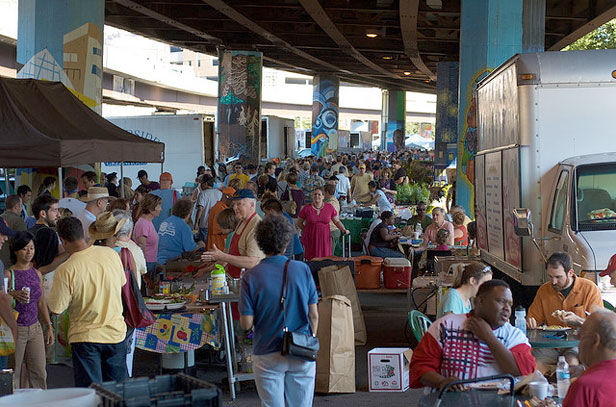 The Baltimore Farmers Market on Saratoga Street is one of several in the city.Photo courtesy Jeff Kubina via Flickr
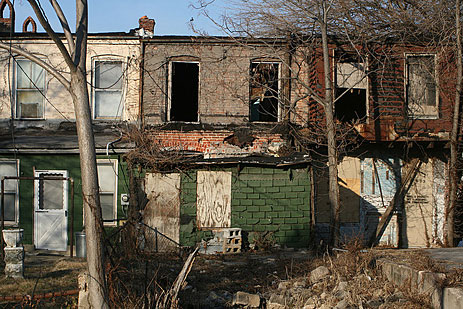 Shows like “The Wire” have made abandoned areas like this one in east Baltimore the image most people have of the city. Photo courtesy urbanfeel via FlickrFor many Americans, any mention of Baltimore conjures up images from two popular TV dramas set in the city: NBC’s Homicide: Life on the Street and HBO’s The Wire. For nearly two decades, those glimpses of Baltimore’s drug trade and violent crime helped define the city.
But that era is fading. In some circles, there’s now a lot more talk of sustainability and green living than of the murder rate, and it’s an agenda that goes beyond the traditional focus on parks, transit, affordable housing, and other longstanding goals. Likewise, the hand-wringing over Baltimore’s unimpressive high-school graduation rates — about half those of its suburbs in recent years — is starting to give way to ambitious planning around workforce training and job opportunities in what some tout as a promising new economic niche for the city’s youth.
The common denominator is farming. Baltimore’s urban agriculture movement has quietly taken off in the past couple of years, with the twin forces of sustainability and economic benefits providing the boost. Under the eyes of hundreds of visiting school kids, two new multi-acre farms are flourishing at the hands of teenagers who come back to tend seedlings, turn compost, and harvest produce to sell at farm stands. The city also has seen a growing cadre of entrepreneurs launch smaller-scale projects, from container gardens on restaurant rooftops to earthworm-fueled composting, with residents discovering the benefits of worm castings as a nutrient-rich fertilizer that can turn a small garden patch into a prolific source of fresh fruits and vegetables.
Seedy areas
In April, Baltimore got National Public Radio’s attention when it launched its Virtual Supermarket project, a partnership joining its health department, two libraries, and Santoni’s Supermarket in an effort to provide healthy food in neighborhoods that don’t have grocery stores. Residents can order groceries at the library and pay with cash, credit cards, or food stamps, then come back to the library for their groceries the next day without having to pay delivery fees. The partners have faced challenges in getting the word out about the program, but have hopes of expanding it should it gather momentum.
The stars of Baltimore’s urban-agriculture movement are two big, relatively new farms run as public-nonprofit partnerships. We spotlight Great Kids Farm, a project of Baltimore City Public Schools, on page 2, and Real Food Farm, a collaboration between Civic Works, the city’s urban service corps, and Safe Healing Foundation, on page 3.
On a smaller scale, there’s Denzell Mitchell, a self-described “country boy” who grew up visiting a family farm several times a year and is trying to pass on the enthusiasm to his grade-school students at Baltimore Montessori Public Charter School. Over the past year, he’s created an edible landscape with 17 raised beds, 12 earth boxes, a small fruit orchard, two chickens, and two bee hives.
Meanwhile, Arthur Morgan, who helped start the Hamilton Crop Circle a few years ago with a community garden in his northeast Baltimore neighborhood, has enlisted a partner, John Paul, to help plant rooftop gardens at local restaurants. They’re also working with Cheryl Wade at Mill Valley General Store on plans to turn her 5,500-square-foot roof into a large garden with a CSA (community-supported agriculture) program, whose members will get shares of the harvest. And Morgan is teaching gardening part-time at Hamilton Elementary-Middle School, where his group helped plant a community garden last year. On Sundays, he sells worms, compost kits and “compost tea” at Baltimore’s largest farmers market, where the farmers donate left-over produce at the close of the market for Our Daily Bread, a Catholic Charities program serving hot meals to the hungry.
Still to come is Big City Farms, a private-sector venture that aims to aggregate small urban farmers and provide them with training, technological resources, and contracts with large customers — such as the school district or Whole Foods — that they wouldn’t otherwise be big enough to land. The company was founded in January by Brian Le Gette, a consumer products entrepreneur, and several partners that include Geraci and Ted Rouse (whose father, James Rouse, developed Columbia, MD, one of the earliest planned communities).
Le Gette and Rouse couch the concept as a way to make small-scale farming economically viable by creating citywide networks of contract farmers. They are bullish about the venture’s prospects and hope to take the concept to other cities across the country after launching it in Baltimore. “I’d call it a pre-tipping-point industry,” Le Gette said.
A blueprint for B’more health
Urban farming might be unfolding in Baltimore at a dizzying pace, but it’s in a context that gives many participants confidence that it will endure. City officials haven’t let the trend get ahead of them. With support from local philanthropic groups that have rallied around the issue, Baltimore was able to hire its first food policy director in April. Holly Freishtat’s desk sits in the city’s planning department, but she’s spent much of her time outside the office working with other city staff and stakeholders to implement the recommendations of Baltimore’s food policy task force, which issued a final report in December with guidance on everything from farmers markets to “healthy food zoning.”
The task force met three times in 2009 after another city commission had finalized a sustainability plan that urged support for urban agriculture as a key strategy. Seema Iyer, who pushed to bring in a food policy director as the city’s strategic planning chief, said it became clear early on that they needed someone in an interdisciplinary role who could coordinate action by various city agencies and stakeholder groups. The fact that urban farming rated as a priority in the sustainability plan only strengthened the case.
“All of
it was kind of the perfect storm in terms of getting us where we needed to go,” agrees Anne Palmer, a program director with Johns Hopkins University’s Center for a Livable Future, who worked closely with Iyer to shape the city’s early food-policy work. Palmer has researched such efforts around the country and says Baltimore stands out on at least one count. “One thing that makes the food work here unique is that from the beginning, the planning and health departments have played a significant role.”
Food policy expert Mark Winne, cofounder of the national group Community Food Security Coalition, is impressed by the city’s progress since he led a workshop there in early 2008. “Baltimore is achieving the right integration of public and private action, and the right departments and functions are being brought into it,” he says.
And the city is taking other big-picture steps to advance the issue. In June, the planning department began a series of public meetings to present a proposed rewrite of the zoning code that is expected to be adopted sometime next year. Among other changes, the draft code would allow residents to grow and sell produce in higher-density neighborhoods, reversing what happened with the last zoning overhaul in 1971.
Beth Strommen, director of the city’s Office of Sustainability, notes that most of Baltimore’s 10,000 vacant lots are located in these areas, and she’s recruited Freishtat to help her office identify city-owned parcels that are ideal for farming. The goal is to identify several city-owned vacant lots well-suited to agriculture and put out a request for proposals this fall to turn them into farms. She met with half a dozen urban farmers this summer to get their input on what to look for in selecting the parcels, from lot size to hours of available sunlight. The city likely will consider some near-term zoning changes as well to address the farmers’ concerns, Strommen says, and she wants to identify a site for a central composting facility.
“I see myself as a person who’s there to help them navigate the bureaucracy. The whole concept of farming in the city is new,” she says. “What I’ve got to do to make this work right now is to keep their costs down.”
The city plans to give greater weight to proposals that offer job training and address so-called “food deserts” by making fresh produce available to residents who live far from supermarkets, Strommen added. But it’s up to the farmers to decide whether they want to accomplish that by selling food at the farm itself, through schools and churches, or by some other means.
“I’m trying not to dictate anything beyond these larger goals,” she says. “This is my way of just making it easier for people. What I heard was ‘I can’t find land.’ What I heard was ‘I don’t understand how to get the approvals.’ So I want to make a one-stop-shop for approvals, and let them figure out the rest of it.”
So far, the city is winning nothing but kudos from the farmers and nonprofit organizations that have taken the lead on urban agriculture in Baltimore. “This is a wonderful way to prime the pump,” says John Ciekot, project director at Civic Works. “The city is paving the way for these enterprises to show what people can do.”
Baltimore Spotlight: Great Kids Farm >
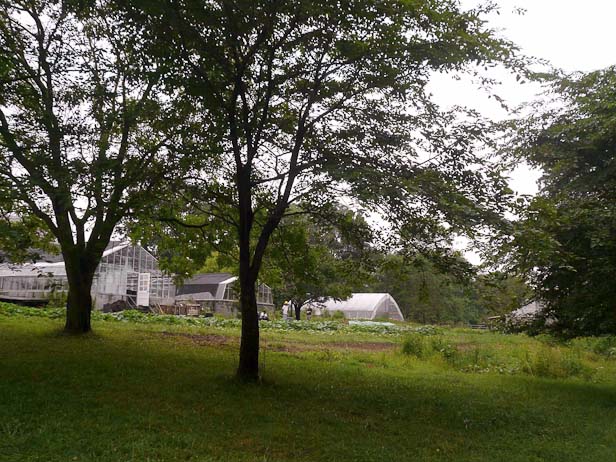 Great Kids Farm has greenhouses for growing well, greens — along with several acres for warmer-weather crops, goats, and bees. Photo: Christine Shenot
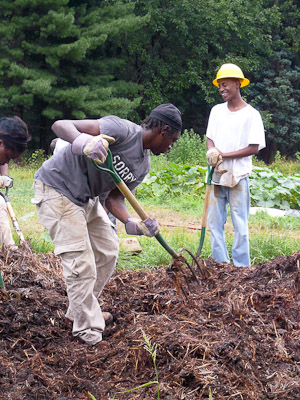 Turning compost at Great Kids FarmPhoto: Christine ShenotCatonsville, MD
A 33-acre urban farm owned by Baltimore City Public Schools that’s providing education and job training to students.
Walking around Great Kids Farm on a sultry summer morning, the only sound is the buzz of cicadas; the only movement, a small group of teenagers turning compost. In mid-July, it’s hard to imagine the energy and activity that prevails when students are here in great numbers.
But that’s exactly what Great Kids Farm is preparing for.
In November 2008 newly arrived Baltimore Public Schools Food Service Director Tony Geraci discovered that the district owned a 33-acre farm that it had let go fallow in recent years, just across the city line in Catonsville. Geraci, a charismatic former chef, rallied volunteers and students from across the school district to clear and replant the neglected property. They built beehives, planted fruit trees, brought in chickens, and turned goats loose to clear overgrown fields.
Baltimore City Public Schools has drawn a lot of attention since Geraci first visited the neglected property and saw a chance to raise the stakes in the farm-to-school trend. He wanted to recreate a working farm that would provide healthy, locally grown fruits and vegetables for school meals, but he didn’t stop there. He also set out to create a place where students of all ages would learn about sustainable living. A setting where they could learn business basics, culinary science, landscaping, and other job skills. And they do.
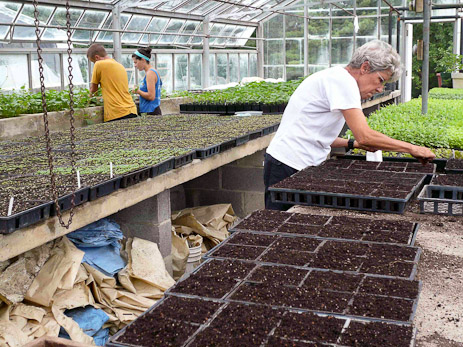 Micro-greens at Great Kids Farm bring in thousands of dollars in sales from local restaurants.Photo: Christine ShenotThings will get even livelier this fall, when the school district launches a formal program offering for-credit courses in agriculture as part of its “Learning to Work” program. High school students will be able to take such courses as Animal and Plant Biotechnology, with Great Kids Farm serving as a living classroom for the school system’s Agricultural Production and Management Career and Technology Education pathway program. The farm is hiring an agriculture educator who will help instructors teach the specialized courses that make up the Curriculum for Agricultural Science Education (CASE) and provide students with information on sustainable farming techniques.
The farm is trying to maximize “the exposure we can give kids to careers and actual work opportunities,” says Michael Sarbanes, who leads the school district’s Office of Partnerships, Communications, and Community Engagement.
Students might manage a farm stand or a cafe, or get other “green-collar” experience learning to run another kind of business. Farm Manager Greg Strella points to flats of newly planted micro-greens as just one example: Students learn how to care for the fast-growing greens. They get the experience of selling them. And in one case, he noted, they got invited to a restaurant that buys the greens to shape bread with one of the chefs.
The greens should bring in $24,500 this year in sales to local restaurants. “We could do more,” he says. “But we get the value that we’re after at this scale.”
Baltimore Spotlight: Real Food Farm >
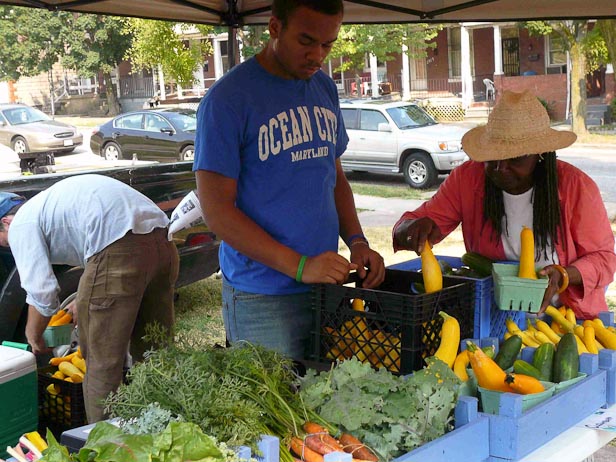 Real Food Farm sets up a farm stand every Wednesday evening outside a health clinic in Baltimore. Photo: Christine Shenot
Baltimore Spotlight: Real Food Farm
Lake Clifton High School Campus, Clifton Park, Md.
This six-acre nonprofit urban farm grows fruits, vegetables, and herbs in high tunnels — also called “hoop houses” — that provide a low-cost, high-yield way to garden year-round. It’s a project of Civic Works, Baltimore’s urban service corps and an AmeriCorps program.
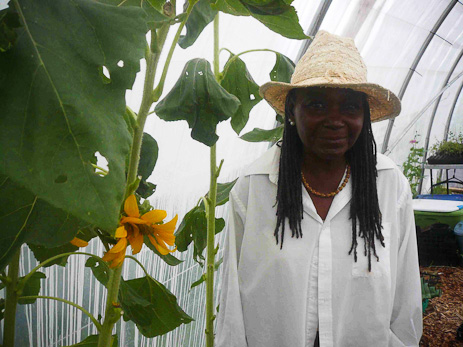 Jessie Scott of Real Food FarmPhoto: Christine ShenotWith rain threatening in the distance, Jessie Scott is showing teenagers from Baltimore’s Conservation Leadership Corps how to stake pepper plants so they won’t droop as the peppers mature. She shares her grandfather’s lesson on hammering as they pound wooden stakes into the ground. “He was always saying ‘stop choking the nail!’,” she says, laughing.
Scott fills many roles in her part-time schedule at Real Food Farm. She knows a lot about gardening from spending so much time on her grandparents’ farm when she was growing up in the small town of Gaston, South Carolina, and from starting a community garden on a vacant lot in her neighborhood four years ago. She also knows how to work with kids, having raised five of her own and now enjoying grandchildren and great-grandchildren.
So it’s no effort to share what she knows about growing real food with the inner-city kids who come to the farm through community-service projects at Civic Works, the Baltimore nonprofit that oversees the farm. “Just about everything we ate [back then] came from the farm,” Scott tells the group clustered around the pepper plants, listing okra, tomatoes, corn, beans, peaches, and figs. “Once it’s in your blood …”
The kids, for their part, seem to enjoy this place. Thomas Scott, a rising senior at Baltimore Freedom Academy, points to a unique reward. “I get to work with products I can eat,” he said matter-of-factly, a statement that could have come straight from the talking points of First Lady Michelle Obama as she plugs her Let’s Move initiative promoting healthy eating and physical activity.
Real Food Farm just got off the ground last fall, with support from the Abell Foundation, the Jim and Patty Rouse Charitable Foundation, and other partners. As soon as the city’s Department of Recreation and Parks and its school district agreed to turn over six acres adjacent to the Lake Clifton High School Campus at Clifton Park for farming, Civic Works teamed up with another nonprofit, Safe Healing Foundation, to split the cost of what they called “HoopVillage,” three “high tunnel” greenhouses with polyethylene sheets stretched over a steel frame. The hoop houses offer a low-cost, high-yield way to garden year-round — like greenhouses, they keep plants warm in the winter and are easily ventilated in the summer by parting the plastic sheeting.
About 200 volunteers spent a full day on each hoop house, recalls Tyler Brown, the farm manager. Seedlings were ready to be planted as soon as they got the plastic sheeting spread over the metal frames and anchored to the ground. Weeks later they were harvesting spinach, kale, chard, and other winter crops.
The farm was established to serve the five surrounding low-income neighborhoods, where most residents have limited access to healthy food. In its first season last winter, despite back-to-back blizzards, the farm yielded more than 1,000 pounds of fresh produce that it sold or donated to residents, schools, and restaurants.
Every Monday, Wednesday, and Friday afternoon, Brown loads up the truck with squash, kale, tomatoes, and whatever else they’ve harvested that day and sets up a farm stand in one of three neighborhoods they’ve targeted for the summer.
Real Food is still just getting started. At build-out, the farm will have 20 hoop houses, rain gardens and additional field crops, and ultimately, a network of mulch-lined trails that will wind past all the hoop houses and planted fields over to the woods, with educational signage. Civic Works plans to put up two more hoop houses this fall, and expects to see students of all ages visit for educational programs, including some from Heritage High School, the farm’s neighbor.
The farm anticipates hiring three or four high school students for part-time jobs. “We want to incorporate a really comprehensive job training program that looks at a future in agriculture,” says Brown.
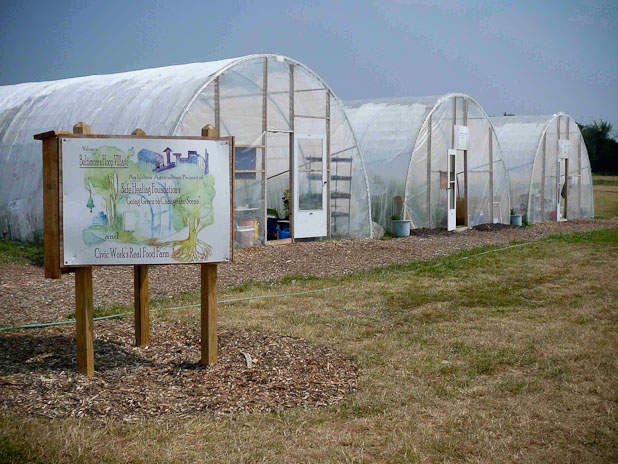 These low-cost hoophouses, built by volunteers, have more than paid for themselves in year-round growing power for Real Food FarmPhoto: Christine Shenot