Enrique Gili's posts RSS feed


Comments

Born to bee wild: How feral pollinators may help prevent colony collapse disorder

A rare cross-sectional glimpse of natural honeycomb construction. (Photo by Max Westby.)

In 2009, lifelong beekeeper Dan Harvey faced an existential crisis when he lost 
much of his honeybee stock to colony collapse disorder (CCD). So the former Vietnam-era Special Forces veteran did what came naturally: He took to the deep dark woods of the Pacific Northwest, searching for answers to his predicament.

Harvey began by hunting for wild and feral bees living near his home in Port Angeles, Wash. (These bees have escaped from commercial colonies and find refuge in the tall timber and glens enveloping the Olympic Peninsula). For years, he crossbred the feral bees he captured with honeybees in order to produce hybridized hives that would be well-suited to the dank climes of the temperate rainforest region.

this story continues
 

Comments

Poop dreams: A farmer on why we should care about manure

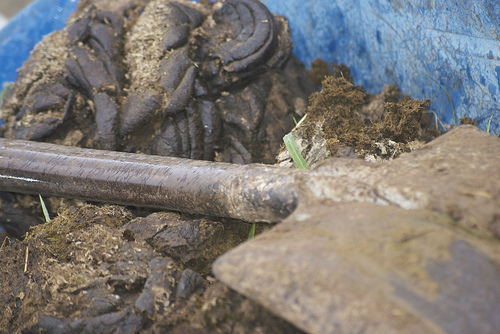
This shit matters. (Photo by David Jones.)

From time to time a book merits its title. Published in 2010, Holy Shit: Managing Manure to Save Mankind may just be the No. 1 book on the No. 2 business. In it, Gene Logsdon manages to be both funny and educational as he advocates for overcoming our aversion to excrement for the sake of healthy soil.

According to Logsdon, we need manure and lots of it. He contends we should follow our nose for practical and elegant solutions to improving soil fertility, and turn waste into compost fit for crops and gardens.

We spoke to Logsdon recently to get the straight poop.

Q. You've had a long career in journalism. What inspired you to write a book on manure?

Gene Logsdon. (Photo by Ben Barnes.)

A. I was hearing from lots of readers who were getting into backyard farm animals, especially chickens. They did not seem to have any appreciation for the rude fact that animals defecate and urinate and no realization that they would have to deal with that manure. Since I really hoped that small-scale animal husbandry would become a fact of American life, and having memories of when it was, even in towns, I knew that without proper manure handling, the new movement was going to get into trouble with neighbors. And lead to all the silly rules that previous generations used to keep farm animals far from their noses.

this story continues
 

Comments

Up a creek: A run-down urban neighborhood finds life in a dead stream

Volunteers plant vegetation to slow erosion along the banks of Chollas Creek. (Photo by Groundwork San Diego.)

Driving down side streets in southeast San Diego past paddling ducks, native sage, and ugly, graffiti-covered utility boxes offers a whiff of the promise and the menace befalling Chollas Creek.

This is no Blue Danube: Bounded and bisected by freeways, a cypher of an old creek traverses low-income neighborhoods via a series of ravines and concrete channels. Nonetheless, a local nonprofit organization has set out to salvage the creek from urban ruin. In the process, the group hopes to create a place for healing and restoration in a neighborhood sorely in need of both.

this story continues
Read more: Cities
 

Comments

New Agtivist: Colin Archipley is teaching soldiers to farm

Colin Archipley (right) in the greenhouse.

Tucked into San Diego’s rolling hills, Archi’s Acres is a stark departure from the war Marine Sgt. Colin Archipley left behind. Rather than hunt down insurgents, he now grows oversized basil and specialty crops on six acres for local markets. The work is hard, but for Sgt. Archipley, it feels like a respite from the six years he spent training and fighting in Iraq.

In need of a second act, Archipley and his wife Karen pooled their resources to open the farm in 2007. Their mission is twofold; they hope to operate a successful small-scale organic farm and help soldiers make the transition from fighters to champions of sustainable agriculture and financial independence. Together the couple runs a program called Veterans Sustainable Agriculture Training (VSAT), a six-week course run in partnership with two local community colleges that focuses on organics and hydroponics (and the combination of the two, which is rare), as well as greenhouse production and the basics of putting together a business plan.

this story continues

Enrique Gili RSS feed

Enrique Gili is a freelance writer living in Southern California.

Advertisement
Advertisement
advertising