Skip to content Skip to site navigation

Susie Cagle's Posts

Comments

Monsanto CEO acknowledges climate change, open to GMO labels, thinks veggies suck

Image (1) monsanto_withered_c.gif for post 40274The Wall Street Journal sat down with Monsanto CEO Hugh Grant in what were probably some very nice chairs for this comfy little edited Q&A. The global agriculture giant is "battered, bruised, and still growing," according to the WSJ, whose cup runneth over with pathos for poor Hugh. The interview kicks off with: "What's the harm in disclosing genetically modified ingredients to consumers?" Yes, Hugh, please tell us about the harm.

Grant says California's Proposition 37 -- which would have required GMO foods to be labeled, and which Monsanto spent millions to defeat (weird, WSJ, y'all left that bit out!) -- "befuddled the issue." But Grant says he's personally "up for the dialogue around labeling." Why? Because he thinks GMOs are so great of course! (Come on, you knew that answer.)

They're the most-tested food product that the world has ever seen. Europe set up its own Food Standards Agency, which has now spent €300 million ($403.7 million), and has concluded that these technologies are safe. [Recently] France determined there's no safety issue on a corn line we submitted there. So there's always a great deal of political noise and turmoil. If you strip that back and you get to the science, the science is very strong around these technologies.

GMO haters gonna GMO hate! And Grant would rather be in the future than in the past. "I think some of the criticism comes with being first in a lot of these spaces. I'd rather be there than at the back of the pack." On the whole, Monsanto has "mended a lot of fences" and "turned things around" recently with the general public, according to Grant, in part because of "consistent messaging." I will give him that!

One of Grant's and Monsanto's messages, apparently: Vegetables taste crappy. This should definitely help the company with the 18-and-under crowd, at least.

Comments

Campaign to label frankenfoods goes viral

organic-gmo-tomato-carousel Want to be able to tell the difference between a natural fish and a genetically engineered frankensalmon in the dystopian food future? It looks like you may not be required to live on the crunchy West Coast for that.

After California's GMO-labeling Proposition 37 failed to pass last fall, bills that would require labels for genetically modified food are rolling in Oregon and Washington, and similar initiatives are picking up steam in Minnesota, Missouri, and New Mexico, as well as in Connecticut and Vermont, where GMO-labeling legislation failed to pass last year amid threats of legal action from Monsanto.

New Mexico could be the first state to pass such a law. State Sen. Peter Wirth of Santa Fe, who is sponsoring the legislation, says the bill is aimed at "leveling the playing field" for food actually grown in fields.

Minnesota is home to the headquarters of General Mills, Hormel, Cargill, and Land-O-Lakes, which were all big contributors to the fight against Prop 37, but citizens groups are pushing legislators to pass a label law there too (and the local Fox affiliate covers them pretty appropriately). Meanwhile, Missouri's legislation would just target genetically modified meat and fish.

The most interesting take on the national GMO label fight comes from the belly of the beast: the International Dairy Foods Association, which just had its annual meeting. From Meat Poultry News:

Read more: Food

Comments

Guacamole Sunday: A better name for the Super Bowl, or a crappy marketing campaign?

It's a good thing that unexpected California frost didn't freeze out the state's avocado crop. It's not just the Golden State that loves nature's butter. Americans' appetite for avocados has exploded over the last decade, jumping significantly in 2012 alone, in no small part due to marketing campaigns by foreign avocado growers. This weekend, Americans are expected to eat several tons of avocados on "Guacamole Sunday" while watching the Super Bowl.

avocados
Nate Steiner

Twilight Greenaway at the Smithsonian's Food Think blog:

Last year, according to the produce industry publication The Packer, about 75 percent of the avocados shipped within the U.S. in the weeks leading up to the Super Bowl came from Mexico. Most of the rest came from Chile. And that translates to a lot of the creamy green fruits. This year Americans will eat almost 79 million pounds of them in the few weeks before the big game -- an eight million pound increase over last year and a 100 percent increase since 2003.

Comments

Good news for peer-to-peer car-sharing

It's a good news day for peer-to-peer car-sharing, and those hideous and somewhat disturbing furry pink mustaches I keep seeing around San Francisco.

Lyft
lizasperling
The detachable pink mustache alerts ride-seekers that this ride is a Lyft.

Today the California Public Utilities Commission said it has reached an agreement with Zimride, the parent company of fast-growing California ride-share purveyor Lyft, to suspend a cease-and-desist notice and $20,000 citation against the company. The PUC is still reviewing its regulations on car-sharing programs in the Golden State and hasn't yet reached similar deals with Uber or Sidecar, which are technically still outlaws, though they don't have the creepy mustaches to match.

This was good timing for Lyft, which announced this morning that it would be expanding to Los Angeles neighborhood by neighborhood in an attempt to cover all that concrete sprawl. And it's not just Lyft that has its sights set on bigger and better car-sharing markets. From Techcrunch:

The move into L.A. marks the first expansion market for Lyft, which became available to riders in San Francisco last summer. To expand into Southern California, the company sent a team to recruit drivers and build the initial community infrastructure in the city. That means interviewing drivers, inspecting their cars, and generally attempting to instill the Lyft culture into the new market. ...

Lyft isn’t the only ride-sharing service that is looking to broaden its footprint. San Francisco-based competitor SideCar recently launched its service in the Seattle area, and is looking to expand even more aggressively in the coming months.

Comments

Will 2013 be the year of ag-gag bills?

The U.N. has declared 2013 to be the Year of Quinoa. But it's also shaping up to be the Year of Ag Gag, those bills that make it illegal to covertly investigate factory farms for animal and ecological abuse. From Bruce Friedrich of Farm Sanctuary:

In 2011, the meat industry backed laws in four states to make taking photos or videos on farms and slaughterhouses illegal. In 2012, the industry pushed similar laws in 10 states. This year, we expect even more.

Photo by Shutterstock.
Shutterstock

In 2011 and 2012, Iowa, Utah, and Missouri all enacted some version of an anti-whistleblower ag-gag law, while similar proposals were struck down in Florida, Illinois, Indiana, Minnesota, Nebraska, New York, and Tennessee.

This year, more such laws are proposed in Nebraska, New Hampshire, and Wyoming.

Read more: Food, Politics

Comments

Right-wingers’ dream town is a new urbanist paradise, but full of guns

Remember this?

GLennbeck

This was Glenn Beck's worst nightmare. Sustainable planned communities were going to destroy our future, he feared.

But over the past few weeks, Beck seems to have had a change of heart. He's now promoting his own Independence, USA, a "city-theme park hybrid" to be located somewhere in Texas with abundant "craftmen and artisan" small businesses and stores, a working ranch "where visitors can learn how to farm and work the land," an innovation center, and dedicated mixed-income housing.

Hold on to your hats, though, folks, because Beck is not alone. The dense green community idea is catching on among the right-wing crowd, and these people even use some of Beck's dreaded key words.

Read more: Cities

Comments

Transportation Secretary Ray LaHood to ride off into the sunset

Ray LaHood.
Bike Portland

Raaaaaaaay!

That collective urbanist cry burst forth on the internet this morning when Transportation Secretary Ray LaHood announced he would not be staying on for Obama's second term. In recent weeks, there was speculation that LaHood might remain in his post at the president's urging, but it was not to be.

Read more: Cities, Politics

Comments

Are you a terrible person for eating quinoa?

The quinoa debate has ravaged the internet these past few weeks -- kind of like how selfish Westerners with a taste for gluten-free grains are allegedly ravaging the livelihoods of South American farmers.

Quinoa growing in Bolivia.
Primeal
Quinoa growing in Bolivia.

Joanna Blythman kicked off the brouhaha earlier this month with a piece for The Guardian contending that the fast-growing Western appetite for quinoa has priced the Peruvian and Bolivian poor out of the market for the delicious, protein-laden (and kind of sperm-resembling) grain. "[T]here's a ghastly irony when the Andean peasant's staple grain becomes too expensive at home because it has acquired hero product status among affluent foreigners preoccupied with personal health, animal welfare and reducing their carbon 'foodprint,'" she writes.

The piece sparked a quinoa pile-on. Esquire called it "the quinoa quandry" (groan). "The more you love quinoa, the more you hate Bolivians," declared a Care2 headline. "A long time ago, 'Bolivian marching powder' meant cocaine. Now it could mean quinoa," wrote a Yahoo! News correspondent who was having a really bad day with ledes. And I think Technorati may actually for reals be suggesting here that "America just needs to send a few hundred Chick-fil-A's to Peru and Bolivia."

Blythman's moral panic about quinoa is not baseless, but it is somewhat misled, and definitely misaimed.

Comments

Waste heat from cities can heat up other parts of the planet

Cities aren't perfectly efficient energy machines, you guys. They're great, especially when transit and density make it possible for city dwellers to use less energy, but cities still release a lot of waste heat out of tailpipes and chimneys. And all that waste heat has to go somewhere.

shutterstock_125443697

According to a new study published in Nature Climate Change, that waste heat is disrupting the jet stream and warming up other parts of the world, thawing winters across northern Asia, eastern China, the Northeast U.S., and southern Canada. From Reuters:

That is different from what has long been known as the urban-heat island effect, where city buildings, roads and sidewalks hold on to the day's warmth and make the urban area hotter than the surrounding countryside.

Instead, the researchers wrote, the excess heat given off by burning fossil fuels appears to change air circulation patterns and then hitch a ride on air and ocean currents, including the jet stream. ...

Read more: Cities, Climate & Energy

Comments

One step forward, one step back for tar-sands protesters

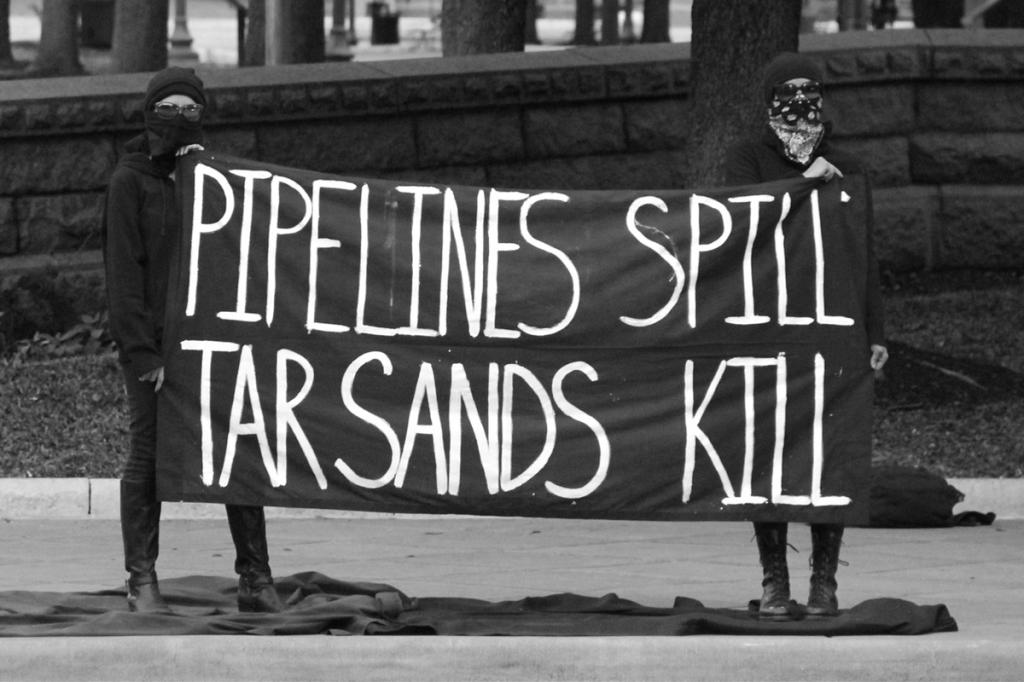
It's a bittersweet moment for direct environmental action against nasty tar-sands pollution. (So many moments are bittersweet in the fight against nasty tar-sands pollution ...)

On the sweet side, Canada's Idle No More movement has gone global today, mobilizing protests around the world to highlight mistreatment of indigenous peoples and the environment. The movement has been galvanized by plans to pipe tar-sands oil across First Nations land in British Columbia and by the Canadian government's attempts to roll back environmental protections for most of the country's waterways. Actions are already rolling across Canada, at U.N. headquarters in New York, and as far away as Australia and Greenland.

"This day of action will peacefully protest attacks on Democracy, Indigenous Sovereignty, Human Rights and Environmental Protections when Canadian MPs return to the House of Commons on January 28th," organizers said in a statement.

But for the bitter: The Tar Sands Blockade, which is fighting ongoing construction of the southern leg of the Keystone XL pipeline in Texas, faced a significant setback in court on Friday.

Read more: Climate & Energy
Don't miss a green thing!
Get Grist in your inbox every morning.