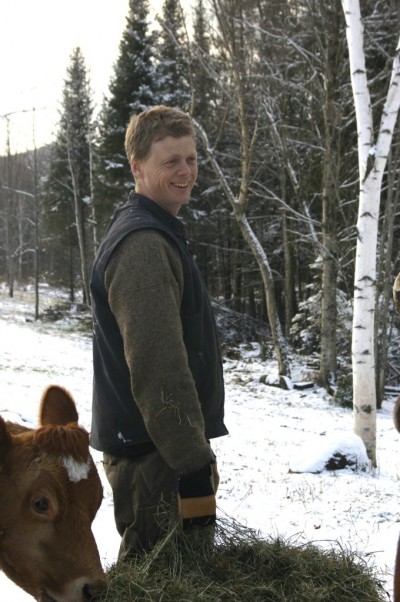
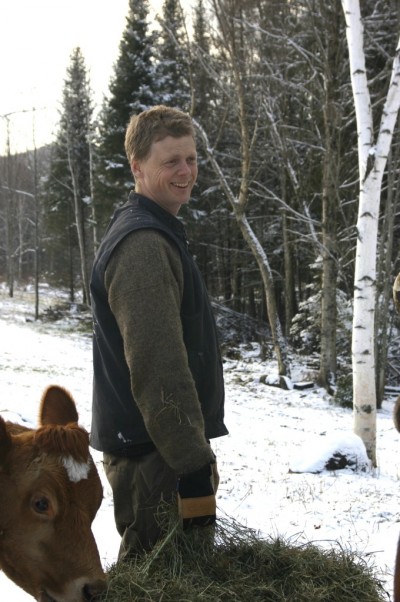
 Ben Hewitt on his farm outside of Hardwick.Hardwick, a hardscrabble town in rural Vermont (pop. 3,200), once based its economy on a non-renewable resource locked up in its surrounding hillsides: granite. But then the granite ran out — taking the town economy down with it. More recently, the town has embarked on a wild experiment. Its economy is now based on farming and food production at a variety of scales, from niche veggie farms to a national organic seed business, from a locavore café to a statewide salad-greens producer. It’s worked. While the national finances plunged into the abyss in 2008, Hardwick kept adding jobs.
As someone who’s interested in food production as a tool of community-scale economic development, I’ve been watching the Hardwick story enthusiastically ever since Marian Burros sang the town’s praises in The New York Times back in 2008. So I was excited this past winter when Ben Hewitt, a Hardwick-area farmer and writer, came out with a book called The Town That Food Saved: How One Community Found Vitality in Local Food.
With great sensitivity and a wealth of on-the-ground reporting, Hewitt shows that the story of Hardwick’s food revolution is a lot more complex and nuanced than could ever be expressed in a newspaper story. For the latest edition of Victual Reality, my podcast about food politics, I recently caught up with Hewitt via phone from his farm outside Hardwick.
(The Victual Reality podcast is part of the Edible Communities project Edible Radio)
A message from
Your support keeps our climate news free.
Grist is the only award-winning newsroom focused on exploring equitable solutions to climate change. It’s vital reporting made entirely possible by loyal readers like you.
At Grist, we don’t believe in paywalls. Instead, we rely on our readers to pitch in what they can so that we can continue bringing you our solution-based climate news. Donate today to keep our site free.