Uncategorized
All Stories
-
The 0.7 Percent Absolution
Portland retracts claim that its CO2 emissions dropped below 1990 levels Breaking the hearts of factoid-citers everywhere, the city of Portland, Ore., has issued a correction to its widely hailed announcement that last year its carbon-dioxide emissions dipped below 1990 levels. Thanks to a subtle data-entry mistake, the figures were miscalculated, and 2004 levels were […]
-
Tender Is the Nitrogen
Lower summer ozone levels give Eastern lungs a break Summer air quality has improved in 19 Eastern states, thanks to a federally mandated cap-and-trade system for nitrogen oxides*. According to a report released yesterday by the U.S. EPA, nitrogen-oxide emissions from power plants and other sources in the region were about 50 percent lower in […]
-
Ranch Dressing-Down
Rancher wins defamation claim against conservation nonprofit An Arizona rancher has employed activist tactics to win a lawsuit against a conservation group, and his success may inspire other ranchers to fight back against greens. Jim Chilton took the Center for Biological Diversity to court last year for defamation, after the group posted photos to its […]
-
CWRU goes green
About 740 students who attend Case Western Reserve University in Ohio will be returning to new living quarters this fall: "The Village at 115," a brand new dormitory that expects to become LEED certified after its opening (as heard on WCPN this morning).
The cluster of buildings is expected to reduce annual energy consumption by 40 percent, and features a mechanism for groundwater recharge that separates stormwater from sewage. One of the more intriguing aspects is a set of monitoring systems -- kiosks in each house will display realtime electricity, water, and steam use, and data will be posted online for researchers (aka parents) to access. The monitoring is intended to function as a "teaching instrument" so the students learn what habits save them energy.
It will be interesting to see what kind of social norms develop among a small community like this when energy use is monitored and made public. Unless CWRU is different from most other universities, it doesn't charge its students piecemeal for heat, AC, water, electricity, etc. Those are common goods that no individual student has a direct financial incentive to conserve. But something tells me the social norms that develop will play a big role in the dorm's decreased energy use.
Jamais Cascio has conveniently just posted more on LEED over at WorldChanging.
-
The wages of Kelo
We talked about Kelo v. New London quite a bit when it was first decided. Here's a little follow-up (via Tapped):
The U.S. Supreme Court recently found that the city's original seizure of private property was constitutional under the principal of eminent domain, and now New London is claiming that the affected homeowners were living on city land for the duration of the lawsuit and owe back rent. It's a new definition of chutzpah: Confiscate land and charge back rent for the years the owners fought confiscation.
-
Gas, oil, and electricity
NPR's Marketplace has on their homepage right now three stories that might be of interest, on gas prices, oil shock simulations, and zero-energy homes.
-
![]()
![]()
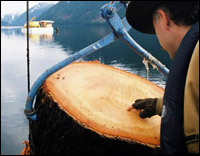
Timber industry turns to underwater crop
As the traditional logging industry deals with unsteady prices and the challenges of globalization, the value of a new crop is coming to light: trees hidden under reservoirs, long given up for lost. Sawn, but not forgotten. Photo: Triton Logging Inc. While no exact count of these “rediscovered” forests — which are being logged primarily […]
-
The proposed DC stadium
By 2008, there will be a new stadium for baseball on the banks of the Anacostia River in Washington, D.C. for the Nationals. The stadium and the associated development will "transform" the surrounding area. D.C. is unique in that the mantra of "grow up not out" faces some legal restrictions, namely height limits on buildings in the city.
In the spirit of hearing from the people, there's a transcript available of a live chat conducted by the Washington Post on Monday dealing with the stadium. The plans have very little detail at the moment, although you will be able to see the Capitol dome over the left field fence. (number of times the environment was mentioned: 1).
One of the participants was Jacqueline Dupree of the Post, who is running a blog-ish site about the project. The interactive map on the Post's main site is also pretty informative.
-
Our materialism disguises a deeper problem
I've been pondering religion a lot lately, what with all the kerfuffle over "Intelligent Design" (on that subject, you only need to read one thing: this).
Joel Makower's latest references an article by Worldwatch Institute Director of Research Gary Gardner called "Hungry for More: Re-Engaging Religious Teachings on Consumption." The idea, from what I can gather, is that all the world's major religions contain moral teachings against over-consumption and economic injustice -- and faith communities need to rediscover and embrace these teachings as they try to deal with a world in which "mass consumerism in wealthy countries has already broken the ecological bank."
To which I say: good luck.
I suppose there's no sense being coy about my distaste for religion (though I should stress that it's my own personal hangup, not representative of Grist or of the environmental community as a whole). But as far as I can see, religion in America -- ubiquitous though it may be -- is fairly toothless in terms of challenging people and getting them to change their behavior. The religion I see is either the "moderate" kind that's mainly devolved into a glorified self-help program or the "extreme" kind that mainly serves to offer its adherents objects of hate and derision (e.g., gays).
Gross oversimplification, yes. But still, the chances of religion in the developed world emerging as a genuine force in opposition to conspicuous overconsumption strike me as roughly nil.
But that's not my point.
-
What happens when the Polish and polar bears meet?
Did you hear the one about the three Polish scientists who almost got eaten by polar bears?
No, seriously. Three researchers were stranded for 15 hours on an island in Norway's Svalbard archipelago (I just really, really wanted to type that pair of words). Hungry polar bears were circling. Yesterday, shortly before Pole met polar, helicopters swooped in and picked them up.
Don't they know it only makes a good movie if you get et?