Latest Articles
-
From Harry to Housing
Um, forgiven In coastal Cali, Clint Eastwood has a rep as a Dirty-Harry developer. But that may change with his latest project, Tehama, which boasts solar and wind power, open space, an organic farm, and native plants. Of course, there’s also a golf course … you got a problem with that? Bar none A London-based […]
-
London Brawling
Leading U.K. scientist excoriates U.S. on climate-disruption obstruction As superstorm Hurricane Rita bears down on Texas and Louisiana, Sir John Lawton, chairman of the U.K.’s Royal Commission on Environmental Pollution, told the Independent that neoconservatives in the U.S. ought to reconsider their obstructionist stance on climate change. “If this makes the climate loonies in the […]
-
Vestal Sturgeons
Sturgeon stocks on extreme worldwide decline People have been consuming black caviar since about 500 B.C., but it may be time to curb the habit: Global stocks of sturgeon, the fish that supplies the salty treat, are in trouble. In a new study published this week in the journal Fish and Fisheries, marine researchers report […]
-
National Geographic describes future tech, and we are frightened
A feature aimed at kids in the online edition of National Geographic called What will life be like in 2035? has a few interesting insights. The magazine first details the technological marvel that'll be all the rage in 2035, the self-driving car:
Relax, play a video game, watch a DVD, or catch up on your reading while you're driving downtown. What? While you're driving? Yep, because you're in your self-driving car. This car makes smart, safe driving decisions by communicating with other vehicles, joining car caravans, and navigating around construction and road debris. All you have to do is tell your smart car where you want to go and it gets you there.
No way! Really? It's just like public transport ... but not. I so can't wait for the future.
And as if that wasn't cool enough, National Geographic also profiles a real kick-ass technology sure to foil the alibis of many a future criminal with science: "brain fingerprinting."
The world is safer for law-abiding citizens, thanks to Brain Fingerprinting (BF), a way to peek into a suspect's mind to verify if he was at the scene of a crime. How? Sort of like a lie detector test, but BF reads a person's involuntary response to a memory. It measures and records specific brain waves that are only active when a person has memories of an event or place. If those brain waves don't register, the person doesn't know about the crime. If memories of the crime do show up, the criminal is busted, and the streets are safer."
I especially like how in the future criminal justice is far simpler. If your brain says you were there, you obviously committed the crime. Busted!
-
Wastes Great, Less Filing
EPA proposes fewer toxics reporting requirements for industrial facilities Industrial plants would report their chemical releases every other year instead of annually under a policy change proposed by the U.S. EPA. The agency also indicated it wants to raise the threshold for reporting the release of certain chemicals from 500 to 5,000 pounds. Both are […]
-
Chip’s Ahoy
Grist head honcho moderates panel on the state of environmentalism If you’re in or around Seattle this weekend, head down to the Paramount Theater for a lively roundtable discussion on the state of the environmental movement: “Whose Planet Is It, Anyway?” Part of Foolproof’s American Voices series, the conversation will include respected leaders from inside […]
-
Nominate one for a prize
Want to help a small conservation organization? Know an exceptional individual making a difference on the ground? Nominate them for one of the annual Whitley Awards, a UK-based award given by the Whitley Fund for Nature that goes to six conservationists making a difference, most often in the developing world. The prizes range from $40,000-$80,000.
You can read short profiles of past winners here and get the application here.
-
Some of Washington’s government-owned forest areas aren’t friendly to hikers
 Yes, those are bullet holes from an automatic weapon, and no, this picture was not taken in a war zone. I took it just a few days ago along the shore of an undeveloped lake located near Washington State's Tahuya forest. This now bullet-riddled outhouse had been placed beside the lake as a public service and is designed like a concrete bomb shelter specifically to take the abuse the public was going to dish out. Instead of providing inexpensive and easily replaced facilities, someone had decided to build an outhouse version of the Maginot line. I cannot imagine what it must have cost to put there.
 -
Animal hows
OK, possibly the best part of this story about a proposed House bill requiring that pets be considered as part of storm evacuation plans is the response from Sara Spaulding of the American Humane Association. She said the legislation, put forth by reps from California, Connecticut, and Massachusetts, doesn't "have any real meat in it."
Seriously, that's sick.
-
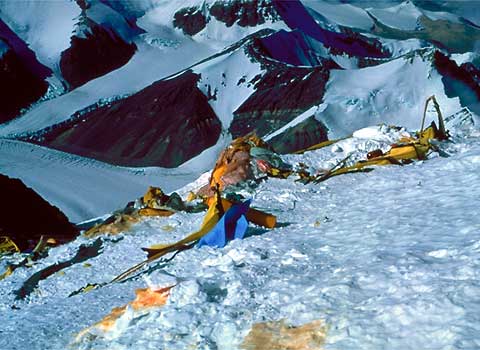
Mountaineering teams organize to clean up the world’s highest mountain peaks
A few months ago, gutsy French test pilot Didier Delsalle landed a helicopter on top of Mount Everest in 75 mph hour winds -- no, not crashed -- quite obviously the highest landing place on earth. He was the first to successfully summit Everest by copter.
And just to make sure it wasn't a fluke, he did it twice.
The previous highest helicopter landing was some 9,035 feet lower, at about 20,000 feet, the record set in 1996 by Nepalese pilot Madan Khatri Chhetri while rescuing climbers. And that's one of the great things about this: the tangible -- though still amazingly dangerous -- possibility of being able to rescue mountaineers on some of the world's highest, harshest peaks.
Delsalle's feat also raises the prospect (and could significantly lower the cost) of cleaning up what many call the "world's highest garbage dump."
In recent years, international teams of eco-conscious mountaineers have organized enormously expensive expeditions to clean up some of Everest's over-50-year legacy of trash, augmenting infrequent government Sherpa-led garbage-retrieval expeditions.
But now another team aims to clean up, at the very least, parts of the Himalayas' 14 peaks above 8,000 meters (about 26,200 feet). This week it's off to the earth's 10th highest mountain, Mt. Annapurna. The high-altitude sanitation engineers also have plans in place to launch a cleanup of their own on Mt. Everest next spring.
If there was ever a job in the trash business I envied, it's this one.