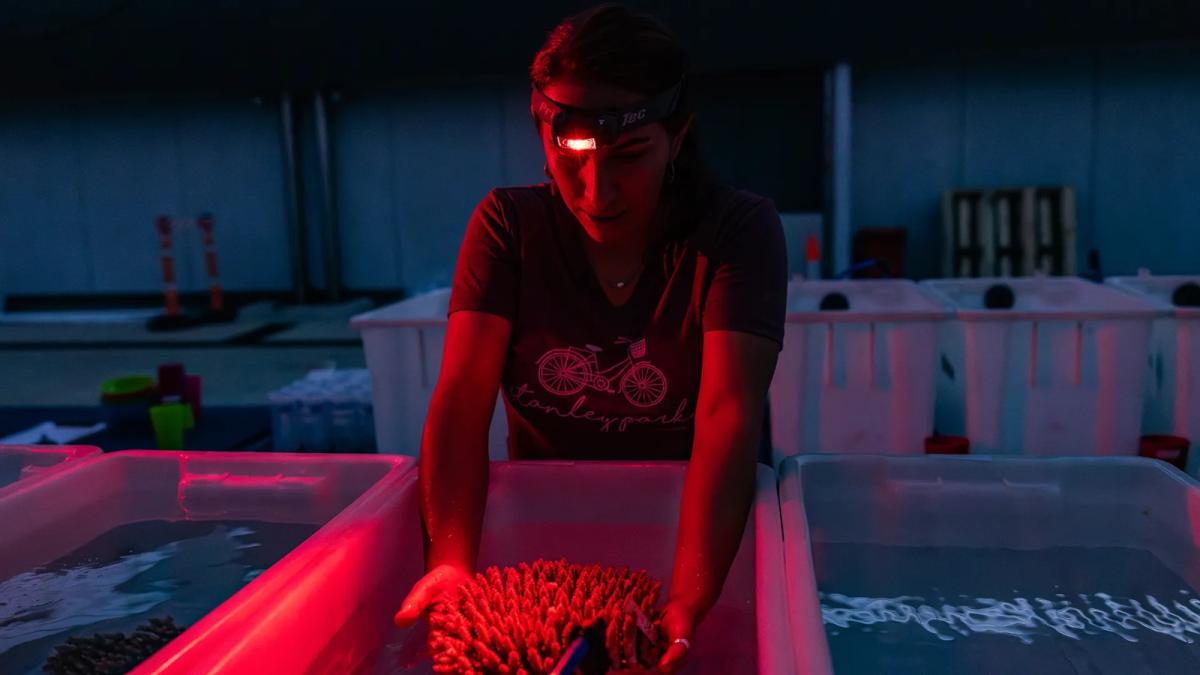
“I just got a whiff,” said Peter Harrison, a marine scientist, as he leaned over the edge of the boat and pointed his flashlight into the dark water. “It’s really coming through now.”
It was shortly after 10 p.m. on a cloudy December night, and Harrison, a coral researcher at Australia’s Southern Cross University, was about 25 miles off the coast of northern Queensland. He was with a group of scientists, tourism operators, and Indigenous Australians who had spent the last few nights above the Great Barrier Reef — the largest living structure on the planet — looking for coral spawn.
And apparently, it has a smell.
Over a few nights in the Australian summer, shortly after the full moon, millions of corals across the Great Barrier Reef start bubbling out pearly bundles of sperm and eggs, known as spawn. It’s as if the reef is snowing upside down. Those bundles float to the surface and break apart. If all goes to plan, the eggs of one coral will encounter the sperm of another and grow into free-swimming coral larvae. Those lar... Read more