agriculture
-
Is there anything that isn't peaking?
Felix Salmon mused on the subject of Peakniks recently (and what a neologism that is!) after reading Ben McGrath's entertainingly morbid piece, "The Dystopians" in The New Yorker ($ub. req'd). While it's worth observing that "peaknik" has typically referred to Peak Oilers, I think it's safe to say that we're all peakniks now.
McGrath talks mostly about financial doomsayers, i.e. Peak Debt and Peak Dollars, but refers generally, if somewhat dismissively, to the "Peaknik Diaspora" and some of its adherents. These would be folks who "believe" in Peak Oil, Peak Carbon, Peak Dirt, Peak Fish. Personally, I think Peak Carbon is a not a terribly useful way to refer to climate change -- although "climate change" is itself a not terribly useful way to refer to climate change (something that Gar Lipow has taken it upon himself to fix). Peak Things, in my humble opinion (speaking of which, why did IMHO go out of favor? Is there no longer any humility on the Internet?), should only refer to resource maximums. Switching that around for carbon -- i.e. we're trying to stop producing carbon so we can declare/achieve Peak Carbon and continue reducing from there -- is just plain confusing. So let's dispense with Peak Carbon.
-
Recent food safety struggles suggest the limits of regulation
It's been a bad week for food safety. First it was the peanut butter, then it was the high fructose corn syrup, and now it's deadly antibiotic-resistant staph bacteria (MRSA) in CAFO pigs (and their minders). And of course, as Bill Marler -- litigious scourge of the food industry -- reminds us, we're continuing to lose the fight against E. coli.
Much has been written about the efforts to track down the sources of contamination. And invariably the companies involved quickly close the their doors (which is how we lost one of the largest ground beef distributors in the country virtually overnight and why the Peanut Corporation of America is no more). But what's truly worrisome is that in each case, the USDA and the FDA (who have joint responsibility for food safety) had information at hand about all of these problems.
In the case of the peanut butter outbreak, the plant in question had a long-documented history of health violations -- discovered, not by the FDA, but by local Georgia authorities to whom the FDA had contracted out inspection services. In essence, short of allowing self-regulation, the FDA managed to find an entity that enjoys even cozier relationships with industry than the FDA itself has. In theory, the Georgia Agriculture Department should have forwarded on reports of violations to federal officials. There's no word yet on where in the lines of communication the breakdown occurred.
-
Beef has 13 times more climate impact than chicken, 57 times more than potatoes

SciAm reports:
- Pound for pound, beef production generates greenhouse gases that contribute more than 13 times as much to global warming as do the gases emitted from producing chicken. For potatoes, the multiplier is 57.
- Beef consumption is rising rapidly, both as population increases and as people eat more meat.
- Producing the annual beef diet of the average American emits as much greenhouse gas as a car driven more than 1,800 miles.
I primarily focus on technology-based solutions since they can be the basis of government policy and since many websites are devoted to personal behavior choices, like No Impact Man.
Behavior-based strategies really only work on a large scale when societal values change (and/or prices jump) sharply, which is certainly inevitable in the coming years as more and more people come to grips with the increasingly painful reality of human-caused global warming (see "What are the near-term climate Pearl Harbors?") and realize just how immoral it is to maintain current levels of GHG emissions per capita at the expense of the next 50 generations to walk the earth (NOAA stunner: Climate change "largely irreversible for 1000 years," with permanent Dust Bowls in Southwest and around the globe).
For a good article on how one meat-loving environmentalist has changed his behavior, see Mike Tidwell's "The Low-Carbon Diet."
This post was created for ClimateProgress.org, a project of the Center for American Progress Action Fund.
-
Beef has 13 times more climate impact than chicken, 57 times more than potatoes
SciAm reports:
- Pound for pound, beef production generates greenhouse gases that contribute more than 13 times as much to global warming as do the gases emitted from producing chicken. For potatoes, the multiplier is 57.
- Beef consumption is rising rapidly, both as population increases and as people eat more meat.
- Producing the annual beef diet of the average American emits as much greenhouse gas as a car driven more than 1,800 miles.
I primarily focus on technology-based solutions since they can be the basis of government policy and since many websites are devoted to personal behavior choices, like No Impact Man.
Behavior-based strategies really only work on a large scale when societal values change (and/or prices jump) sharply, which is certainly inevitable in the coming years as more and more people come to grips with the increasingly painful reality of human-caused global warming (see "What are the near-term climate Pearl Harbors?") and realize just how immoral it is to maintain current levels of GHG emissions per capita at the expense of the next 50 generations to walk the earth (NOAA stunner: Climate change "largely irreversible for 1000 years," with permanent Dust Bowls in Southwest and around the globe).
For a good article on how one meat-loving environmentalist has changed his behavior, see Mike Tidwell's "The Low-Carbon Diet."
This post was created for ClimateProgress.org, a project of the Center for American Progress Action Fund.
-
![]()
![]()
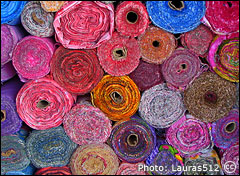
Umbra on organic fabric
Dear Umbra, First let me say that I just discovered your column and have been happily spending most of my time reading your archives. Excellent stuff! I am a total fabric geek; I love to make my own clothes and other fabric-y items, but I worry about synthetics and chemical dyes and chemically grown fibers. […]
-
The Gates Foundation's techy vision for African ag
In his first annual letter on the doings at the Bill & Melinda Gates Foundation, Bill Gates devotes a page to his foundation's efforts to boost agriculture in Africa.
Like the software wizard he once was, Gates identifies a problem and conjures up a solution. The problem is that African food production has stagnated while population has grown; the solution is to develop "new seeds" and make available "other inputs like fertilizer" so that farmers can "increase ... output significantly."
That, in a nutshell, is what happened in the U.S., Western Europe, and to a lesser extent India over the past half-century with the rise of industrial agriculture. Gates wants to repackage it for Africa, in what he calls a "new Green Revolution."
The document never considers the complex history of agriculture in Africa; nor does it mull the social and ecological effects of industrial-style agriculture in the West and India. Are we still so enamored of our food system that we feel compelled to export it to Africa?
A more robust vision for that continent's food future is laid out by the United Nation's Conference on Trade and Development and U.N. Environmental Program. Called "Organic Agriculture and Food Security in Africa" [PDF], the report emerged in 2008 with the support of more than a dozen civil-society organizations throughout Africa.
The report concludes that organic and near-organic agriculture is ideally suited for millions of marginalized smallholder farmers in Africa -- and build food security and soil fertility in unison.
The model of development that Gates favors -- essentially moving in the direction of nearly post-agricultural Western societies -- may be a relic of an era of cheap fossil energy and low awareness of ecological costs. Other ways of progress exist -- and I wish our most influential and best-funded foundation would explore them.
-
If Michael Pollan ruled the world …
"If it had been President Pollan, I probably wouldn't be here right now."
-- USDA chief Tom Vilsack
-
Picking the battles will be key to reforming food policy
Ah, the House Agriculture Committee. Never will you find a more wretched hive of scum and villainy.
Well, maybe that's a bit of an overstatement, but not by too much, I don't think. As Michael Pollan put it, "It's where decent ag legislation goes to die."
Does sustainable agriculture have any hope of support there? Well, we can be somewhat cheered by the fact that, with the Republican caucus as small as it has been in decades, the House Ag Committee has a mere 17 Republicans in contrast to its 29 Democrats. And the House being the House, you can be sure that those 17 Republicans will have plenty of time to work on their canasta skills (or whatever it is minority members do with all their spare time) because they certainly won't be writing legislation.
Unfortunately for us, the Democratic membership is mostly comprised of Blue Dogs (i.e. conservative Democrats) from farm states who have no real interest in or incentive for reform. And one thing is certain: Committee Chair and Blue Dog extraordinaire Rep. Collin Peterson (Minn.) is no Henry Waxman, the hero of reform and oversight now leading the way on climate change and health-care reform.
In some ways, it's good news that the Farm Bill won't come up for re-authorization for several years. First, it means President Barack Obama doesn't have to dive right into this political-capital destroying mess of subsidy reform -- he has, after all, promised to eliminate subsidies for farmers who make more than $250,000 in farm income, two-thirds less than the current limit (and he put it in writing, no less). But more importantly, it gives us time to plot.
What should a foodie do between now and then? Now that we've got our shiny new President, it'd be nice to take him out for a spin, food policy-wise, even if we can't immediately head for the rocky terrain of the Farm Bill. Dave Murphy has written about what we might expect from the USDA, the good as well as the bad and the ugly. But what about some of the other areas that impact food and agriculture policy beyond the USDA and beyond what's contained in the Farm Bill? I thought I might do a series of posts on some of these areas since they'll deeply affect the development of sustainable agriculture. Let's start small. How's international trade policy grab you?
-
All eyes on ag chief Vilsack's undersecretary pick
There have been whispers recently from Washington, D.C., that indicate that the wheels of change are grinding to a halt even before the Inauguration of our next President takes place.
The recent nomination of former Iowa Gov. Tom Vilsack as Secretary of Ag was a disappointment to many in the sustainable ag and family farm community because of Vilsack's close relationship with agribusiness and his penchant for promoting biotech and corn-based ethanol. Despite some positive comments during his confirmation hearing regarding nutrition, local foods and climate change, many in the sustainable ag community remain skeptical, while some remain hopeful.
I've written previously, as have others, to place Tom's record in context; that he was the first Democratic governor of Iowa in 40 years and that during his governorship he had to contend with a Republican House and Senate.
This will not be the case when he heads the USDA with solid majorities in Congress, a call for "change in America" and support from the White House. There will be no one to blame for failing to put forward a progressive agenda for America's food and farm future.