Arctic
-
Arctic sea ice is refreezing quite slowly. Go figure!
When records were being set for loss of summer Arctic sea ice area (2007) and sea ice volume (2008), the deniers spent all their time talking about how quickly the ice refroze in the ensuing months. Now, they are strangely quiet on the remarkably slow refreezing we’re seeing. Why the slow refreezing this year? I’ll […]
-
UK Met Office: Catastrophic climate change
Finally, some of the top climate modelers in the world have done a “plausible worst case scenario,” as Dr Richard Betts, Head of Climate Impacts at the Met Office Hadley Centre, put it today in a terrific and terrifying talk (audio here, PPT here). No, I’m not taking about a simple analysis of what happens […]
-
Will we see record low Arctic ice volume this year?
“Daily sea ice extent as of July 21. The solid blue line indicates 2009 … the purple line shows 2008; and the solid gray line indicates average extent from 1979 to 2000.” The blogosphere and scientific community are all abuzz as to whether 2009 will beat 2007 in minimum Arctic sea ice area. See, for […]
-
![]()
![]()
With a melting Greenland as a backdrop, Danish minister urges climate action
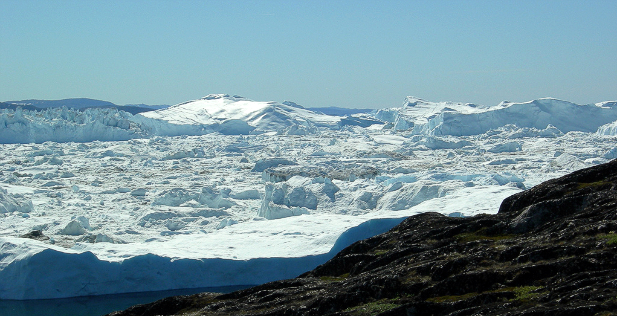
The Sermeq Kujalleq glacier (also known as the Jakobshavn Glacier) near where it flows into the sea in western Greeland. The photo was taken in the summer of 2008. Scientists have recorded the glacier’s rapid melt over the past decade.Courtesy kriskaer via Flickr Here’s a tip for the ministers who are attending the latest of […]
-
![]()
![]()
New NSIDC director on “death spiral” Arctic ice
I interviewed by email Dr. Mark Serreze, recently named director of The National Snow and Ice Data Center. Partly I wanted him to explain his “death spiral” metaphor for Arctic ice (see NSIDC: Arctic melt passes the point of no return, “We hate to say we told you so, but we did”). And partly I […]
-
MIT doubles its 2095 warming projection to 10°F
Today’s question: How the heck does the Greenland ice sheet survive accelerated disintegration from projected 20°F warming by the 2090s? I previously blogged on how the Massachusetts Institute of Technology Joint Program on the Science and Policy of Climate Change has joined the climate realists — the growing group of scientists who understand that the […]
-
![]()
![]()
The iceman walketh
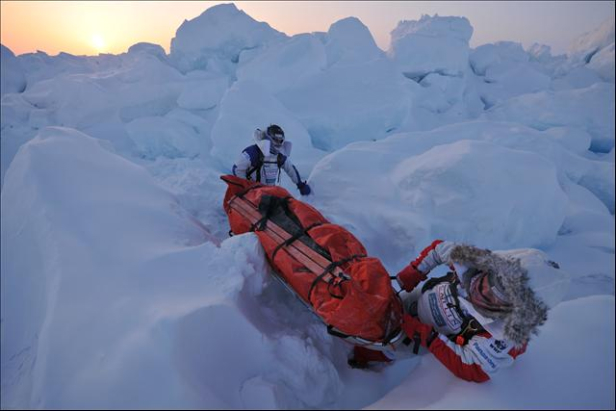
To study the conditions of sea ice, one must walk very carefully across it. Here, two members of the Catlin Arctic Survey team maneuver a supply sled through a rough patch.Courtesy Catlin Arctic Survey To millions around the world, Pen Hadow — the first person ever to trek to the North Pole alone without any […]
-
The International Polar Year: 'Arctic sea ice will probably not recover'
Some of the top polar scientists in the world have concluded (boldface in original):
Our main conclusions so far indicate that there is a very low probability that Arctic sea ice will ever recover. As predicted by all IPCC models, Arctic sea ice is more likely to disappear in summer in the near future. However it seems like this is going to happen much sooner than models predicted, as pointed out by recent observations and data reanalysis undertaken during IPY and the Damocles Integrated Project. The entire Arctic system is evolving to a new super interglacial stage seasonally ice free, and this will have profound consequences for all the elements of the Arctic cryosphere, marine and terrestrial ecosystems and human activities. Both the atmosphere and the ocean circulation and stratification (ventilation) will also be affected.
This is what U.S. experts have been saying for a while (see here). Though not every scientist got the memo (see here). And this is just one in a long line of climate impacts coming up faster than the models projected (see here for a list).
But what I think is quite interesting is that this is the first time I've seen such leading polar scientists elaborate so bluntly the potentially dire consequences of an ice-free arctic:
-
AAAS: Climate change is coming much harder, much faster than predicted
The American Association for the Advancement of Science is holding its annual meeting, so you can expect a flurry of climate announcements -- though not as much as at the annual meeting of the American Geophysical Union (see here and here). The Washington Post and AFP are reporting:
It seems the dire warnings about the oncoming devastation wrought by global warming were not dire enough, a top climate scientist warned Saturday.
Okay, this is what I've been saying for a few years now, but it's good to hear more and more leading climate scientists besides James Hansen and John Holdren being blunt with the public on this (see links below for others who are now telling it like it is). In this case, it's Christopher Field, founding director of the Carnegie Institution's Department of Global Ecology at Stanford University, who said
We are basically looking now at a future climate that's beyond anything we've considered seriously in climate model simulations.
The source of Field's concern -- what else could it be but our old nemesis, amplifying carbon cycle feedbacks: