Australia
-
Obama takes on the anti-scientific delayers
What is the best way to talk about those who are devoting their efforts to spread disinformation on climate science and/or climate legislation? Recent speeches by President Obama and Australian Prime Minister Rudd, who represent the two biggest industrialized countries that have so far refused to take action, offer some suggestions. Certainly, if you want […]
-
![]()
![]()
How industry pressures and competing national agendas dim prospects for a climate treaty
A version of this post was originally published on the website of the Center for Public Integrity and is reposted on Grist with CPI’s kind permission. —– It is said that borders don’t matter to the atmosphere — all nations have to work together to tackle the problem of climate change. But the forces that […]
-
![]()
![]()
The defeat of Australia’s climate plan is not bad news for cap-and-trade
It may be tempting to view the Australian Senate’s defeat Wednesday of climate change legislation as a portent of things to come as the U.S. Senate prepares to take up a cap-and-trade bill. Queensland is Australia’s coal country. Its mines power the country and feed China’s demand for energy.Courtesy Wikimedia CommonsBut the rejection of the […]
-
What’s going down, Down Under?
Australia is the canary-in-the-coal-mine koala-in-the-bushfire for climate change, since it is the most arid habited continent (see “Australia today offers horrific glimpse of U.S. Southwest, much of planet, post-2040” and “Global Boiling: Australia’s hellish black Saturday of extreme fire“). Prime Minister Rudd has been “moving forward with an imperfect but positive climate policy agenda that […]
-
![]()
![]()
Australia’s real climate on climate change
This article was co-written with Erwin Jackson, Director of Policy and Research at the Climate Institute, Australia’s leading independent policy think tank on climate change. The U.S. House of Representatives has joined the Obama administration in its resolve to finally move forward and address the problem of global warming by recently passing the American Clean […]
-
![]()
![]()
The Climate Post: The blind press grope the carbon legislation elephant
This week’s climate headlines are reminiscent of an old joke that touted “newspaper headlines the day after nuclear war.” The New York Times: “Nuclear War, Third World Hit Hardest.” The Wall Street Journal: “Nuclear War, Effect on Markets Uncertain.” The Boston Globe: “Tip O’Neill Safe After Nuclear Blast.” USA Today: “We’re Dead! Full AFC-NFC Box […]
-
![]()
![]()
Climate change hits Australia with a vengeance
Depressing. Photo: Georgie Sharp via Flickr Despite its economic woes, The Los Angeles Times still employs some of the best environmental reporters in the business, including a personal favorite, Julie Cart, who always brings compassion (and great quotes) to her work. Her story about how climate change is devastating Australia ran this week on the […]
-
What does economic 'recovery' mean on an extreme weather planet?
This is a guest essay by Tom Engelhardt, co-founder of the American Empire Project and an editor of the Nation Institute's TomDispatch.com. Englehardt is also the author of The End of Victory Culture and the editor of The World According to TomDispatch: America in the New Age of Empire. This post was originally published on TomDispatch and is republished here with Tom's kind permission.
-----
It turns out that you don't want to be a former city dweller in rural parts of southernmost Australia, a stalk of wheat in China or Iraq, a soybean in Argentina, an almond or grape in northern California, a cow in Texas, or almost anything in parts of east Africa right now. Let me explain.
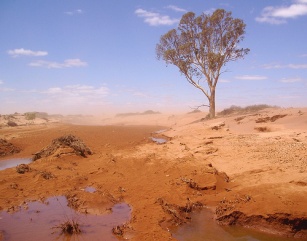
As anyone who has turned on the prime-time TV news these last weeks knows, southeastern Australia has been burning up. It's already dry climate has been growing ever hotter. "The great drying," Australian environmental scientist Tim Flannery calls it. At its epicenter, Melbourne recorded its hottest day ever this month at a sweltering 115.5 degrees, while temperatures soared even higher in the surrounding countryside. After more than a decade of drought, followed by the lowest rainfall on record, the eucalyptus forests are now burning. To be exact, they are now pouring vast quantities of stored carbon dioxide, the greenhouse gas considered largely responsible for global warming, into the atmosphere.
In fact, everything's been burning there. Huge sheets of flame, possibly aided and abetted by arsonists, tore through whole towns. More than 180 people are dead and thousands homeless. Flannery, who has written eloquently about global warming, drove through the fire belt, and reported:
-
CNN, ABC, WashPost, and AP blow Australian wildfire, drought, heat-wave story
If the U.S. media refuse to make the connection between record breaking wildfire, drought, and heat waves and human-caused global warming, why would anyone be surprised if the U.S. public doesn't put it as a higher priority or make the connection itself (see here)?
Australia knows it's facing climate-driven impacts that threaten it with complete collapse (see here). AFP (French international media) get this: "Australian wildfire ferocity linked to climate change: experts." So does Reuter's climate change correspondent in Asia: "Australia fires a climate wake-up call: experts."
I saw the CNN and ABC stories, and you can read the AP's stories, which have been published in the Washington Post and NY Times (though the NYT redeemed itself, see below). The media love a good calamity of Biblical proportion: