Big Oil
-
![]()
![]()
What if climate groups copied dirty industry tactics…?
If Big Coal or Big Oil can pay to generate fake grassroots opposition to climate and energy legislation, couldn’t green groups flip the tables and do the same? Grist got to thinking about what a pro-climate astroturfing campaign would look like… Got other ideas for pro-climate bill astroturfing? Drop ’em in the comments section below.
-
![]()
![]()
Larry Craig, oil lobbyist
Illustration by Tom Twigg/GristThis is an actual thing: Larry Craig, former punchline of Idaho, has opened a Washington consulting firm to work as an energy lobbyist. New West Strategies LLC offers “strategic advice, guidance, and advocacy” from Craig, the senator was arrested in 2007 in a sting operation against men cruising for sex at the […]
-
![]()
![]()
“Back to Petroleum”: BP shuts clean energy HQ, slashes renewables budget, dives into tar sands
The UK’s Guardian reports: BP has shut down its alternative energy headquarters in London, accepted the resignation of its clean energy boss and imposed budget cuts in moves likely to be seen by environmental critics as further signs of the oil group moving “back to petroleum”. Sad, but not terribly original or surprising (see “Shell […]
-
![]()
![]()
Dirty energy interests have spent $79 million this year lobbying Congress
The oil, gas, and electricity sectors spent tens of millions more to lobby Congress in the first quarter of 2009 than their renewable-energy counterparts. Big whoop, right? You could have guessed that. But the disparity between their spending — at a time when Congress is seriously considering far-reaching climate and energy legislation — is striking. […]
-
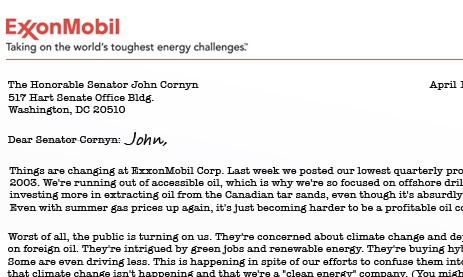
Chevron hires former CNN correspondent to spin report on Amazon destruction
The New York Times has a great story about Chevron hiring a former CNN reporter to produce a “news” report to counter a 60 Minutes segment on the oil company’s contamination of the Amazon rainforest in Ecuador. On May 3, 60 Minutes ran a story on the $27 billion lawsuit against Chevron for environmental damage, […]
-
The ocean does represent a major source of energy, just not the one you’re thinking of
In the minutes after midnight on March 24, 1989, the Exxon Valdez poured 10.8 million gallons of oil into Alaska’s Prince William Sound. The spill turned pristine spruce-lined waters into a sticky death trap for countless animals, including a quarter of a million birds. Yet two decades later, the lessons of Exxon Valdez have not […]
-
Big Oil [hearts] biofuels
Update [2009-3-19 12:37:25 by Tom Philpott]:Also on the theme of Big Oil loving biofuels: Valero Energy, the largest U.S. oil refiner, just snapped up seven ethanol plants from bankrupt ethanol maker Verasun for $1 billion. To get the plants, Valero beat out corn-processing giant Archer Daniels Midland, which had bid $700 million. ——————- From Reuters: […]
-
Also, we need new resources …
"The time for implacable opposition, for going it alone, has passed. We need new approaches and greater adaptability if we are to achieve acceptance of fossil fuels as sustainable resources."
-- ConocoPhillips CEO James Mulva [PDF]
-
Canadian PM and business groups use Obama's visit to shill for dirty tar sands oil
On
WednesdayThursday, Barack Obama is heading up to Canada, where they're getting nervous about growing protectionist and environmentalist sentiment in the U.S. Canadian PM Stephen Harper is widely expected to hype the special trade relationship between the two countries and push Obama for a climate partnership that spares tar sands oil -- one of the biggest sources of greenhouse gas emissions in North America -- from any carbon restrictions. (Hey, if the U.S. is going easy on coal, why shouldn't Canada go easy on tar sands?)To that end, during Obama's visit, a group called the Canadian American Business Council (boasting such luminaries as Exxon Mobil and Shell Oil) will be running full-page ads in major U.S. publications, which say:
The countries share the largest energy trade relationship in the world, with Canada supplying more oil and natural gas to the U.S. than any other foreign supplier. Second only to Saudi Arabia in proven petroleum reserves, Canada is poised to securely supply even more oil and natural gas to the U.S., while industries on both sides of the border innovate and invest in technologies to enhance environmental responsibility.
"Enhance environmental responsibility," you say? Let's take a look at a recent dispatch from Canada's Pembina Institute:
Today the Pembina Institute submitted comments on a draft Alberta Government policy that would allow in situ oil sands operations to burn dirtier fuels, which would significantly increase the intensity and total amount of greenhouse gas pollution and air emissions from the sector. ...
The policy would allow oil sands companies operating in situ projects to switch from burning natural gas to much dirtier, more carbon intensive fossil fuels such as raw bitumen or the waste from oil sands upgrading (petroleum coke and asphaltenes). Compared to conventional oil production, in situ oil sands production produces four times the greenhouse gas pollution per barrel when burning relatively cleaner natural gas. According to the Pembina Institute's analysis, in situ oil sands operations burning petroleum coke without any mitigation would produce 66 per cent more greenhouse gas pollution than if the same operation were to burn natural gas. The Alberta Government document states that the policy may be expanded to include other industrial activities in the future.Depends on what the meaning of "enhance" is, I guess.
U.S. group Forest Ethics is running the following full-page ad in response: