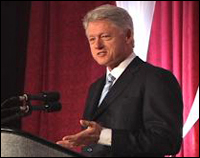
Bill Clinton
-
-
Worth about $20 million per word

Eliciting gasps and goosebumps at a press conference this morning at the Clinton Global Initiative in midtown Manhattan, Richard Branson, CEO of the mega-conglomerate Virgin Group, announced a commitment to invest a staggering $3 billion toward solving climate change, focusing his investments on developing biofuels and other oil alternatives. The transcript of his public vow follows:
-
Bill and peak oil
Bill Clinton is officially on the peak oil bandwagon, and wants the nation's newspaper editors to hop on with him.
(via Oil Drum)
-
Bad behavior at the U.N. climate talks further marred America’s rep
What to say about the behavior of the Bush administration in Montreal these last two weeks? As the consensus and will to act among the world's governments grows stronger and stronger, the administration's posturing starts looking less sinister and more ... just embarrassing.
The main goal of the COP MOP talks this time around was to come to some agreement about what happens after Kyoto. U.S. chief negotiator Harlan Watson (Exxon's favorite) arrived in Montreal saying "the United States is opposed to any such discussions," making it crystal clear -- if John Bolton's recess appointment as U.N. ambassador didn't -- that the U.S. doesn't give a flying frick what the international community thinks.
But wait, how about we add a little pissiness to our intransigence? The really embarrassing stuff went down late Thursday, when the AP ran a story revealing that Bill Clinton would be coming to speak. Let's go to tape:
Bush-administration officials privately threatened organizers of the U.N. Climate Change Conference, telling them that any chance there might've been for the United States to sign on to the Kyoto global-warming protocol would be scuttled if they allowed Bill Clinton to speak at the gathering today in Montreal ...
...
"It's just astounding," the source told New York Magazine. "It came through loud and clear from the Bush people -- they wouldn't sign the deal if Clinton were allowed to speak."To their immense credit, the organizers called the bluff and told Clinton to come anyway. In his speech, Clinton said Bush is "flat wrong" in his contention that curbing emissions would hurt the economy. (Of course that's irrelevant, since what Bush really thinks is that curbing emissions will hurt his political contributors, which is true.)
The Bushies backed down -- even trotted out a spokesflack to say that speeches like Clinton's were "useful opportunities to hear a wide range of views on global climate change" -- and agreed to attend informal talks the following day.
Oh, but then they walked out of those talks.
-
Clinton
I'm listening to an interview with Bill Clinton on public radio. He just claimed that his administration had the best environmental record since the (Theodore) Roosevelt administration -- citing, in particular, the Roadless Rule. He also said that he wanted to raise CAFE standards, but "Congress wouldn't pass it," even when the Democrats were in the majority.
What do you think?
Update [2005-6-3 20:44:39 by Dave Roberts]: In answer to a question about managing China's transition to global powerhouse, Clinton said it's crucial to (among other things) create a new generation of high-tech, high-wage jobs. What jobs? "Clean energy."
Ira Flatow then responded that he had 8 years to advance smart energy policy, and he didn't (though less bluntly put). Clinton had three responses:
- Energy issues had low visibility back then, because other priorities were intruding and oil was cheap;
- the Republican congress enjoyed the oil and coal economy, and still does;
- and he did actually do some stuff, tax credits and such, not to mention Kyoto.
Update [2005-6-3 21:22:14 by Dave Roberts]: A caller just asked him about the hydrogen economy. His answer, paraphrased: Hydrogen is great, and eventually we'll end up there. But it's a ways out. It shouldn't take money from more short-term achievable things like hybrids, compressed natural gas, solar, wind, etc. In general, we should spend far more on the emerging clean-energy economy.
The problem is that the old energy economy -- oil and coal -- is highly centralized, with access to influence, and very well-financed. The new energy economy is decentralized, entrepreneurial, under-financed, and lacking clear markets. The feds should help it along.
Flatow then asked him about nuclear, mentioning that "a lot of green people" are saying it's the answer. His answer, paraphrased: We should "look seriously" at it, and it's clear "we can run safe nuclear power plants." However:
- Will we get enough benefits in the short run given the enormous capital requirements, or would it make more sense to use that money building up renewable energy?
- Should we build 40 new nuke plants before we know what to do with the waste (Yucca was chosen for political, not environmental reasons)?
- Is nuclear more more cost effective than "letting 1000 flowers bloom" with small-scale wind, solar, biomass, etc. projects?
-
![]()
![]()
Clinton, late convert to climate-change cause, now preaching up a storm
He wasn’t known as the eco-warrior president. Nor was he a visionary on energy independence. But Bill Clinton is now using his legendary charisma and silver tongue to help mobilize the shift away from fossil fuels. Bill gets heated up over climate. Photo: Clinton Presidential Foundation. “[T]he decisions we make or fail to make in […]
-
Judge? Not!
As Washington simmered this weekend, at least one intractable political problem appeared to melt away in the withering summer sun. Or did it? In the relative quiet of the Fourth of July weekend, the New York Times reported that Pres. Clinton would enter into a (some would say Faustian) bargain with Sen. Orrin Hatch (R-Utah). […]