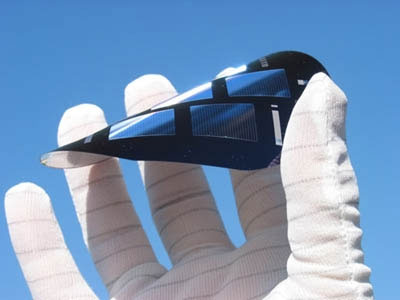
solar voltaic power
-
First DOE loan guarantee goes to solar
Today the Department of Energy announced its first energy loan guarantee. It’s going to … Solyndra, a manufacturer of solar panels. What’s the phrase? Oh, right: elections have consequences.
-
![]()
![]()
Solar PV market doubled to 6 Gigawatts in 2008
After growing 19 percent in 2006 and 62 percent in 2007, world solar photovoltaic (PV) market installations exploded by 110 percent last year to a staggering 5.95 GW, according to Solarbuzz’s Annual Report, Marketbuzz 2009: Europe accounted for 82% of world demand in 2008. Spain’s 285% growth pushed Germany into second place in the market […]
-
Feed-in tariffs, Chu off-message, MPG v. GPM, and the prospects for solar PV
I have about three months worth of unattended tabs open in my browser -- over 100, at last count. Ridiculous, I know. I figure now that comments are turned off on our site (it's weirdly quiet in here!), I'm going to do some speed blogging to get them all cleared away in anticipation of the torrent of news coming down the pike.
• In Florida, an odd-couple pair of legislators -- Rep. Keith Fitzgerald (D-Sarasota) and Rep. Paige Kreegel (R-Punta Gorda) -- are collaborating on a bill that would push Gainesville's innovative feed-in tariff program statewide. Fitzgerald wrote the bill; Kreegel is chair of the state's House Energy & Utilities Policy Committee. They view feed-in tariffs as an economic stimulus and jobs program. Naturally utilities oppose them.
• I know Chu Worship is the order of the day in green circles, but I'm sorry to say that most of what I've seen of our new Energy Secretary's communication with the public has been, IMHO, counterproductive. Like this. Does the Obama administration really want to be encouraging the myth that progress on climate is dependent on scientific and technological breakthroughs? Or this. Does the administration really want to be encouraging the notion that a recession is a bad time to pass a price on carbon?
• What's the deal with the MPG Illusion? The arguments for shifting to GPM (gallons-per-mile) seem compelling, but this doesn't seem to have taken off or spread at all.
• Climate change is threatening some of the world's most valuable archeological sites.
• Researchers at the Lawrence Berkeley National Laboratory have produced a fascinating report on the installed costs of solar voltaics (PDF). Here are the main conclusions:
-
How a small Nevada town lures major solar investment
In 1995, Boulder City, Nevada, paid $1.3 million for a land buffer to make sure that Las Vegas didn't get any closer. It has since used that buffer to become a world leader in solar energy, and is making $2 million (and counting) in annual revenue from solar leases. How did the city pull this off? What is the key to their solar success? Read this excellent article in the Las Vegas Sun to find out.
The city, 40 miles southeast of Las Vegas, averages 350 sunny days per year, allowing a local tavern to offer free beer on the days when the sun doesn't shine.
That's got to have at least something to do with it.
-
L.A. solar not dead, regardless of final vote on ballot measure
Despite rumors to the contrary, solar is not dead in Los Angeles. Not only is the outcome of Measure B still undecided, but Measure B is only a third of the larger L.A. solar plan [PDF]. And, frankly, the vote is irrelevant. On Wednesday, L.A. Mayor Antonio Villaraigosa said:
I can tell you, regardless of what happens, we're moving ahead on our solar initiative.
It's clear from listening to the discussion of Measure B that both supporters and opponents support solar power. This was not a referendum on solar, this was a referendum on process. People were pissed about how the measure got on the ballot. Some unions were rightfully pissed that the measure cut them out in favor of other unions. And so on.
It seems that there was no real reason to put this on the ballot in the first place, especially with so much process-related political baggage. From his comments on Wednesday, it appears that the mayor will now do what mayors normally do: establish ambitious goals, work out all the details with stakeholders through established oversight processes, and make it happen.
-
Los Angelenos narrowly reject city-wide solar plan
Los Angeles voters yesterday rejected the Green Energy Good Jobs ballot initiative (AKA Measure B), according unofficial results from the city clerk’s office. The plan, which failed by about 1,000 votes, would have led to the installation of thousands of solar panels on rooftops and parking lots throughout the city. It would have required the […]
-
Berkeley's program to finance solar systems through property tax assessments is off to great start
The city of Berkeley, Calif. is pioneering a program to help homeowners finance solar systems through property tax assessments. How's that working out?
The first tranche of funds sold out in nine minutes.
And on Friday, the first two checks were handed out to proud owners of new solar systems. Meanwhile, we were able to tweak the federal tax code to ensure that program participants can still use the federal investment tax credit (thanks, Speaker Pelosi). And we are working with partners in eight states and counting to get enabling legislation on the books to allow more cities to replicate the model.
Note that this program can be set up to fund more than just solar electric. Solar hot-water and energy-efficiency upgrades can and should be included as well.
-
A closer look at PG&E's immensely promising solar proposal
Last Tuesday, PG&E, the second largest utility in California, announced a major new solar initiative: 250 megawatts (MW) of utility-owned, distributed generation solar, and a further 250 MW to be built by private solar developers, under fixed-price contracts, at the utility's cost of service.
This is very good news, with implications I predict will reverberate through the solar policy community for quite awhile.
First, let's take the issue of utility involvement in the distributed generation solar market. I co-wrote an article on this last fall with my colleague Kevin Fox. The upshot: utility involvement in solar brings the opportunity for new economies of scale, but can also raise concerns about the potential of monopoly power crowding out private solar developers and stifling competition. The future of solar is dependent on nurturing a competitive workforce throughout the value chain, and healthy competition to foster a robust market and bring costs down for consumers.
Our suggested cure: utility involvement in the distributed generation solar industry should be conditioned on opening access for private solar companies to provide the same value to ratepayers. On first look, PG&E's application appears to meet this standard. The program maximizes the benefits of utility involvement while minimizing the potential drawbacks.
PG&E's solar program follows on the heels of similar announcements from Southern California Edison, San Diego Gas & Electric, and Los Angeles Department of Water and Power. SCE and LADWP's approaches contained efforts to limit markets and exclude participation, and as a result have been met with robust challenges.
The second policy implication concerns discussions around feed-in tariffs. While this is not a classic feed-in tariff in that it doesn't contain a must-take element (developers will submit projects to PG&E under standard contract and prices, winners will be selected based on assessed project viability and other elements), this proposal will re-introduce the spirit of competition when discussing fixed price contracts. More on this later.
Finally, we are going to see a lot of discussion on the price. PG&E projects that its cost of service will be the equivalent of $0.246/kWh, plus time-of-delivery adder, totaling $0.295 kWh. Given that the San Francisco Public Utilities Commission just signed a contract for 5 MW at $0.235 in one of the least sunny places in California, and Austin Energy signed a 30 MW contract for a reported $0.165 c/kWh, I believe this is a case of PG&E underpromising so as to overdeliver. We'll see once they make their actual bid. In any event, it's sunny days for the California solar industry.
-
L.A. solar vote could measure nation’s appetite for renewables
Next week Los Angeles voters will vote on an ambitious solar energy plan that would add solar panels on rooftops and parking lots across the city and require the city’s energy utility to rapidly increase the amount of solar power it uses. The vote could give a snapshot of public support for renewable energy, just […]