United States
-
Craig Williams took on the Pentagon to stop chemical-waste burning
“We’re a little outnumbered, and a little outspent,” says Craig Williams, “but we’ve turned around decisions by the biggest bureaucracy on the planet.” Williams, founder of the nonprofit Chemical Weapons Working Group and a cabinetmaker by trade, has been fighting for more than two decades to ensure that the U.S. military disposes of chemical weapons […]
-
Meet this year’s winners of the Goldman Environmental Prize
The winners (left to right): Silas Kpanan’Ayoung Siakor, Yu Xiaogang, Tarcísio Feitosa da Silva, Anne Kajir, Olya Melen, and Craig Williams. Photo: Goldman Environmental Prize. Though the connection between people and their surroundings is undeniable — a serving of clean air, anyone? — defense of the environment is still sometimes considered antisocial behavior. But this […]
-
![]()
![]()
What Mexican activists can teach the U.S. about poverty and the planet
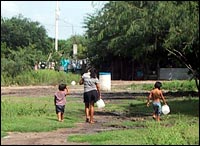
As the border organizer for Sierra Club’s Environmental Justice program, I bounce back and forth across the U.S.-Mexico border supporting grassroots environmental activists. More than the food, language, or currency, the biggest difference from one side to the other is what issues are considered “environmental.” Perhaps nowhere else on earth is there such a long […]
-
![]()
![]()
While the wealthy may strive for “simple living,” the poor try simply surviving
In the early 1990s, I knew a 10-year-old boy named Davy who had never been to Toys “R” Us. When I told his story, people would often respond to this part of his life with a sort of sentimental longing. “How wonderful that he has never been to that awful place,” they’d say. Davy’s lack […]
-
![]()
![]()
Why the Montreal climate summit was too painful to watch
I’ve been to climate meetings in locales that stretch from Kyoto to The Hague, Mexico City to the Maldives. It would have been awfully easy to get in the old hybrid and drive two hours north to Montreal for the big climate-change confab that wrapped up this weekend — if nothing else, it’s a city […]
-
Which parts of the U.S. have put themselves in nature’s way?
It's easy to see in hindsight. Yes, Hurricane Katrina was a natural disaster, but it was aided by some very unnatural factors -- developed wetlands and neglected levees, to name two. Figuring there must be other parts of the U.S. in human-made peril, we talked with experts to learn where we've made ourselves most vulnerable, and what -- in lieu of scrapping the whole country and starting over -- is being done to help.
-
![]()
![]()
Post-Katrina floodwaters are dirty, but so are other U.S. waterways
Last month, “toxic gumbo” entered the American lexicon with the speed and force of the floodwaters it describes. A LexisNexis search of major U.S. publications doesn’t return a single hit for the phrase in the year before Hurricane Katrina. But in the 30 days after the storm’s landfall, 66 articles contained the phrase. Measure twice, […]
-
Could TV and film be the key to the renewable energy revolution?
On several occasions I have written about television shows and movies. In doing so, I've tried (albeit unsuccessfully) to start a discussion about the impact they have on audiences when they address environmental issues and/or feature eco-friendly products (hybrids, windmills, etc).
Recently, I issued a call asking (and paraphrasing Bill McKibben): "Where are the movies? The TV shows? The comics? The bleeping video games?"
I believe exposure to such content will help introduce enviro concepts to consumers of pop culture, create awareness (you mean windmills aren't only a Dutch thing?), educate (hey, I didn't realize you could fit two dead bodies in the back of a Toyota Prius!), and start a conversation (do you think Julia Roberts drinks organic soy milk in real life?).
That said, I direct you to a recent piece (based on a true story) by our friend Joel Makower. Our story begins:
(Fade in: two small children running around in a playground. Pan right: A hybrid car slowly drives by while the blades of huge windmills rotate in the background. Narrator's voice begins ... )
If you could pay an extra five or ten bucks a month to help reduce global warming, childhood asthma, rolling brownouts, the national debt, and the threats of Al-Qaeda, would you bother? I'm guessing you'd think that a no-brainer.
So, why aren't you buying clean energy?
The question has been befuddling everyone from environmental activists to utility executives. Nearly every American, it seems, understands that generating electricity from the sun, the wind, the earth's heat, or gases generated by rotting waste is good news for everyone -- the planet, people's health, national security, and the economy.
So, what's the problem? They just don't think clean energy works. -
New Asia-Pacific climate pact is long on PR, short on substance
Staunch U.S. allies, enviro activists, and just about everyone else was caught flat-footed last week when the U.S., Australia, and four Asian countries unveiled a new pact intended to help curb greenhouse-gas emissions. In the days since, some details about the surprise alliance have trickled out, but its mission and intended impact remain murky. Known […]