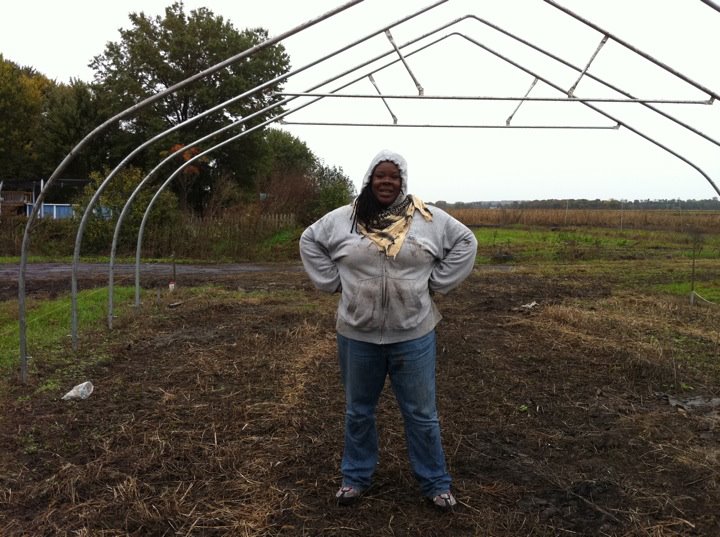
The website for Tanya Fields’ The BLK Projek describes her vision as seeking “to address food justice, public & mental health issues as they specifically relate to under-served women of color through culturally relevant education, beautification of public spaces, urban gardening and community programming.”
All true. But the high-minded rhetoric doesn’t quite capture the drama of the moment when Fields decided to engage in some direct-action urban guerrilla farming by cutting the lock on a gate to a vacant lot near her home in the South Bronx.
“It was Memorial Day, 2010,” she recalls. “We were giving out vegan hot dogs, and planting sunflowers, and cleaning up weeds.”
And then suddenly the owner of the lot, who hadn’t answered Fields’ calls for a year, showed up. And then the police got involved. And then Fields had to scramble to find the cash to pay for a new lock and repairs to the gate.
It’s not easy being a food justice activist in the South Bronx, says Fields, who was born and raised across the river in Harlem. It’s especially tricky when you are the mother of fou... Read more