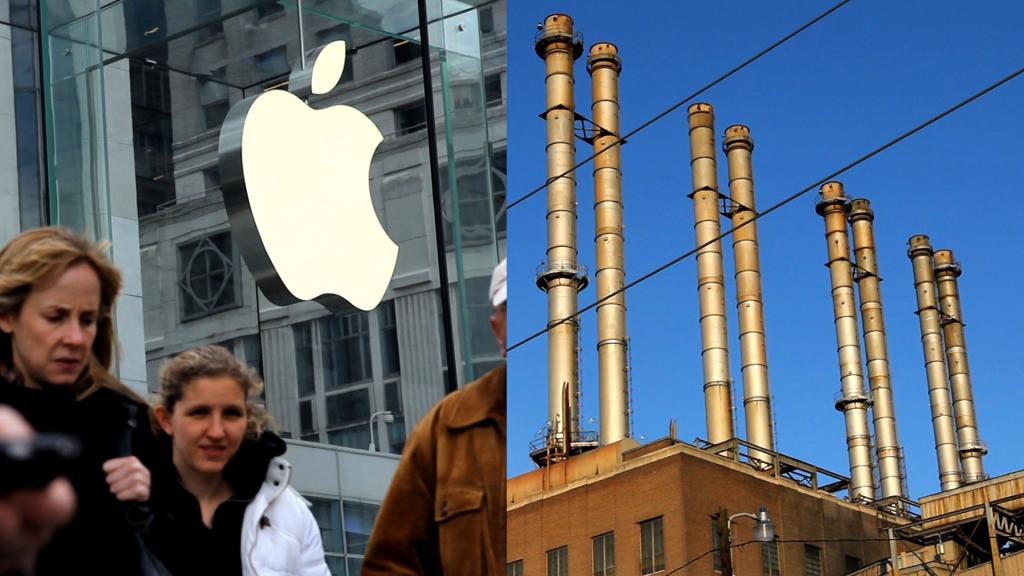
You've heard about the Foxconn factory in China where your iPad is assembled. But have you ever considered the energy required to store your emails, photos, and videos in the cloud? As worldwide demand for data storage skyrockets, so do the power needs of the servers where all our digital archives live. While some companies (like Facebook) have made great progress in ditching dirty fossil-fuel energy for cleaner renewables, a few internet giants lag far behind. Climate Desk visited Maiden, N.C., for a close-up view of what will soon be one of the world's biggest data centers -- owned by Apple and powered by the coal-heavy power behemoth Duke Energy.
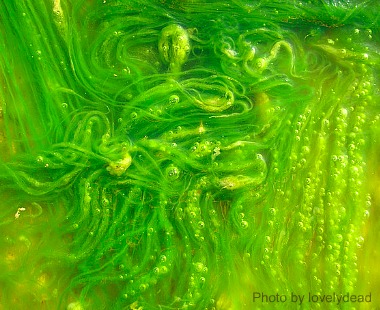
In the spectrum of alternative fuel sources, biofuel made from algae is perhaps the most easily mocked. How could the slimy green muck that grows in your aquarium and washes up on the beach be a future cornerstone of American energy independence? So when President Obama stood before the University of Miami recently and said algae could provide up to 17 percent of our transportation fuel, we wanted to know: Is he right? Here's what we found out:
The idea that a changing climate can persuade the ground to shake, volcanoes to rumble, and tsunamis to crash on to unsuspecting coastlines seems, at first, to be bordering on the insane. How can what happens in the thin envelope of gas that shrouds and protects our world possibly influence the potentially Earth-shattering processes that operate deep beneath the surface? The fact that it does reflects a failure of our imagination and a limited understanding of the manner in which the different physical components of our planet -- the atmosphere, the oceans, and the solid Earth, or geosphere -- intertwine and interact.
If we think about climate change at all, most of us do so in a very simplistic way: So, the weather might get a bit warmer, floods and droughts may become more of a problem, and sea levels will slowly creep upwards. Evidence reveals, however, that our planet is an almost unimaginably complicated beast, which reacts to a dramatically changing climate in all manner of different ways; a few -- like the aforementioned -- straightforward and predictable; some surprising; and others downright implausible. Into the latter category fall the manifold responses of the geosphere.
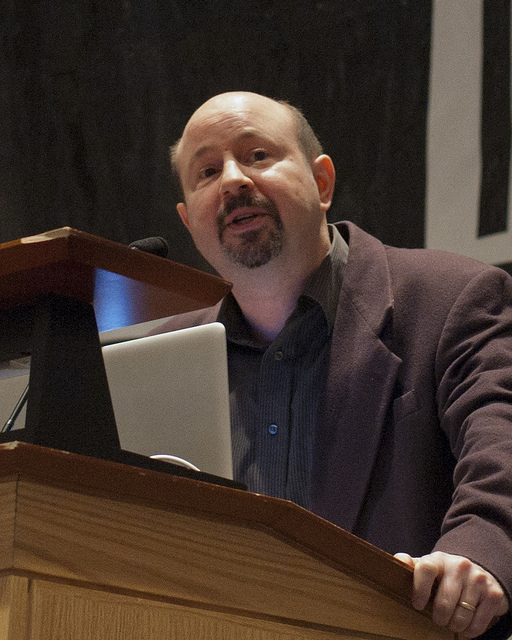
Michael Mann speaking at Penn State. (Photo by Penn State.)
This article was written by Suzanne Goldenberg forThe Guardian.
It is almost possible to dismiss Michael Mann's account of a vast conspiracy by the fossil fuel industry to harass scientists and befuddle the public. His story of that campaign, and his own journey from naive computer geek to battle-hardened climate ninja, seems overwrought, maybe even paranoid.
But now comes the unauthorized release of documents showing how a libertarian think tank, the Heartland Institute, which has in the past been supported by Exxon, spent millions on lavish conferences attacking scientists and concocting projects to counter science teaching for kindergarteners.
Mann's story of what he calls the climate wars, the fight by powerful entrenched interests to undermine and twist the science meant to guide government policy, starts to seem pretty much on the money. He's telling it in a book out on March 6, The Hockey Stick and the Climate Wars: Dispatches from the Front Lines.
A weather presenter and a celebrity chef walk into a kitchen … that was the novel hook for this cooking class (and, hell, it's not often Climate Desk gets to film a cooking show).
This is about as far away from the dry, cracked soil of a Texas cattle ranch as it gets: Fifth Avenue, New York City. At a seminar that cost $225 a head, a small selection of guests learned about the impact of 2011's record number of billion dollar disasters -- there were 12, including the ongoing drought in Texas -- and how to cook around them using substitute ingredients. While author and restaurateur Lidia Bastianich talked about the ingredients affected by last year's weather, TV meteorologist Bonnie Schneider (you've probably seen her on CNN) explained how climate change is causing tougher farming conditions and leaving Americans with bigger food bills.
Kerry Emanuel.Prominent MIT researcher Kerry Emanuel has been receiving an unprecedented "frenzy of hate" after a video featuring an interview with him was published recently by Climate Desk. Emails contained "veiled threats against my wife," and other "tangible threats," Emanuel, a highly-regarded atmospheric scientist and director of MIT's Atmospheres, Oceans, and Climate program, said in an interview. "They were vile, these emails. They were the kind of emails nobody would like to receive." "What was a little bit new about it was dragging family members into it and feeling that my family might be under threat, so naturally I didn't …
Nathan Swanson might be the greenest dentist in the state of New Hampshire ... or the whole country. His practice, Newmarket Dental, reduces radiation by using a digital X-ray sensor, hands out toothbrushes made with recycled yogurt containers, and is on its way to being a paperless office. Swanson can't make getting your teeth cleaned more fun, but he can make it greener. Check out the video to find out how he does it.
Editor's note: We've mentioned the ways northeastern states are planning for the disappearance of and loss of income from sugar maples here on Grist several times over the past year. But this video really brings the issue home (if the way to your conscience is through your taste buds, that is). Meet farmer and retired teacher Martha Carlson and hear her up-close-and-personal take on sugar maple trees and the unique (and delicious) food they provide. If we continue warming the planet at the same rate, most sugar maples will be gone by 2100. But it's not just a future danger …
In the run-up to the New Hampshire primary, former Rep. Bob Inglis, MIT climate scientist Kerry Emanuel, and other Republicans talk about why climate action is a conservative value:
The Climate Desk is a journalistic collaboration dedicated to exploring the impact -- human, environmental, economic, political -- of a changing climate. The partners are The Atlantic, Center for Investigative Reporting, The Guardian, Grist, Mother Jones, Slate, Wired, and PBS's public-affairs show Need To Know.