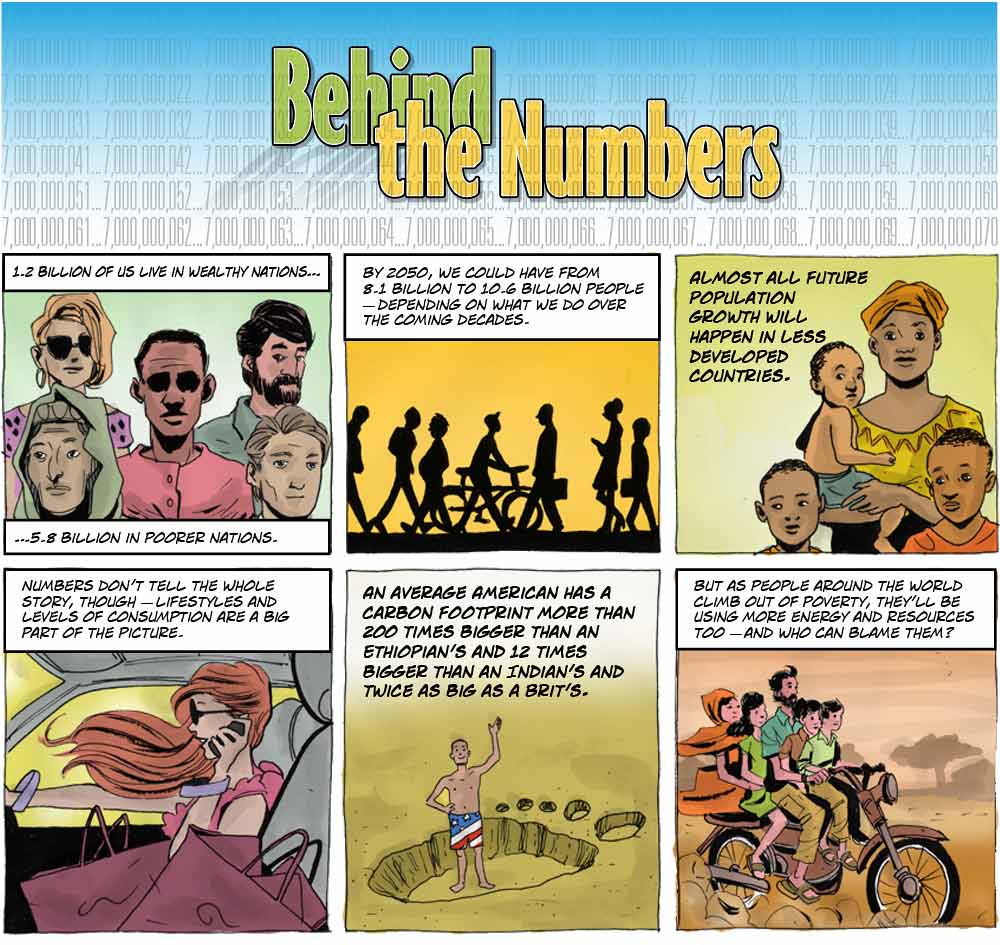
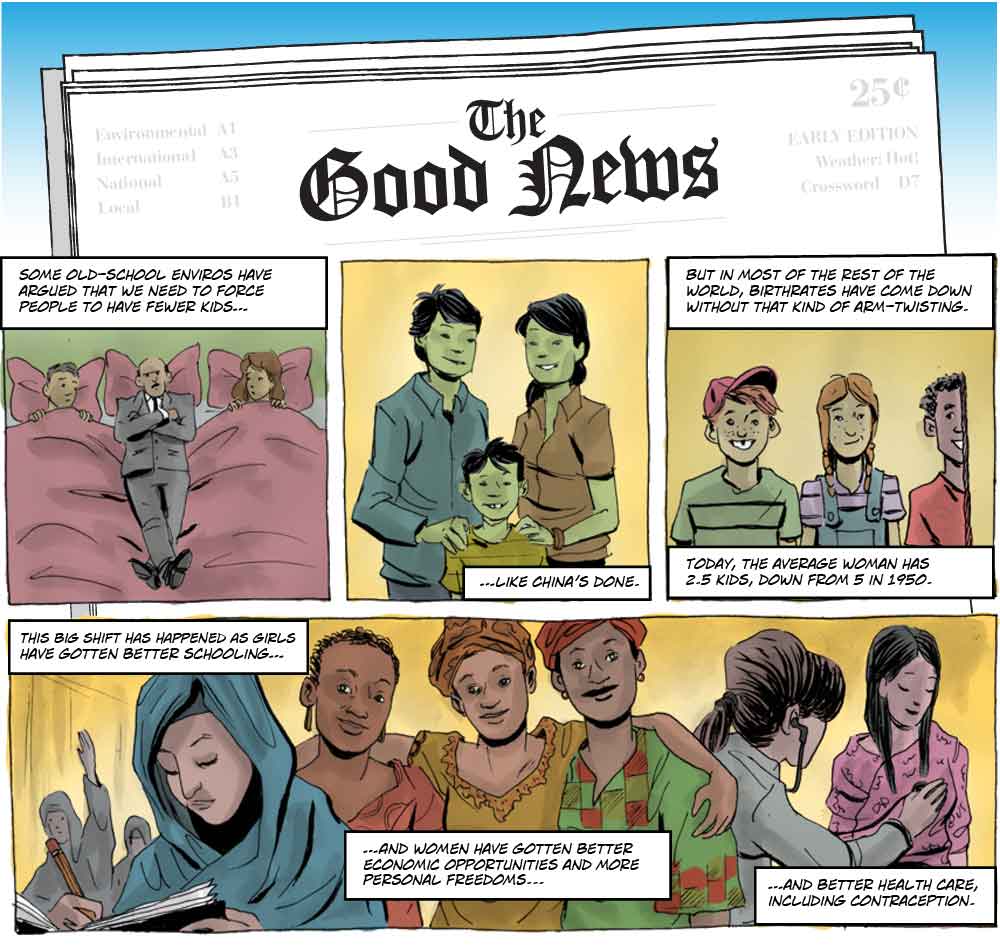
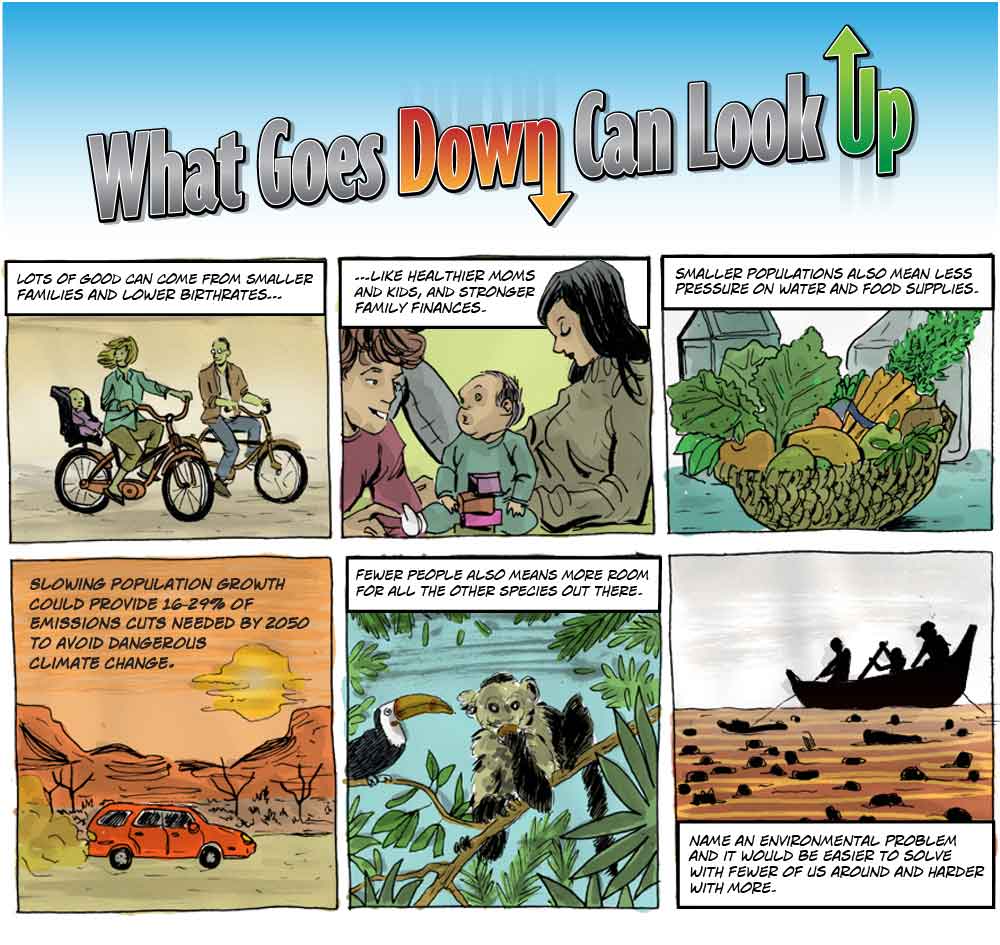
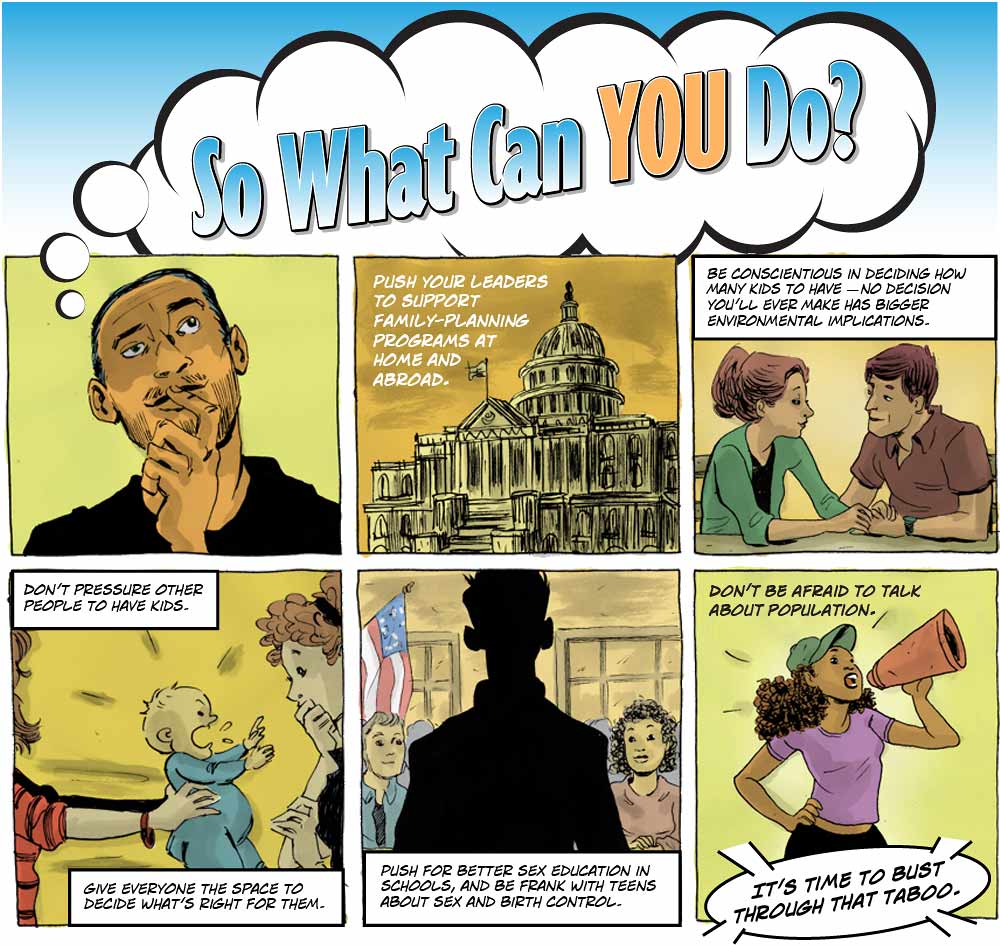
The world population is hitting 7 billion. But what does that really mean? In this comic, we unpack some of the numbers and nuances. Click the image below to view the comic, and then click on each page to go to the next one:
For those without javascript enabled, here are links to each page:
- 7 Billion, Unpacked
- Behind the Numbers
- The Good News
- Room for Improvement
- What Goes Down Can Look Up
- So What Can You Do?
Or you can download and read the comic as a PDF.
Written by Lisa Hymas. Illustrated by Thomas Pitilli. Lettering and headers by Warp Graphics.
[UPDATE: This has been updated to reflect the fact that Oct. 31, 2011, has now come and gone.]
—–
Sources:
Read more on population. Check out our series 7 billion: What to expect when you’re expanding.1. World population projected to reach 7 billion on Oct. 31, 2011. Source: United Nations Population Fund press release.
2. It took 50,000 years for the human population to reach 1 billion. Sources: “What If Experts Are Wrong on World Population Growth?” by Carl Haub, Yale Environment 360. “Scientists Rough Out Humanity’s 50,000-Year-Old Story,” by Nicholas Wade, New York Times Learning Network.
3. It’s taken 12 years to add the latest billion. Source: “Population Bulletin: The World at 7 Billion,” Population Reference Bureau.
4. World population is growing by 83 million people a year. Source: “2011 World Population Data Sheet,” Population Reference Bureau.
5. World population is growing by 227,000 people a day. Source: “2011 World Population Data Sheet,” Population Reference Bureau.
6. About 1.2 billion of the world’s people live in wealthy countries and about 5.8 billion in poorer countries. Source: “2011 World Population Data Sheet,” Population Reference Bureau.
7. By 2050, we could have from 8.1 billion to 10.6 billion people. Source: “World Population to Reach 10 Billion by 2100 If Fertility in All Countries Converges to Replacement Level” [PDF], United Nations.
8. Essentially all of the population growth during the rest of this century will take place in less developed countries. Source: “Rapid Growth in Less Developed Regions,” United Nations Population Fund.
9. One American has a carbon footprint more than 200 times bigger than an Ethiopian’s, and 12 times bigger than an Indian’s, and twice as big as a Brit’s. Source: “World carbon dioxide emissions data by country: China speeds ahead of the rest,” The Guardian.
10. Today, the average woman has 2.5 kids, down from 5 in 1950. Source: “9 Billion?” by Leslie Roberts, Science.
11. An estimated 215 million women in developing countries want to prevent pregnancy but don’t have access to modern birth control. Source: “Facts on Investing in Family Planning and Maternal and Newborn Health” [PDF], Guttmacher Institute.
12. We could provide family-planning services to all women in developing countries for about $17 billion a year. Sources: “Population policies, programmes and the environment,” by J. Joseph Speidel et al., Philosophical Transactions B. Correspondence with J. Joseph Speidel, August 2011.
13. Wall Street firms paid $20.8 billion in cash bonuses to their employees in New York in 2010. Sources: “Wall Street bonuses,” The Economist. “Wall Street Cash Bonuses Fall, Despite Strong Profit,” by Brett Philbin, The Wall Street Journal.
14. Nearly half (49 percent) of all pregnancies in the U.S. in 2006 were unintended. Source: “Unintended pregnancy in the United States: incidence and disparities, 2006” [PDF], by Lawrence B. Finer and Mia R. Zolna, Contraception.
15. Three in 10 American girls get pregnant while in their teens. Source: “How is the 3 in 10 Statistic Calculated?” [PDF], The National Campaign to Prevent Teen and Unplanned Pregnancy.
16. The Obama administration is addressing the high cost of prescription birth control. Source: “Insurance Coverage for Contraception Is Required,” by Robert Pear, The New York Times.
17. Family planning can lead to improvements in the health of mothers and their children. Sources: “Adding It Up: The Costs and Benefits of Investing in Family Planning and Maternal and Newborn Health” [PDF], by Susheela Singh et al., Guttmacher Institute. “Facts on Investing in Family Planning and Maternal and Newborn Health” [PDF], Guttmacher Institute.
18. Family planning can help families climb out of poverty. Sources: “Population Growth and Poverty,” U.N. Population Fund. “Family Planning Improves Quality of Life and Opportunities for Women” [PDF], USAID. “Expenditures on Children by Families,” USDA.
19. Slowing population growth could provide 16-29 percent of emissions cuts needed by 2050 to avoid dangerous climate change. Source: “Global demographic trends and future carbon emissions,” by Brian C. O’Neill et al., Proceedings of the National Academy of Sciences.
20. For an average person, the most consequential environmental decisions you’ll ever make are whether to have kids and how many. Source: “Reproduction and the carbon legacies of individuals” [PDF], by Paul A. Murtaugh and Michael G. Schlax, Global Environmental Change.
21. Talking about family planning can help bring down birthrates. Source: “Talking Their Way Out of a Population Crisis,” by Helen Epstein, The New York Times.
A message from
Your support keeps our climate news free.
Grist is the only award-winning newsroom focused on exploring equitable solutions to climate change. It’s vital reporting made entirely possible by loyal readers like you.
At Grist, we don’t believe in paywalls. Instead, we rely on our readers to pitch in what they can so that we can continue bringing you our solution-based climate news. Donate today to keep our site free. All donations DOUBLED for a limited time.