For more than a decade, the clean energy economy has been on a steep growth trajectory. Companies have poured billions of dollars into battery manufacturing, solar and wind generation, and electric vehicle plants in the U.S., as solar costs fell sharply and EV sales surged. That momentum is set to continue surging in much of the world — but in the United States, it’s starting to stall.
According to a new report from the clean energy think tank E2, new investment in clean energy projects last year was dwarfed by a cascade of cancellations for projects already in progress. For every dollar announced in new clean energy projects, companies canceled, closed, or downsized roughly three dollars’ worth. In total, at least roughly $35 billion in projects were abandoned last year, compared to just $3.4 billion in cancellations in 2023 and 2024 combined.
“That’s pretty jarring considering how much progress we made in previous years,” said Michael Timberlake, a director of research and publications at E2. “The rest of the world is generally doubling down or transitioning further, and the U.S. is now becoming increasingly combative and antagonistic towards clean energy industries.”
Timberlake said the Trump administration’s attacks on renewable energy are the main driver of the slowdown. Companies began pulling back their investments shortly after the November 2024 election, when a victorious Trump telegraphed that he would promote fossil fuels over solar, wind, and other clean energy technologies. For instance, TotalEnergies, the French oil-and-gas giant, paused development of two offshore wind projects in late November 2024, citing uncertainty after Trump’s election. The company has not restarted the projects since.
Trump followed through on those promises once in office: One of his first actions in office was to pause leasing and permitting for offshore wind. The freeze resulted in several wind developers indefinitely pausing or abandoning their projects while lawsuits trickled through the courts. (Federal judges have issued judgments in favor of the wind companies in recent months.) Trump’s administration also pulled billions of dollars in funding for a range of clean energy projects and cancelled or retooled Biden-era policies favorable to the industry, such as energy-efficiency measures, IRS tax guidance, and loans for a transmission line expected to carry solar and wind power.
Congress, at the behest of Trump, also passed the “One Big Beautiful Act” over the summer. In addition to sunsetting lucrative tax credits for renewable energy production, the law hammered the electric vehicle industry from multiple sides: It ended investment credits supporting the buildout of battery manufacturers, and simultaneously nixed the $7,500 tax credit available to American consumers who purchase EVs.
Timberlake cautioned against pinning clean energy’s disappointing year on any one policy. While the One Big Beautiful Act was the “biggest signifier” of the shift, “the overall policy and regulatory attack” is to blame for the glut of project cancellations, he said. “It’s not an environment that encourages more investment because no one knows what six months from now will look like.”
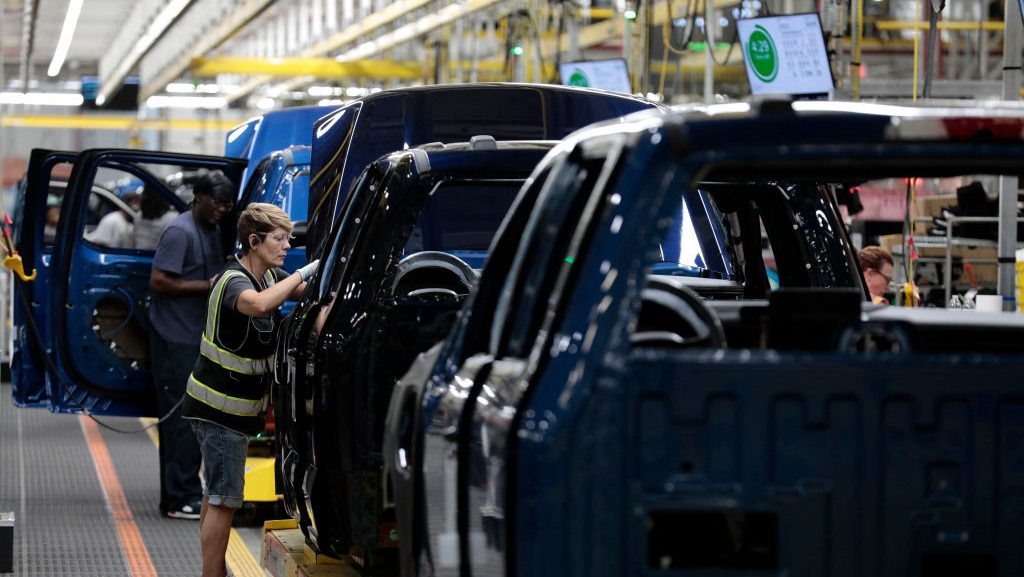
Electric vehicle and battery manufacturing have been hit the hardest over the past year. Each sector lost roughly $21 billion in investment over the past year, according to E2’s analysis, which includes some overlapping projects that serve both purposes. The industries also lost an estimated 48,000 potential jobs. These two industries likely lost the most investments because they had been growing the fastest in recent years, meaning they had more projects in the pipeline to cancel or downsize once President Trump was elected. The EV industry’s outlook, in particular, changed once Congress repealed consumer tax credits made available by former President Joe Biden. That, along with the general policy uncertainty, led to automakers revising their expectations for EV demand in the U.S. and reallocating their investments accordingly.
Some states were hit harder than others. In 2025 alone, Michigan lost 13 clean energy projects worth $8.1 billion — more than twice as many as any other state, due to its role as the capital of the U.S. auto industry. Illinois, Georgia, and New York also lost billions of dollars in investments.
Many automakers that scaled back electric vehicle plans last year redirected those investments rather than abandoning them outright. Ford, for example, had originally planned to build all-electric commercial vehicles at its $1.5 billion Ohio Assembly Plant in Avon Lake. But after revising its EV ambitions, the company pivoted the facility toward gas-powered and hybrid vans. Because Ford did not scrap the plant altogether, Timberlake said, facilities like Avon Lake could still be retrofitted for electric vehicle production if market conditions and policy outlooks improve.
“The silver lining view is they’re hopefully maintaining those facilities so that when there is certainty, those factories will still be available for making EVs down the road,” said Timberlake.
A message from
Your support keeps our climate news free.
Grist is the only award-winning newsroom focused on exploring equitable solutions to climate change. It’s vital reporting made entirely possible by loyal readers like you.
At Grist, we don’t believe in paywalls. Instead, we rely on our readers to pitch in what they can so that we can continue bringing you our solution-based climate news. Donate today to keep our site free.