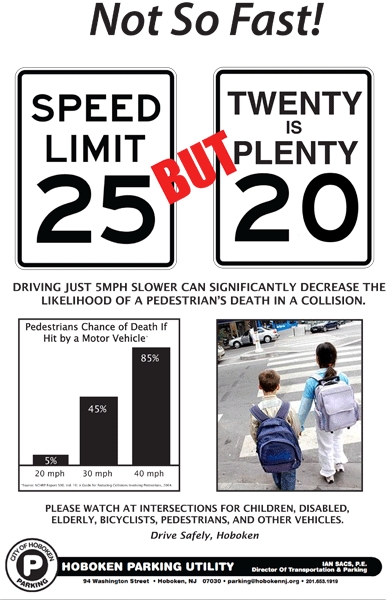
 Hoboken, N.J., launched a “Twenty is Plenty” campaign to ask drivers to voluntarily slow down to 20 mph where the limit is 25. (New York is also trying this out in certain places.)
It’s a safety thing. Crashes between autos and pedestrians have a 40 percent risk of fatality if the driver is doing 30 mph. But that risk drops to just 5 percent at 20 mph, according to the city’s transportation and parking director, Ian Sacs.
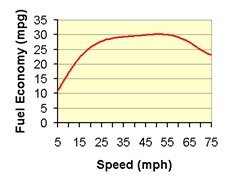
It’s also a green thing, indirectly. Fuel economy for most car engines runs on a curve (see below), with the peak around 55, so efficiency is actually worse at 20 than at 25. However! Slower speeds are safer and more attractive to bikers and walkers, which brings broader environmental (and public health) benefits.
Some drivers are unhappy about the initiative, even if it is voluntary. It inspired thoughtful online comments such as “the risk of fatality for a pedestrian is 0% if they don’t get hit,” in the Jersey Journal.
In a Planetizen post, Hoboken’s transportation director explained why simply lowering the speed limit isn’t necessarily an effective strategy for getting drivers to slow down. He says roads are engineered to “feel” safe to drivers at a particular speed — often higher than the posted limit — and lowering the limit may not slow them all down. He also says the prevailing engineering literature makes it easier to make a case for raising a limit than lowering one.
 Fueleconomy.govThat’s why the city settled on a strategy of appealing to concern about safety in trying to change social norms about driving in neighborhoods. It’s modeled after a U.K. “Twenty is Plenty” campaign that’s trying to change both norms and laws. It’s gotten the default speed limit lowered in Limpley Stoke (yes, that’s a place), Edinburgh, Bristol, Oxford, Cambridge, and elsewhere.
Here’s some propaganda from crazy Brits opposed to running over kids:
A message from
Your support keeps our climate news free.
Grist is the only award-winning newsroom focused on exploring equitable solutions to climate change. It’s vital reporting made entirely possible by loyal readers like you.
At Grist, we don’t believe in paywalls. Instead, we rely on our readers to pitch in what they can so that we can continue bringing you our solution-based climate news. Donate today to keep our site free.