Skip to content
Grist home Donate
Subscribe to The Weekly

We hand-package the week’s best Grist stories. Delivered free every Saturday morning.

Grist home Donate
Sign up for The Weekly

We hand-package the week’s best Grist stories. Delivered free every Saturday morning.

25 Years on the Climate Beat
Grist home
  • Follow
    • Follow us on Facebook
    • Follow us on Twitter
    • Follow us on Instagram
    • Follow us on YouTube
    • Follow us on Bluesky

    Get a weekly dose of climate inspiration in your inbox

  • Donate
  • Donate

Menu

A nonprofit, independent media organization dedicated to telling stories of climate solutions and a just future.

Search

Go To

  • About
  • Support Us
  • Newsletters
  • Advertise
  • Become a Member
  • Events
  • The Grist 50
  • Imagine 2200 Cli-Fi
  • Pitch Us
  • Local News

Topics

  • Politics
  • Energy
  • Equity
  • Solutions
  • All Topics

  • Follow us on Facebook
  • Follow us on Twitter
  • Follow us on Instagram
  • Follow us on YouTube
  • Follow us on Bluesky

Get a weekly dose of climate inspiration in your inbox

German small solar cheaper than big U.S. solar

This post originally appeared on Energy Self-Reliant States, a resource of the Institute for Local Self-Reliance’s New Rules Project. The U.S. has a hodge-podge of utility, state, and federal tax-based incentives. The Germans have a comprehensive feed-in tariff, providing CLEAN contracts (in the U.S. parlance) to anyone who wants to go solar (or wind, or […]

John Farrell
Published
Sep 27, 2011
Topic
Uncategorized
Share/Republish
Copy Link Republish
Copy Link Email Email SMS SMS X Facebook
Republish
Reddit LinkedIn Bluesky

This post originally appeared on Energy Self-Reliant States, a resource of the Institute for Local Self-Reliance’s New Rules Project.

The U.S. has a hodge-podge of utility, state, and federal tax-based incentives. The Germans have a comprehensive feed-in tariff, providing CLEAN contracts (in the U.S. parlance) to anyone who wants to go solar (or wind, or biogas, etc). What does that mean for the price of solar?

From a study of U.S. solar prices reported in Renewables International:

Perhaps most surprisingly, the study found that the planned arrays [in the U.S.] larger than one megawatt have an average installed price of $4.50 per watt, with only a third of the systems in the pipeline coming in at prices below four dollars per watt. As Renewables International reported in January, the installed system price of photovoltaics in the US was easily 60 percent above the level in Germany in 2010 for equivalent system sizes (arrays smaller than 100 kilowatts). [Emphasis added.]

Grist thanks its sponsors. Become one.

To support our nonprofit environmental journalism, please consider disabling your ad-blocker to allow ads on Grist. Here's How

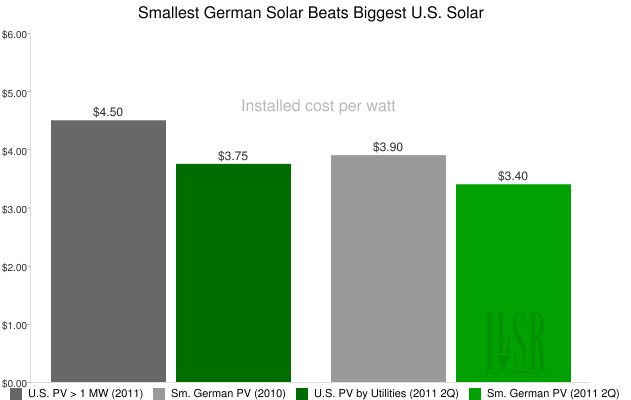
While large-scale U.S. solar comes in at $4.50 per Watt, small-scale German solar (10-100 kilowatts) averaged $3.90 per Watt in 2010 and $3.40 per Watt in the second quarter of 2011.  he German price advantage in solar is like having a pint of your favorite craft or microbrew beer for less than a Budweiser.

Of course, price comparisons are tricky, because the U.S. has no clearinghouse for solar installation data (again, the result of its hodge-podge federal-state-local policies). A just-released study of U.S. solar prices by the Solar Energy Industries Association found utility-constructed solar in the U.S. is now being installed at $3.75 per Watt. It’s not clear how much overlap there is between that data and the Renewables International report of $4.50 per Watt for solar 1 megawatt and larger.

Either way, small German rooftop solar is still beating U.S. large-scale solar. Here’s a chart illustrating that cost differential, with U.S. and German prices updated for the 2nd quarter of 2011.
Click to view larger version

Grist thanks its sponsors. Become one.

To support our nonprofit environmental journalism, please consider disabling your ad-blocker to allow ads on Grist. Here's How

If the German solar prices are wunderbar, that makes the U.S. “furchtbar.”


A message from   

Your support keeps our climate news free.

Grist is the only award-winning newsroom focused on exploring equitable solutions to climate change. It’s vital reporting made entirely possible by loyal readers like you.

At Grist, we don’t believe in paywalls. Instead, we rely on our readers to pitch in what they can so that we can continue bringing you our solution-based climate news. Donate today to keep our site free. 

Grist is the only award-winning newsroom focused on exploring equitable solutions to climate change. It’s vital reporting made entirely possible by loyal readers like you.

At Grist, we don’t believe in paywalls. Instead, we rely on our readers to pitch in what they can so that we can continue bringing you our solution-based climate news.

Donate Now Not Now

A message from  

Your support keeps our climate news free.

Grist is the only award-winning newsroom focused on exploring equitable solutions to climate change. It’s vital reporting made entirely possible by loyal readers like you.

At Grist, we don’t believe in paywalls. Instead, we rely on our readers to pitch in what they can so that we can continue bringing you our solution-based climate news. Donate today to keep our site free. 

Nikhil Swaminathan
Nikhil Swaminathan
CEO, Grist
DONATE NOW
Not Now
Next Article

How DIY and the ‘IKEA effect’ make us green

Christopher Mims Culture

Grist thanks its sponsors. Become one.

Grist thanks its sponsors. Become one.

To support our nonprofit environmental journalism, please consider disabling your ad-blocker to allow ads on Grist. Here's How

Uncategorized

Data centers, drought, and dispossession: The real nightmares in Ari Aster’s ‘Eddington’

Miacel Spotted Elk
  • The science behind the heat dome — ‘a mosh pit’ of molecules

    Matt Simon
  • Trump is bypassing community input to fast-track energy projects that risk pollution

    Izzy Ross
  • What Tesla’s massive image problem means for the world’s transition to EVs

    Paul Krantz

Latest

Three Iranian women sit in a group talking on a stone sidewalk along the dried-up riverbed

Iran’s regime has survived war, sanctions, and uprising. Environmental crises may bring it down.

Katie Surma, Inside Climate News
  • Trump’s EPA is taking itself out of the regulation game

    Jake Bittle
  • Trump is trying to kill clean energy. The market has other plans.

    Matt Simon
  • Daria Egereva fought for Indigenous voices at the UN. Now she’s in a Russian jail.

    Anita Hofschneider

Modal Gallery

/

The only newsroom focused on finding solutions at the intersection of climate and justice. Donate today to help keep Grist’s site and newsletters free. 

Support Grist

Topics

  • Energy
  • Politics
  • Solutions
  • Accountability
  • Extreme Weather
  • The Grist 50

Company

  • About
  • Team
  • Contact
  • Careers
  • Fellowships
  • Pressroom

More

  • Newsletters
  • Events
  • Become a Member
  • Advertising
  • Republish
  • Accessibility

© 1999-2026 Grist Magazine, Inc. All rights reserved. Grist is powered by WordPress VIP. Terms of Use | Privacy Policy

  • Follow us on Facebook
  • Follow us on Twitter
  • Follow us on Instagram
  • Follow us on YouTube
  • Follow us on Bluesky
Share This Video: