Uncategorized
All Stories
-
Mountaineering teams organize to clean up the world’s highest mountain peaks
A few months ago, gutsy French test pilot Didier Delsalle landed a helicopter on top of Mount Everest in 75 mph hour winds -- no, not crashed -- quite obviously the highest landing place on earth. He was the first to successfully summit Everest by copter.
And just to make sure it wasn't a fluke, he did it twice.
The previous highest helicopter landing was some 9,035 feet lower, at about 20,000 feet, the record set in 1996 by Nepalese pilot Madan Khatri Chhetri while rescuing climbers. And that's one of the great things about this: the tangible -- though still amazingly dangerous -- possibility of being able to rescue mountaineers on some of the world's highest, harshest peaks.
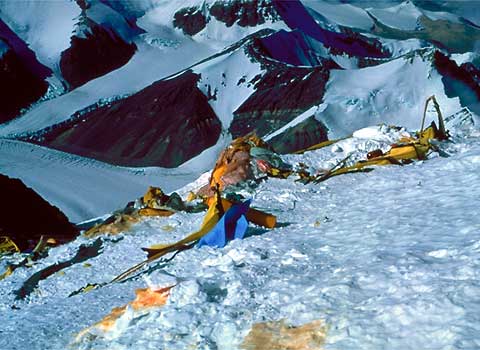
Delsalle's feat also raises the prospect (and could significantly lower the cost) of cleaning up what many call the "world's highest garbage dump."
In recent years, international teams of eco-conscious mountaineers have organized enormously expensive expeditions to clean up some of Everest's over-50-year legacy of trash, augmenting infrequent government Sherpa-led garbage-retrieval expeditions.
But now another team aims to clean up, at the very least, parts of the Himalayas' 14 peaks above 8,000 meters (about 26,200 feet). This week it's off to the earth's 10th highest mountain, Mt. Annapurna. The high-altitude sanitation engineers also have plans in place to launch a cleanup of their own on Mt. Everest next spring.
If there was ever a job in the trash business I envied, it's this one.
-
Fear, Kitty Kitty Kitty
Humans struggle to live peacefully with beasties Large carnivores have made impressive comebacks in some parts of the U.S. Now the question is how humans can live with them in harmony. In Oregon, after cougars were hunted to near-extinction, voters banned the practice of hunting with radio-collared dogs. The state’s big-cat population has since jumped […]
-
Acquittin’ Time
Judge dismisses murder charges against Mexican peasant ecologist Mexican forest activist Felipe Arreaga was freed last week after 10 months in jail, acquitted by a judge on murder charges stemming from the 1998 death of rancher and landowner Bernardino Bautista’s son. Arreaga is a leader in the peasant-ecologist movement of Mexico’s Petatlan Sierra, which gained […]
-
The Weak in Review
New Orleans floodwalls should have stood up to Katrina’s storm surge Why did the floodwalls on Lake Pontchartrain fail to protect New Orleans? The official explanation from the U.S. Army Corps of Engineers has been that the key 17th Street and London Avenue floodwalls were built to protect against a Category 3 hurricane — a […]
-
The Sun’ll Come Out Tomorrow
The defeat of Cali’s solar initiative isn’t the end of the fight California’s Million Solar Roofs initiative crashed and burned, thanks to a malodorous combination of parochial politics and interest-group stubbornness. But hope is not lost, says David Hochschild, director of policy at Vote Solar Initiative. The California Public Utilities Commission is authorized to implement […]
-
California’s Million Solar Roofs moving ahead, and setting pace for national climate action
The defeat in the California legislature of the bipartisan Million Solar Roofs bill earlier this month was a big blow, but the initiative -- and the broader spirit behind it -- are carrying on, says David Hochschild, director of policy at Vote Solar Initiative, a nonprofit working to bring solar energy into the mainstream. Here, Hochschild shares his take in an op-ed written for Grist:
-
Reflections by moderate Republicans from environmental days of yore
I'm attending the kick-off event of Duke University's new Nicholas Institute for Environmental Policy Solutions, a science-policy shop within the extremely well-endowed Nicholas School of the Environment and Earth Sciences. The crowd is large and august, with moderate Republicans from a different age of US environmental politics taking center stage.
Russell Train, the second EPA administrator, told stories of exploiting Nixon's political interest in environmental issues (he wanted to neutralize a potential wedge issue if Muskie had been the 1972 nominee) to get some of the country's landmark legislation through. Bipartisanship was the name of the game then, a stark contrast to today. Video of Train's talk (as well as Jared Diamond's and Richard Osbourne's of Duke Energy) is available here.
-
Gulf Toast
Woods, wetlands, and marine ecosystems hit hard by storm, pollution The Gulf Coast’s estuaries, wetlands, and cypress swamps are hurting in the wake of Hurricane Katrina. The storm damaged 25 national wildlife refuges, and recovery costs are expected to be at least $93 million — about a quarter of the federal refuge budget. In Mississippi’s […]
-
How Green Was My Rally
Protest on behalf of Arctic Refuge draws thousands to D.C. Thousands of Americans rallied in Washington, D.C., yesterday — some dressed like polar and grizzly bears — to demand that the Arctic National Wildlife Refuge be protected from oil drilling. Congressional Republicans, riding the wake of Hurricane Katrina’s disruptions to the nation’s oil supply and […]
-
Survey says …
The good news: A survey of 800 voters nationwide found that 79 percent favor "stronger national standards to protect our land, air, and water."
The bad news: Only 22 percent said environmental issues played a major role in their recent voting.
William K. Reilly, former EPA head and chair of the Duke University Nicholas Institute responsible for the poll, states the obvious: "There is a clear disconnect here."