Uncategorized
All Stories
-
Wind
Speaking of Jim Motavalli, he has a nice primer in E Magazine on the history and current challenges of the wind power industry. Good reading.
-
![]()
![]()
Doctors, vets, and scientists unite in brave new world of conservation medicine
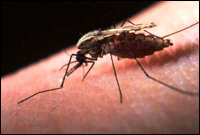
Mosquitoes have Hawaii all abuzz. Photo: WHO/TDR/Stammers. On an airport runway in Hawaii last fall, a sparrow nearly became a canary. State officials testing captured birds got one positive result for the West Nile virus, which had yet to arrive from the mainland. Hawaii and Alaska remain the only states in the U.S. that haven’t […]
-
People, People Who Breed People
Better make room — world population to hit 9.1 billion by 2050 There will be 9.1 billion people on this li’l planet of ours by 2050, according to revised U.N. population figures released yesterday. That’s a 40 percent increase from today’s mere (!) 6.5 billion. While population in developed countries is expected to remain largely […]
-
Who speaks for the armadillo?
I'm all for animal rights, to a point. I mean, we're like, y'know, all part of the same interconnected web and stuff? But sometimes a sense of humor goes a long way. What do you mean, road-kill candy is offensive? Next thing I know, you're going to tell me Nerds are an affront to environmental editors everywhere.
Update [2005-2-25 16:24:57 by Katharine Wroth]: Alas, this one has already been resolved. For the sake of the children, this candy will no longer see the light of day. Which is good, because all those eight-year-olds driving cars would have started aiming straight for the squirrels.
-
Black gold, Texas tea
Relating to this post: One good argument for using public policy to aggressively push alternative fuels and regulate environmental quality is that affordable oil is running out. There is, of course, much dispute over when Hubbert's peak will be reached, or whether it already has been. Some even believe that new technologies will continue to enable us to extract oil from more and more obscure places, ensuring steady supply.
Unlikely.
Four good posts to read on oil: Joel Makower says Hubbert's peak is here, drawing on a letter from an anonymous oil company employee on EnergyBulletin. Then, there's Kevin Drum, who points out that of course demand is about to exceed supply -- we've known that's coming for years -- and points back to this post of his from last year, which gets into the details.
I leave you with this cheery thought from anonymous oil guy:
It is not a question of "if" peak oil has occurred - it has! The better question might be "when are the crows coming home to roost?" When will we begin to actually experience the shortages and the rising prices? I think we might make a decade, if everybody plays nice across the world. But when has that ever happened when something got scarce?
-
REACH
Great post over on greenState about the power and implications of the E.U.'s new REACH regulations (it stands for "Registration, Evaluation and Authorization of Chemicals"). As Grist readers -- but few in the U.S. public -- probably know, very few of the 30,000 some chemicals on the market have been tested for safety. We're testing them -- you, me, our children -- right now, by using them. REACH says that companies must test chemicals, and publicly post the results, before putting them on the market.
Naturally, this scares the shit out of chemical companies, and they're doing everything they can to derail it, with the help of their handmaidens in the Bush administration. But the E.U. has become a global economic power, and we might not be able to manipulate them at will. Says greenState:
As the EU has an economy similar in size to the U.S., it will become difficult for the $500 billion chemical industry to develop one set of products for Europe and another set for the U.S. Once REACH is in place, citizens around the world will be able to access detailed information on the safety of chemical products, and use that information to force their own governments to pass similar laws. California has already indicated its desire to enact regulations similar to REACH, and other governments are sure to follow suit.
Yup.So this may be a new development for political activists in the U.S., that decisions in Europe can affect health and environmental standards around the world. But considering the current political climate in America, this comes as welcome news. Let's hope that the EU continues to pursue aggressive environmental legislation, and that corporate lobbyists do not succeed in weakening such legislation the way they have in the U.S.
-
Kyoto and Africa
In this post, Jamais Cascio argues (among other things) that Kyoto will be a boon to African countries, because of the treaty's Clean Development Mechanism, which, as explained well here, allows companies and countries to build or fund clean energy projects in developing countries in exchange for carbon-emissions credits that can be traded on the open market. He points to this story, which describes several possible projects in South Africa that stand to benefit.
But South Africa is somewhat anomalous in Africa, in terms of stability and economic development. What of poorer, less stable African countries?
-
Environmental quality and the economy
I found this piece in the CSR frustratingly sketchy and inconclusive. It makes the somewhat obvious point that restrictive environmental regulations stimulate the growth of industries and technologies that meliorate environmental impacts. Pass a law that says coal-fired power plants have to install scrubbers, the scrubber industry benefits. So for that class of industries and technologies, environmental regulations do not, contra the anti-Kyoto crowd, suppress economic development.
But that gets us nowhere. As the author acknowledges:
Of course, green technology represents only a small part of the nation's economy. Gauging whether stricter environmental regulation helps - or hurts - the overall economy is tougher and more controversial.
To say the least. There's a good bit of research indicating that improving environmental quality is not an overall drag on the economy. But what greens need is a compelling -- and by compelling I don't mean rhetorically compelling, but empirically compelling -- case that clean technology is naturally going to grow and eventually eclipse polluting technology, and thus that it would be wise economically to use public policy to nudge us in that direction. That's certainly what I believe, and so too does Eric de Place:
Maintaining our economy's singular reliance on fossil fuels is not a smart growth strategy for the 21st century. Global supplies of petroleum are waning and combating climate change (principally through reductions in fossil fuel combustion) will become ever-more important. So clean energy alternatives and energy efficiency will be critical in the coming decades.
Numbers, though. I want numbers. Readers, help out: Point me to some numbers.
-
Cascadia scorecard
Today, Northwest Environment Watch released their annual Cascadia Scorecard. If you live in the Northwest -- or care about it -- you should give it a read.
 Launched in 2004, the Cascadia Scorecard charts the Pacific Northwest's success at creating a sustainable economy and way of life.
 The 2005 Scorecard gives a concise update on how Cascadia ranks in seven key trends--health, economy, population, energy, sprawl, forests, and pollution--but hones in on one of the most critical issues facing the region: energy.
It details the weaknesses of the region's energy system and argues that Cascadia can achieve true security, and a stronger economy, by investing in a clean-energy revolution that is already gathering force.
Most of the Scorecard data are available on the Web on the pages for each indicator; we also do daily updates on the Scorecard weblog.
-
The problem
An extraordinary piece of writing by Alex Steffen over on Worldchanging. If you are looking for a reasonably comprehensive but concise description of the problem in which we -- that is, humanity -- find ourselves, now you know where to find it. Required reading.