Uncategorized
All Stories
-
![]()
![]()
Ecuadorian government shuts down leading environmental group
Ecuadorian President Rafael Correa Last Monday, environmentalists were shocked to learn that the Ecuadorian government had shut down Acción Ecológica (Environmental Action), withdrawing the legal status of one of South America’s best-known environmental groups. Acción Ecológica has in recent months supported indigenous-led, mass protests and highway blockades against President Rafael Correa’s support for large-scale mining. […]
-
Climate policy can be fair to families all across the country
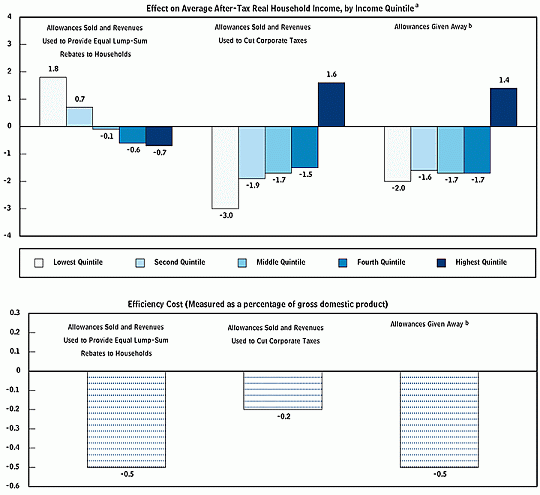
As regular readers know, we’ve done a bit of cheerleading for the “cap and dividend” concept, which is also called “Cap-and-Cashback,” since it would hand cash receipts from government-run carbon auctions right back to consumers. Cap-and-Cashback strikes me as a fundamentally fair climate policy, since it protects low- and middle-income families from the effects of […]
-
Friday music blogging: Neko Case
ListenPlay "Never Turn Your Back On Mother Earth," by Neko CaseNeko Case has the most compelling voice in popular music. Full stop. She could sing the phone book and it would sound thrilling, and beautiful, and mysterious, and vaguely threatening. Luckily, she's a really good songwriter too.
She got her start in cowboy punk bands, but drifted pretty quickly to a kind of timeless Americana, starting with 1997's The Virginian. Of course, as every indie fanboy knows, she really came to popular attention as a singer in the New Pornographers, who burst on the scene with 2000's Mass Romantic. She didn't do any writing for them, but she elevated every song she appeared on and is at least partially responsible for most of their classics.
 Her army of ardent admirers (yes, yes, she's beautiful) helped make 2002's Blacklisted a big success, and every album since then has gotten richer, not to mention more successful.
The latest, out this month, is Middle Cyclone. It's got guest appearances from an array of indie luminaries from M. Ward to members of the New Pornographers, but as always the focus is on that spooky, haunting, amazing voice.
This isn't the best song from the album, but given the context, how could I choose any other? It's a cover of a song from the band Sparks: "Never Turn Your Back On Mother Earth." Word.
-
Energy efficiency saves lives
The New Yorker's Steve Coll is reading through the stimulus bill. This is interesting:
The energy-efficiency issue is the most interesting [in Title III, "Department of Defense"]. In 2008, a Defense Science Board Task Force studied the Pentagon's use of energy and how its dependence on costly (in lives and budgets) convoys hauling gasoline and jet fuel in war theatres might be reduced. The report found that one of the most fuel-sucking practices of the military is its use of generators in the field to run air conditioners to cool highly energy-inefficient tents and trailers. In Iraq alone, the report implies, more than a few soldiers have died on roads where their mission was hauling fuel to cool down tents and barracks that, if properly insulated, might not have required so much energy in the first place. There are many other fascinating findings about war-fighting and energy, if you don't already possess enough ridiculously dense and wonky material for your book club.
-
Coal ash on CounterSpin
FAIR's podcast CounterSpin has a great interview with Kristen Lombardi of the Center for Public Integrity. She's the author of an important new coal ash expose featured in the March 6 show. "Coal Ash: The Hidden Story," and its map of just the known slurry dumps -- not including all the ones coal companies won't tell anyone about -- are great.
-
Energy storage, emissions hotspots, waste-to-fuel, and feed-in tariffs again
• I wish I was as funny as The Editors.
• Interesting: AEP, one of the most coal-heavy and change-resistant utilities on the planet, is experimenting with backyard energy storage systems.
• A good piece from the Center for Progressive Reform examines the risk of "hotspots" in a carbon cap-and-trade program. Of course there's no such thing as a carbon hotspot, but facilities that create carbon also tend to create co-pollutants, so it's a legitimate fear. Author Shana Jones has some ideas for how cap-and-trade could be crafted to avoid this danger.
• Ontario recently instituted a feed-in tariff program. What happened?
So many local wind and solar developers -- as well as homeowners looking to install photovoltaic panels -- applied for Ontario’s standard offer that the government’s 10-year target cap of 1,000 megawatts was exceeded within a year.
Said one energy analyst, "The lesson is that renewable energy technology was a lot more market-ready than the energy planners thought it was." Golly, I wonder if that's true in the U.S. too?
• Biofuels Digest has an interesting report on the promise of "waste-to-fuel" companies, which take municipal solid waste -- i.e., garbage -- and make biofuel out of it:
-
Smart infrastructure, courts v. coal, and energy efficiency all over
• The Wall Street Journal has a long and fascinating piece that expands the "smart" conversation beyond the grid to discuss smart infrastructure generally, including smart transportation and smart water infrastructure. Turns out information technology can help out all sorts of places!
• Largely unnoticed by the media, EarthJustice won a big victory in court recently:
A federal court has ruled that the U.S. Environmental Protection Agency must close a loophole that -- for more than 25 years -- has made it easy for mining companies, coal ash dumps, and a host of other polluting industries to skip out on costly cleanups by declaring bankruptcy. The case concerned EPA's failure to issue "financial assurances" standards that ensure that polluting industries will always remain financially able to clean up dangerous spills and other contaminated sites.
• Homebuyers are starting to specifically request green, energy-saving features.
• PBS recently did an excellent hour-long documentary on "clean coal" called Dark Energy: The Clean Coal Controversy. You can watch the whole thing online at the linked site.
• This is pretty cool: the first zero-emission research station in the Arctic. Nice video:
-
New Greenpeace report details path to clean energy
Greenpeace has just released an important report called "Energy [R]evolution: A Sustainable U.S.A. Energy Outlook." It details how the U.S. can cut greenhouse gas emissions without using nuclear or coal.
The report finds that off-the-shelf clean energy technology can cut U.S. carbon dioxide emissions from fossil fuels by at least 23 percent from current levels by 2020 and 85 percent by 2050 (equal to a 12 percent cut by 2020 and an 83 percent cut by 2050 from 1990 levels) -- at half the cost and double the job-creation of what it would take to meet U.S. energy needs with dirty energy sources.
Throughout, the study makes conservative assumptions to ensure the real-world viability of the scenario. The report assumes that only currently available technologies will be used and no appliances or power plants will be retired prematurely, and adopts the same projections for population and economic growth included in the International Energy Agency's World Energy Outlook.Here's a video of Sen. Bernie Sanders discussing the report:
I'm going to read the thing before I say anything else about it.
-
Must-have slide No. 2: The 'global-change-type drought' and the future of extreme weather

This must-have slide comes from a 2005 study, "Regional vegetation die-off in response to global-change-type drought." I first saw it in a powerful 2005 presentation [PDF] by climatologist Jonathan Overpeck, "Warm climate abrupt change-paleo-perspectives," that concluded "climate change seldom occurs gradually."
Overpeck noted that the 2005 study, together with the recent evidence that temperature [in red] and annual precipitation [in blue] are headed in opposite directions in the U.S. Southwest, raises the question of whether we are at the "dawn of the super-interglacial drought."
Before explaining why I like this slide and how it shows the future of extreme weather, I need to review the conclusion of the study, which was led by the University of Arizona, with Los Alamos National Laboratory and the U.S. Geological Survey:
Global climate change is projected to yield increases in frequency and intensity of drought occurring under warming temperatures, referred to here as global-change-type drought ...
Our results are notable in documenting rapid, regional-scale mortality of a dominant tree species in response to subcontinental drought accompanied by anomalously high temperatures.The researchers examined a huge three-million acre die-off of vegetation in 2002-2003 "in response to drought and associated bark beetle infestations" in the Four Corners area (Arizona, New Mexico, Colorado, and Utah).
This drought was not quite as dry as the one in that region in the 1950s, but it was much warmer, hence it was a global-warming-type drought. The recent drought had "nearly complete tree mortality across many size and age classes" whereas "most of the patchy mortality in the 1950s was associated with trees [greater than] 100 years old."
The study concluded: