Uncategorized
All Stories
-
Major media outlet officially over eco-trend
CNN -- or some overworked and over-it headline writer at CNN -- calls it: "Cisco Goes -- What Else? -- Green." Seriously, Cisco -- that's so 2008.
-
Arctic sea ice drops below 2007 levels
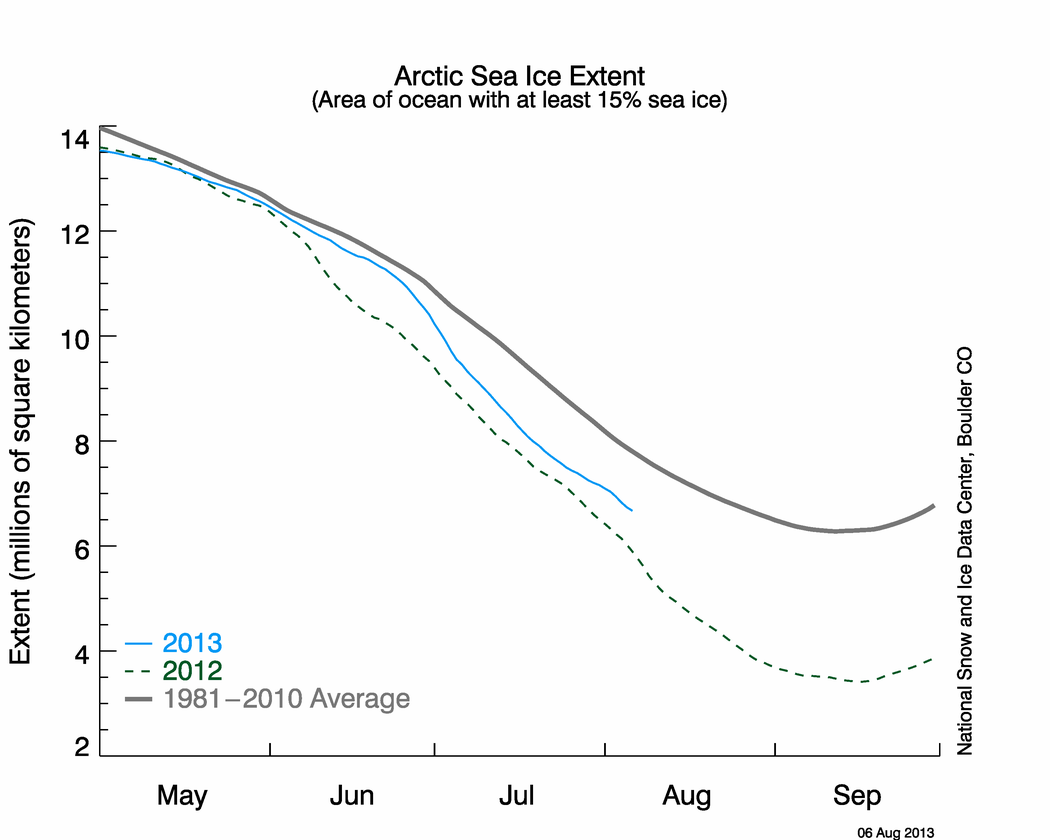
Arctic sea ice extent just dipped below January 2007 levels in the last few days, according to the daily time series from the National Snow and Ice Data Center:

The NSIDC notes that they are showing the data from 2007 on this figure since that year "went on to reach the lowest summer minimum in the satellite record."
The NSIDC also has an interesting 2008 Year-in-Review for cryosphere buffs. It explains why the ice stopped growing for a week in mid-December. It also has an interesting graphic comparing the Arctic sea ice extent in 2008 with 2007:
-
You can't violate the laws of physics
"The erroneous belief that stabilizing emissions would quickly stabilize the climate supports wait-and-see policies but violates basic laws of physics."
-- Dr. John Sterman, risk analyst at the Sloan School of Business, M.I.T.
-
Next stop for Obama team: EPA's endangerment finding

Stopped EPA from blocking California's effort to regulate tailpipe GHG emissions. Check!
Stopped a new coal plant. Check!
The next "stop" on the Obama Climate Action Train is the "endangerment finding" so the EPA can finally put a stop on greenhouse gases.
In Massachusetts [vs. EPA], the Supreme Court found that greenhouse gases (GHGs) are "pollutants" under the Clean Air Act; that EPA must determine whether GHGs emitted from new motor vehicles do or do not endanger public health or welfare, or supply a reason for not making this determination; and that, if EPA makes an "endangerment finding," it must issue regulations.
The key question: Can elevated levels of GHG concentrations be reasonably anticipated to endanger public health or welfare? Does the Pope buy papal indulgences carbon offsets?
This is not a tough call for a President who just said: "climate change, which, if left unchecked, could result in violent conflict, terrible storms, shrinking coastlines, and irreversible catastrophe." And for 1,000 years! Indeed, he campaigned on this very issue (see the October 16 post, "Obama to declare CO2 a dangerous pollutant").
In an email to EPA employees [PDF], Administrator Lisa Jackson wrote of "five priorities that will receive my personal attention" -- the first of which is "Reducing greenhouse gas emissions":
As Congress does its work [on global warming legislation], we will move ahead to comply with the Supreme Court's decision recognizing EPA's obligation to address climate change under the Clean Air Act.
Greenwire ($ub. req'd) has the full story:
-
Revkin has leading system dynamics expert Sterman on NOAA's 1,000-years-of-hell paper
I am a big fan of MIT's John Sterman, one of the world's leading experts on systems thinking.
In a post on "The Greenhouse Effect and the Bathtub Effect," Andrew Revkin notes that Sterman's work trying to reduce the biggest source of climate confusion is related to the new NOAA-led paper that I discussed here: Climate change "largely irreversible for 1000 years," with permanent Dust Bowls in the Southwest and around the globe.
The bathtub analogy is that while atmospheric concentrations (the total stock of CO2 already in the air) might be thought of as the water level in the bathtub, emissions (the yearly new flow into the air) are the rate of water flowing into a bathtub. We need to lower the level, not just the flow. A great video clarifying the issue is here. It is narrated by my friend Andrew Jones. If you want to play the simulation itself, go here.
Revkin got Sterman's comments on the paper, which I am reposting below:
-
Holmes Hummel on climate policy design
Holmes Hummel is a "Lecturer and Policy Specialist at the UC-Berkeley Energy Resources Group, and previously served as a Congressional Science Fellow focused on energy and climate policy development." That's from her bio. What's not on her bio is the fact that she's smarter than you and 10 of your smartest friends, combined.
She's put together a PowerPoint slideshow and taped a lecture titled, "U.S. Energy and Climate Policy on the Road Ahead," and it's worth your while to give it a read/listen. Find it under the "Recent Posts" section, here.
-
U.N. climate official clarifies remarks about near-term summit
Monday, U.N. climate chief Yvo de Boer sounded an awful lot like he was making a major announcement about a newly planned international summit on climate change. As the Financial Times reported, the U.N.'s top climate official said a meeting was necessary to lay groundwork before the international climate conference in Copenhagen this December. De Boer's remarks indicated that U.N. Secretary General Ban Ki-Moon felt the same way and was looking to call a summit in February or March.
But the secretary-general's office was mum on the matter when contacted by Grist yesterday. Today, de Boer's office confirmed that nothing is planned as of yet.
"The Secretary General is planning to organize a High Level Event with Heads of State and Government for all Members States in the margins of the General Assembly in September," John Hay, a spokesperson for de Boer, wrote in an e-mail. "He is also exploring other avenues to galvanize Heads of State and Government and support high level political engagement throughout the next 11 months. No specifics, however, are confirmed at this time."
The possibility of 30 to 40 heads of state meeting as early as February or March was a "personal hope" on de Boer's part, not a concrete plan, Hay said. One of the newest heads of state, President Barack Obama, is likely to have a big say in the timing.
"Obviously, this is designed to get the U.S. back in play," said John Anthony, communications director for climate and energy for the United Nations Foundation. "[But] just look at what's happening domestically. It's a real crowded calendar on many fronts."
Reuters has more on what de Boer wants to accomplish before Copenhagen.
-
NYT gets schooled by readers on efficiency
Last week The New York Times had an editorial singing the praises of energy efficiency. It wasn't bad, nor particularly great -- mixing up conservation with efficiency, focusing too much on oil/transportation, and never giving a decent sense of scale.
On Sunday, however, came a battery of letters in response to the editorial, all of which are excellent and all of which expand the focus in new ways. One of them is from Tom Casten, father of our own Sean and champion of recycled energy. Another emphasizes steady long-term research; several praise solar power's potential; another notes the key role of walkable communities and transit; another mentions meat consumption.
There's a lot of untapped, unaggregated expertise out there on this. I hope the NYT notices the great feedback and pursues the issue further. Imagine how much efficiency we could wring out of our economy if we had the whole culture focused on it.
-
Can Congress be trusted to get necessary GHG legislation right?
We need an economy-wide greenhouse gas bill that puts a price on GHG emissions and allows reallocation of capital in response. Congress increasingly appears unable to produce such a bill.
First came the fiasco of Lieberman-Warner, wherein it became quite apparent that the route to Congressional approval was paved with district-directed pork, stealing money out of CO2-reduction efforts and distributing it to any number of pet projects. Thankfully, that failed.
Then last week, Speaker Pelosi suggested that the great thing about cap-and-trade is that it gives Congress money to dole out to favored interests:
I believe we have to [implement cap and trade] because we see that as a source of revenue ...
Again, the idea that the purpose of a GHG bill is to reduce CO2 emissions is completely subsumed by salivation over the potential grab bag.
Now comes this, from E&E Daily ($ub. req'd), noting that given the choice between a California waiver and cap-and-trade, legislators from the rust belt prefer cap-and-trade. Why? Because it might give them a chance to throw some money back at their districts:
Sen. Debbie Stabenow (D-Mich.), for example, pointed to the large new revenue stream often linked to a cap-and-trade system, saying that the money would help domestic automakers retool their plants to meet a tighter suite of emission standards.
"I think that ultimately this gets addressed in the energy bill to slash cap and trade," Stabenow said. "It's not enough just to talk about the regulations. If we want to have a domestic auto industry, we have to be provided support, particularly in the middle of this global credit crisis where we have to invest massive amounts of money and aren't able to get credit."Is the purpose of a cap-and-trade bill really to provide bailout dollars to the auto industry?
-
OIRA chief on making the invisible visible
In a post on Cass Sunstein (new head of OIRA) I mentioned his work with behavioral economics and his book Nudge and wondered, "What other unobtrusive-but-effective green policy tweaks could be made to nudge people toward greener behavior?"
Clearly Sunstein is reading Grist, as he responded a few days later with a piece in the Chicago Tribune: "A gentle prod to go green." After some throat-clearing (and tangential carbon tax shilling) he gets to examples: