Uncategorized
All Stories
-
'Monaco Declaration' sounds alarm about ocean acidification
If the idea of acidic oceans sounds problematic, it should. The carbon emissions that trap heat in the atmosphere also wind up in the ocean, where they dissolve and turn the water acidic. This lowering of the pH of seawater -- already underway -- threatens coral reefs, shellfish, and the vast food chains to which they belong.
Today 155 scientists issued a report on the rising danger of ocean acidification, saying swift and drastic emissions cuts are needed to curb the problem. The Monaco Declaration [PDF] is based on the work of the Second International Symposium on the Ocean in a High-CO2 World, held in Monaco last October. It's not the first warning scientists have issued about ocean acidification, though the call to action from scientists from 26 countries is unusually strongly worded:
Ocean acidification could affect marine food webs and lead to substantial changes in commercial fish stocks, threatening protein supply and food security for millions of people as well as the multi-billion dollar fishing industry by mid-century, ocean acidification may render most regions chemically inhospitable to coral reefs. These and other acidification-related changes could affect a wealth of marine goods and services, such as our ability to use the ocean to manage waste, to provide chemicals to make new medicines, and to benefit from its natural capacity to regulate climate.
The report aims to reposition ocean acidification from a peripheral environmental issue to "the other CO2 problem that must be grappled with alongside climate change." Additionally, as the pH of seawater falls, the process reduces the ocean's ability to absorb more carbon. Oceans currently absorb one quarter of the CO2 emitted by human activities, the report says.
The solution to acidification is essentially the same as that for climate change -- reduce carbon emissions. The declaration's action points are quite predictable: More research, bring policymakers and economists on board, and enact a global carbon emissions plan. Acidification doesn't require a separate plan as much as it provides another reason for an aggressive global climate treaty. From the declaration:
Solving this problem will require a monumental worldwide effort. All countries must contribute, and developed countries must lead by example and by engineering new technologies to help solve the problem. Promoting these technologies will be rewarded economically, and prevention of severe environmental degradation will be far less costly for all nations than would be trying to live with the consequences of the present approach where CO2 emissions and atmospheric CO2 concentrations continue to increase, year after year.
The International Geosphere-Biosphere Programme, which helped organize the October summit, didn't explain its timing on the declaration, though it's a safe bet the release is designed to build on the momentum of new U.S. leadership. Not only has President Obama declared a return of science to the executive branch, he's also a bodysurfer from Hawaii who may be inclined to pay attention to oceanic issues. He's nominated ocean-protection superstar (at least in marine biology circles) Jane Lubchenco to lead the National Oceanic and Atmosphere Administration, though she won't be confirmed until a commerce secretary is first nominated and confirmed (thank you very much, Bill Richardson).
It's not clear how scientists involved in acidification research intend to make a broader public-message push this year, though the declaration acknowledges the issue has a lot riding on the COP-15 climate talks in Copenhagen this December.
-
Grist hearts a certain congressman from Brooklyn
Big green shout outs this week to some folks who’ve tried to do something about the damage America’s cars are doing to the atmosphere, our foreign policy, oceans, urban air quality, open space, pedestrian and bike safety, settlement patterns, commutes … wait, where were we? Oh, right, green shouts outs! The first goes to Rep. […]
-
Significant turning points in the rise of the domestic wind industry
"The wind industry now employs more people than coal mining in the United States," reports Todd Woody.
Jerome a Paris notes another portentous development:
For the fourth consecutive year, the US set records in 2008 for the construction of new wind farms, with more than 8,300MW installed in the year, making the country the leader for both yearly installations and, for the first time in many years, overall installed capacity (nudging out Germany which has long been the world leader).
(Despite that, he thinks 2009 will be a rough year for wind, thanks to the late renewal of the PTC and the credit crisis. He recommends a few ways the feds could support wind over the speed bump and help its long-term growth, namely stable, predictable federal rules, preferably a feed-in tariff.)
And finally, in Salon, Jeff Biggers writes about the battle over Coal River Mountain -- the cosmically evil Massey mining subsidiary that wants to blow the mountain up to get at coal vs. the scrappy grassroots coalition that wants to build a wind farm instead. Could this be another turning point in the making?
-
Report shows that feds have failed to protect marine mammals, even though it's required by law
Pity the poor false killer whale.
Fishermen in Hawaii who set longlines studded with thousands of hooks over dozens of miles often snag the whales -- actually large dolphins -- instead of their desired tuna or swordfish. Even the federal government, in the form of the National Marine Fisheries Service, acknowledges that the false killer whale is seriously threatened by longline fishing. NMFS has named the whale a top priority for protection under the Marine Mammal Protection Act.
In 2004, NMFS determined the fishery was killing false killer whales at a level that mandated action under the Marine Mammal Protection Act, yet the agency has yet to attempt to solve the problem. The Hawaiian longline fishery continues killing false killer whales, unabatedly.
And this isn't an isolated scenario. In a scathing new report [PDF], the U.S. Government Accountability Office found that NMFS has failed to follow through on the directives of the Marine Mammal Protection Act on numerous levels, primarily thanks to a lack of funding and inadequate data.
-
Major media outlet officially over eco-trend
CNN -- or some overworked and over-it headline writer at CNN -- calls it: "Cisco Goes -- What Else? -- Green." Seriously, Cisco -- that's so 2008.
-
Arctic sea ice drops below 2007 levels
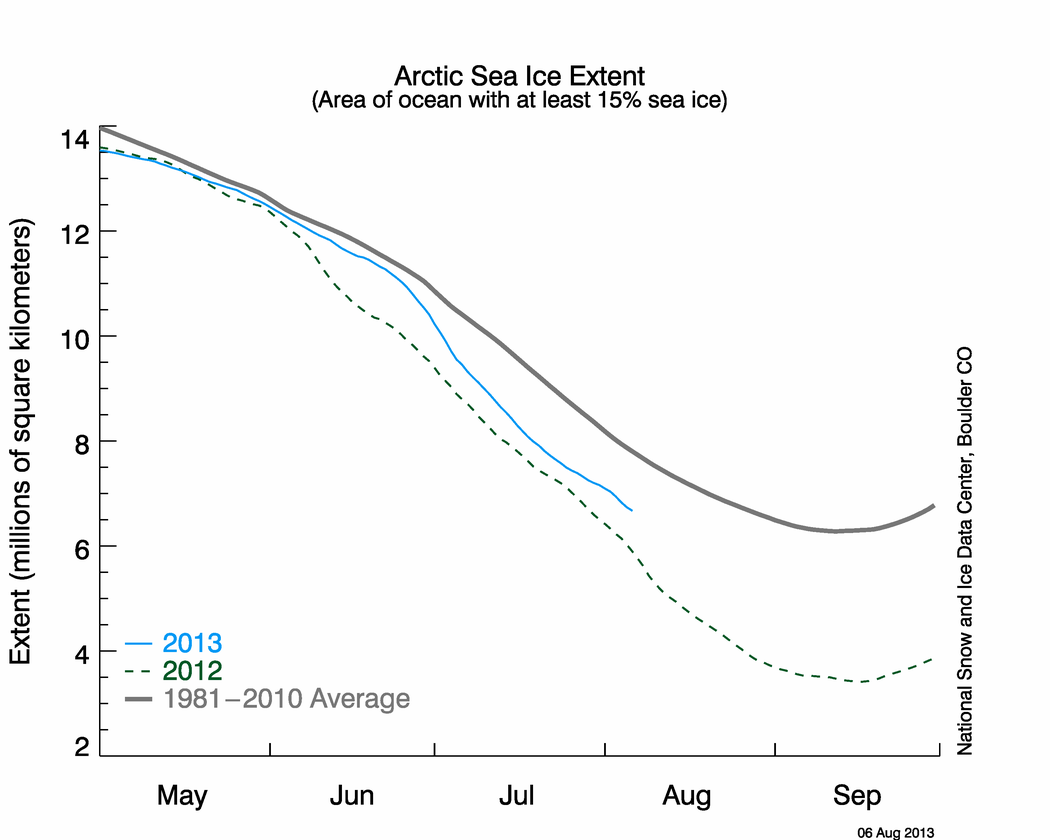
Arctic sea ice extent just dipped below January 2007 levels in the last few days, according to the daily time series from the National Snow and Ice Data Center:

The NSIDC notes that they are showing the data from 2007 on this figure since that year "went on to reach the lowest summer minimum in the satellite record."
The NSIDC also has an interesting 2008 Year-in-Review for cryosphere buffs. It explains why the ice stopped growing for a week in mid-December. It also has an interesting graphic comparing the Arctic sea ice extent in 2008 with 2007:
-
You can't violate the laws of physics
"The erroneous belief that stabilizing emissions would quickly stabilize the climate supports wait-and-see policies but violates basic laws of physics."
-- Dr. John Sterman, risk analyst at the Sloan School of Business, M.I.T.
-
Next stop for Obama team: EPA's endangerment finding

Stopped EPA from blocking California's effort to regulate tailpipe GHG emissions. Check!
Stopped a new coal plant. Check!
The next "stop" on the Obama Climate Action Train is the "endangerment finding" so the EPA can finally put a stop on greenhouse gases.
In Massachusetts [vs. EPA], the Supreme Court found that greenhouse gases (GHGs) are "pollutants" under the Clean Air Act; that EPA must determine whether GHGs emitted from new motor vehicles do or do not endanger public health or welfare, or supply a reason for not making this determination; and that, if EPA makes an "endangerment finding," it must issue regulations.
The key question: Can elevated levels of GHG concentrations be reasonably anticipated to endanger public health or welfare? Does the Pope buy papal indulgences carbon offsets?
This is not a tough call for a President who just said: "climate change, which, if left unchecked, could result in violent conflict, terrible storms, shrinking coastlines, and irreversible catastrophe." And for 1,000 years! Indeed, he campaigned on this very issue (see the October 16 post, "Obama to declare CO2 a dangerous pollutant").
In an email to EPA employees [PDF], Administrator Lisa Jackson wrote of "five priorities that will receive my personal attention" -- the first of which is "Reducing greenhouse gas emissions":
As Congress does its work [on global warming legislation], we will move ahead to comply with the Supreme Court's decision recognizing EPA's obligation to address climate change under the Clean Air Act.
Greenwire ($ub. req'd) has the full story:
-
Revkin has leading system dynamics expert Sterman on NOAA's 1,000-years-of-hell paper
I am a big fan of MIT's John Sterman, one of the world's leading experts on systems thinking.
In a post on "The Greenhouse Effect and the Bathtub Effect," Andrew Revkin notes that Sterman's work trying to reduce the biggest source of climate confusion is related to the new NOAA-led paper that I discussed here: Climate change "largely irreversible for 1000 years," with permanent Dust Bowls in the Southwest and around the globe.
The bathtub analogy is that while atmospheric concentrations (the total stock of CO2 already in the air) might be thought of as the water level in the bathtub, emissions (the yearly new flow into the air) are the rate of water flowing into a bathtub. We need to lower the level, not just the flow. A great video clarifying the issue is here. It is narrated by my friend Andrew Jones. If you want to play the simulation itself, go here.
Revkin got Sterman's comments on the paper, which I am reposting below:
-
Holmes Hummel on climate policy design
Holmes Hummel is a "Lecturer and Policy Specialist at the UC-Berkeley Energy Resources Group, and previously served as a Congressional Science Fellow focused on energy and climate policy development." That's from her bio. What's not on her bio is the fact that she's smarter than you and 10 of your smartest friends, combined.
She's put together a PowerPoint slideshow and taped a lecture titled, "U.S. Energy and Climate Policy on the Road Ahead," and it's worth your while to give it a read/listen. Find it under the "Recent Posts" section, here.