Uncategorized
All Stories
-
McKibben wonders if U.S. is mature enough to confront climate change.
Check out Bill McKibben’s essay in the latest Foreign Policy magazine. It’s full of straight talk about the reality of climate change, debunking plenty of the skeptics’ arguments along the way. For McKibben (a Grist board member, BTW), the real question is whether there’s sufficient will in the international community to take on the very […]
-
Natural gas utility to spend $6.6 million on conservation and efficiency efforts
This is cool news:
December 23, 2008 -- The Virginia State Corporation Commission (VSCC) today approved the Virginia Natural Gas (VNG) proposed conservation and ratemaking efficiency plan.
The plan calls for new energy conservation programs, coupled with a revenue adjustment mechanism, designed to assist customers in managing their energy costs.
As part of the plan, VNG will provide $6.6 million over three years in new conservation initiatives. VNG projects that customers who participate in these new programs, set to begin rolling out in early 2009, can significantly reduce their monthly natural gas usage.This is via NRDC, who shares this very cool map of decoupling programs across the nation:
-
Two questions for James Hansen
Following are two questions for James Hansen and Grist readers, relating to Dr. Hansen's tax-and-dividend proposal in his recent policy recommendations to Obama:
1. Would it not be advantageous to use dividends to give consumers an equity stake and interest in decarbonization?
This could be achieved by investing carbon tax revenue in renewable energy and clean technologies in exchange for equity, and distributing equity shares to the public on an equitable per-capita basis. The shares would yield dividends that increase -- not decrease -- as carbon is phased out.
2. Is tax-and-dividend fundamentally incompatible with cap-and-trade?
Many of the ills of cap-and-trade ("special interests, lobbyists, ...") are associated with free allocation, but allowance auctioning (which Obama favors) would be similar to a tax in terms of revenue generation and potential for consumer dividends. Moreover, an auction with a price floor would be equivalent to a carbon tax as long as there are sufficiently many allowances to satisfy market demand at the price threshold. (The price would only increase if the tax incentive is insufficient to achieve the cap.) A recognition of the commonality between carbon taxes and cap-and-trade could help overcome political barriers to action on climate change.
-
Battery makers come begging to Congress
American lithium-ion battery makers, including giants like 3M, are banding together to try to extract a few billion dollars from Congress so they can build a shiny battery manufacturing plant that, for whatever reason, they aren't willing to spend their own money on. This latest handout request is a fairly dubious idea that is nevertheless likely to appeal to a lot of people on grounds of both economic nationalism and a vague aura of environmental goodness.
Whatever you think of the request, though, let's at least all agree not to put up with this:
"We don't want to go from being dependent on Middle East oil to Asian batteries."
- Jeff Depew, chief executive of Imara, a start-up that makes lithium-ion batteriesOil is a viscous substance, finite in quantity, concentrated in hard-to-reach pockets in certain corners of the globe. These properties allow a relatively small handful of countries to exert some imperfect control over its supply. Batteries differ from oil in just about every important way.*
Depew has an obvious interest in promoting American battery manufacturers. But surely savvy outsiders understand that a competitive, low-cost industry, whether centered in Asia or anywhere else, is good for everyone who needs batteries?
Recently, Andrew Grove, former chairman of Intel Corp., began urging the chip maker to explore whether it could play a role in battery manufacturing. Mr. Grove and others say U.S. companies must step up efforts to produce advanced batteries for the country's car industry or America will end up trading its dependence on foreign petroleum for dependence on foreign-made batteries.
Oh, well. The industry consortium is organized by Jim Greenberger, a lawyer specializing in clean tech. In case you're not scared enough yet of the Asian battery menace, Greenberger spells it out:
-
Scientists and journalists team up to get the climate story straight
What do Weather Channel seductress Heidi Cullen, Steven "wedge" Pacala, former TIME writer Michael Lemonick, soon-to-be NOAA head Jane Lubchenco, and Grist founding board member Ben Strauss have in common?
They're all part of an new project called Climate Central. It was mentioned briefly in this recent post about Lubchenco, but it's so interesting and innovative that it merits further digital ink -- which I was going to provide myself, but Curtis Brainard of the Columbia Journalism Review beat me to it.
Climate Central is a hybrid team of nearly two dozen journalists and scientists -- spread between a main office in Princeton, New Jersey and a smaller one in Palo Alto, California -- who work side by side on stories for television, print, and the Web. Relying upon a non-profit business model that is similar to The Center for Investigative Reporting, ProPublica, and others, Climate Central pitches its work to local and national news outlets, looking for collaborative editorial partnerships. It also makes its various experts, many of who are still affiliated with major research institutions, available as primary sources. The goal is to "localize" the story around regions, states, or even cities, in order to highlight the various and particular ways that changes in climate are affecting people's daily lives.
As Brainard points out, this new effort comes at a time when traditional news outlets are struggling to produce original environment-related content (many, like CNN, have axed their science and environment teams).
Whether Climate Central will be, as communications scholar Matthew Nisbet puts it, "the future of science journalism -- non-profit partnerships providing independent and syndicated science coverage," or whether it will falter under conflicts of interest (real or perceived), remains to be seen.
But it's great to see scientists stepping up to the plate -- or if you'll indulge a double-edged pun -- to the green screen.
-
Despite continued shenanigans, prospects looking up for Mass. wind project
The final environmental impact statement on Cape Wind was supposed to hit the press in December, but it's been put back another month thanks to the delay tactics of the 'antis' in Congress, this time notably Rep Jim Oberstar (D-Minn) who was recently singled out in Grist as an outstanding advocate for progressive stances on energy and transit, but only in Minnesota, I guess. The Providence Journal takes him and those he probably acted on behalf of to task here:
This is another win for the Kennedys, who have summer houses on Nantucket Sound, and Bill Koch, a fossil-fuel billionaire and a hardball political player and paymaster, and the leader of the anti-wind-farm group the Alliance to Protect Nantucket Sound ... That the vast majority of Massachusetts residents support Cape Wind seems not to matter at all ...
The FEIS is expected to be very positive on the proposal, opening the way to who knows what next hurdle the Alliance will erect, 7 years now after Cape Wind was first proposed.
-
-
World's biggest solar power tower to open in Spain
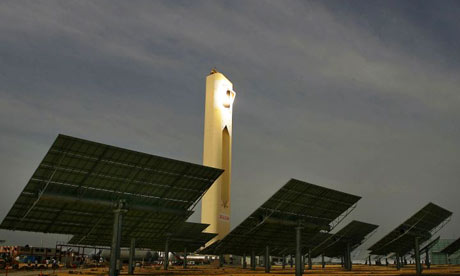
The world's biggest solar tower will open early this year in Spain. The race for leadership in the next generation of solar power is taking off.
The U.K. Guardian reports that in the desert 20 miles outside Seville, the Spanish company Abengoa will be deploying over 1,000 sun-tracking mirrors -- each "about half the size of a tennis court" -- to superheat water to 260°C to drive a steam turbine and generate 20MW of electricity.
Concentrated solar power (CSP) technology, as it is known, is seen by many as a simpler, cheaper and more efficient way to harness the sun's energy than other methods such as photovoltaic (PV) panels.
Spain is placing a huge bet on CSP to meet their renewable energy and carbon targets:
-
Who do we repay for the pollution from which we have benefitted?
If I buy bread from you, when you want to sell it to me, and we agree on a price, that's a deal between the two of us. Now imagine that you getting up early to bake bread wakes two people who would rather sleep in. They are not a factor in our deal -- they are "external" to our market exchange and any effect on them is an "externality" we have ignored in agreeing on our price. The same logic holds for the greenhouse gases your ovens generated when you baked the bread. That contribution to climate change is an "environmental externality."
How many of those did you create today?
-
Friday music blogging: Murs
ListenPlay "The Science," by MursMurs is a prolific underground rapper out of L.A. He's been around for over 15 years now, as part of at least five hip-hop groups and, recently, as a solo artist. He's something of a legend in the indie rap world.
His latest album, Murs for President, is a doozy. In particular, this song, "The Science," seems to sum up basically everything there is to know about rap. I guess there aren't many hip-hop fans around here, but this one's worth listening to for the lyrics alone.
