Uncategorized
All Stories
-
More than a quarter of U.S. bird species are endangered
It’s not a good time to be a bird in the U.S. The Watch List 2007, published by the National Audubon Society and American Bird Conservancy, finds that 178 bird species in the continental U.S. and 39 in Hawaii are vulnerable to extinction. That’s almost all of Hawaii’s non-migratory native birds and more than a […]
-
Gray wolves in Southwest aren’t faring well
Mexican gray wolves are running into all kinds of trouble in the American Southwest. The wolves were hunted to the brink of extinction in the early 1900s; reintroduction began in 1998, and the U.S. Fish and Wildlife Service originally predicted that by now there would be a self-sustaining population of 100 wolves and 18 breeding […]
-
FEMA sets deadline for Katrina trailer park closures
What’s worse than being a storm victim housed in a formaldehyde-soaked trailer that makes you sick? How about getting kicked out of said dwelling? FEMA has announced an accelerated schedule for moving 3,700 families out of trailers set up to house Hurricane Katrina refugees, pledging to be “with them every step of the way” as […]
-
EPA sued by 12 states over relaxed toxic-chemical rule
The U.S. EPA’s moves to relax the nation’s toxics reporting rule will not go unchallenged. Twelve states have announced they’re suing the agency over rule changes to the Toxics Release Inventory that allow companies to file less-informative reports and escape reporting if they release less than 5,000 pounds of toxic chemicals, up from the previous […]
-
An influx of jellies in strange places is not so hard to explain
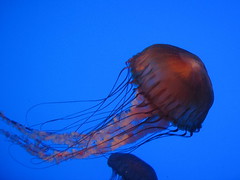 Over Thanksgiving, I came across a news story that may represent the perfect storm of issues plaguing the oceans. A salmon farm in Northern Ireland was wiped out by a huge swarm of mauve stingers (Pelagia noctiluca), a jelly usually found in the warm Mediterranean sea.
In a 35-foot-deep, 10-square-mile swath, the jellies stung and killed 100,000 salmon before workers could reach the pens. It must have been quite a sight. The jelly's scientific name means "light of the sea," and the creatures give off an eerie, purple-red glow. I can only imagine that, at that scale, the sea looked possessed.
The incident may seem strange and isolated, but it touches on three major issues facing the oceans.
-
Chinese officials deny Three Gorges Dam role in landslide
Since a landslide killed 31 people near China’s Three Gorges Dam last week, officials have been rushing to cover their bums. While acknowledging that the massive energy project’s effect on geologic activity must be monitored, a project bigwig pledged that “there will not be any major damage to the life and property of the people […]
-
U.N. hails success of billion-tree planting program
Nature-lovin’ nations around the world planted more than 1 billion trees during 2007, meeting a kinda arbitrary goal set by the U.N. last November. The effort, boosted by Ethiopia’s planting of 700 million trees, “is a further sign of the breathtaking momentum witnessed this year on the challenge for this generation — climate change,” said […]
-
Watch presidential candidates discuss climate and energy
On Nov. 17, 2007, Grist cosponsored the first-ever presidential candidate forum focusing on climate change and energy policy. Hillary Clinton, John Edwards, and Dennis Kucinich attended and spoke in-depth about their green platforms. (All Democratic and Republican presidential candidates were invited to attend.) Watch the forum below, or read the transcript [PDF]. For more information […]
-
Commission on bluefin conservation comes up empty again
The following is a guest essay from Carl Safina, the oceans' most articulate defender and director of the Orion Grassroots Network member group Blue Ocean Institute. His books include Song for the Blue Ocean, Eye of the Albatross, and Voyage of the Turtle. His blog also is a must-read.

-----
The story goes like this: It's one of the largest, fastest, most gorgeous fish in the sea. Unfortunately, its extraordinary warm-bloodedness makes its muscle delicious to the strange seafood-loving creatures that live on land. The value of bluefin tuna meat goes up due to global demand for sushi and sashimi. As the price goes up, fishing increases. Too many fish are caught and the population collapses. Over the past 50 years, bluefin fisheries have collapsed off Brazil, in the North Sea, and recently off the eastern U.S. and Canada.
The Commission tasked with managing Atlantic bluefin fisheries is completely broken. The 43-nation International Commission for the Conservation of Atlantic Tunas met this month in, appropriately enough, Turkey, to discuss the fate of bluefin tuna in the Atlantic. Usually referred to by its acronym ICCAT -- pronounced eye-cat -- it should be called instead ICCAN'T. Or, keep the acronym and change its name to International Conspiracy to Catch All Tuna.
-
Canada sets aside huge tracts of land for protection
The Canadian government plans to set aside 25.5 million acres of northern boreal forest and tundra as protected land, off-limits from resource development. The total acreage (hectarage?) of the protected area is 11 times the size of Yellowstone National Park — or, in Canadian, about twice the size of Nova Scotia and more than five […]

