Uncategorized
All Stories
-
![]()
![]()
How South American biofuels are gaining steam, and why that freaks the U.S. out
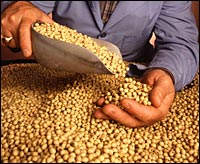
In his drab office in the fashion-obsessed chaos of downtown Buenos Aires, Argentina, Edmundo Defferrari cuts a farmhand’s figure in a corporate man’s world. Soy is growing up down south. Photo: USDA/Keith Weller. The 28-year-old industrial engineer, in cap, jeans, and scruffy beard, taps through a PowerPoint presentation choked with graphs, statistics, and cartoon renderings […]
-
The Arctic Shuffle
One:
One questioner pointed out the tepid support for ANWR from oil companies, "leading some on Wall Street to say this is more of a political issue than an energy economics issue." Another person pointed out that Norton's forecast of a million barrels a day from ANWR was "somewhat underwhelming."
If geologists were to decide that there were only three thimbles of oil beneath area 1002, there would still be something to be said for going down to get them, just to prove that this nation cannot be forever paralyzed by people wielding environmentalism as a cover for collectivism.
It's not about oil any more, it's about political power, and if they have to piss on one of the country's last untouched places to prove their wankers are bigger, they'll do it.
-
Perilous
New York City nonprofit Transportation Alternatives has produced this crazy 60-second video of a bicyclist trying to navigate a bike lane in Manhattan. Not for the faint of heart.
If you're into the whole NYC-biking-video thing, the New York Bicycling Coalition has a whole list of short video clips from around the city.
But first and foremost check out the TransAlt one, which they're using to lobby for better bike lanes.
-
Turn the Meat Around
Conservationists pay to end hunting in western Canada wilderness The Raincoast Conservation Foundation opposes sport hunting, and it’s putting its money where its mouth is: It purchased key hunting rights to a prime wilderness area along the coast of British Columbia, and plans to end sport hunting there for good. In late November, the group […]
-
Stickin’ It to the Pan
DuPont to pay $16.5 million for hiding chemical’s risks DuPont will pay $16.5 million in a settlement with the U.S. EPA for failing to report information on health and environmental risks of perfluorooctanoic acid (PFOA), a chemical used to make Teflon and other plastics. Greenies are ticked that the company won’t be forced to admit […]
-
Stevens
Yesterday I posted some of an article from Congressional Quarterly about the mad rush by some Congressfolk -- particularly Sen. Ted Stevens (R-Alaska) -- to get Arctic Refuge drilling passed this year. They sense that this is their last chance.
I really encourage you to go read it if you haven't already. It's quite eye-opening.
Stevens is aiming to put Gulf hurricane relief and refuge drilling together in the same bill (either the budget bill or the defense appropriations bill), so lawmakers have to vote for both or against both.
"It's going to be awfully hard to vote against [hurricane aid]," Stevens said. "If it's in there, maybe people will vote with me on ANWR."
Take a moment and really think that over.
Stevens is talking about holding aid to desperately needy people hostage in order to shove through a drilling provision contrary to the repeatedly expressed preferences of the majority of Americans.
By now this kind of stuff barely raises an eyebrow -- Stevens obviously feels no shame openly discussing it -- but that doesn't make it any less venal.
-
Bill Gates bets on ethanol
I don't think Tom Philpott is going to be happy about this. Industrial corn, as far as the eye can see ...
-
Interactive map identifies areas of imminent extinction
 Researchers have identified 595 sites for species protection in a new interactive map. Representing more than a dozen major conservation groups, collaborators on the map were able to pinpoint areas where extinction is a question of when, not if.
 Each spot on the map represents either the only place an endangered species is found or a spot where 95 percent of the species' population is found. Almost 800 endangered species are listed with the map's danger spots, though they include only birds, mammals, amphibians, conifers, and some reptiles, as others have yet to be studied or identified.
The map appears to be the first major project of the Alliance for Zero Extinction, a global coalition of biodiversity-minded organizations.
-
Ford kudos
Say what you will about the fuel-efficiency of their vehicle fleet -- it looks like Ford did the right thing this time.