Last week, the U.N. Permanent Forum on Indigenous Issues released urgent calls to action, including a pause on fast-tracked critical mineral projects and increased funding for Indigenous climate projects. But those recommendations come as the Forum itself is facing an existential crisis.
For 25 years, the Forum has been the leading United Nations body representing Indigenous peoples, but that status has not always translated to policy change by member states or the U.N. itself. Growing questions about the Forum’s effectiveness also come amid budget cuts at the U.N., Trump’s rejection of multilateralism, and ongoing efforts to streamline U.N. processes. These intersecting challenges are all threatening to push the Forum, and the causes Indigenous representatives bring to it, even further toward the margins.
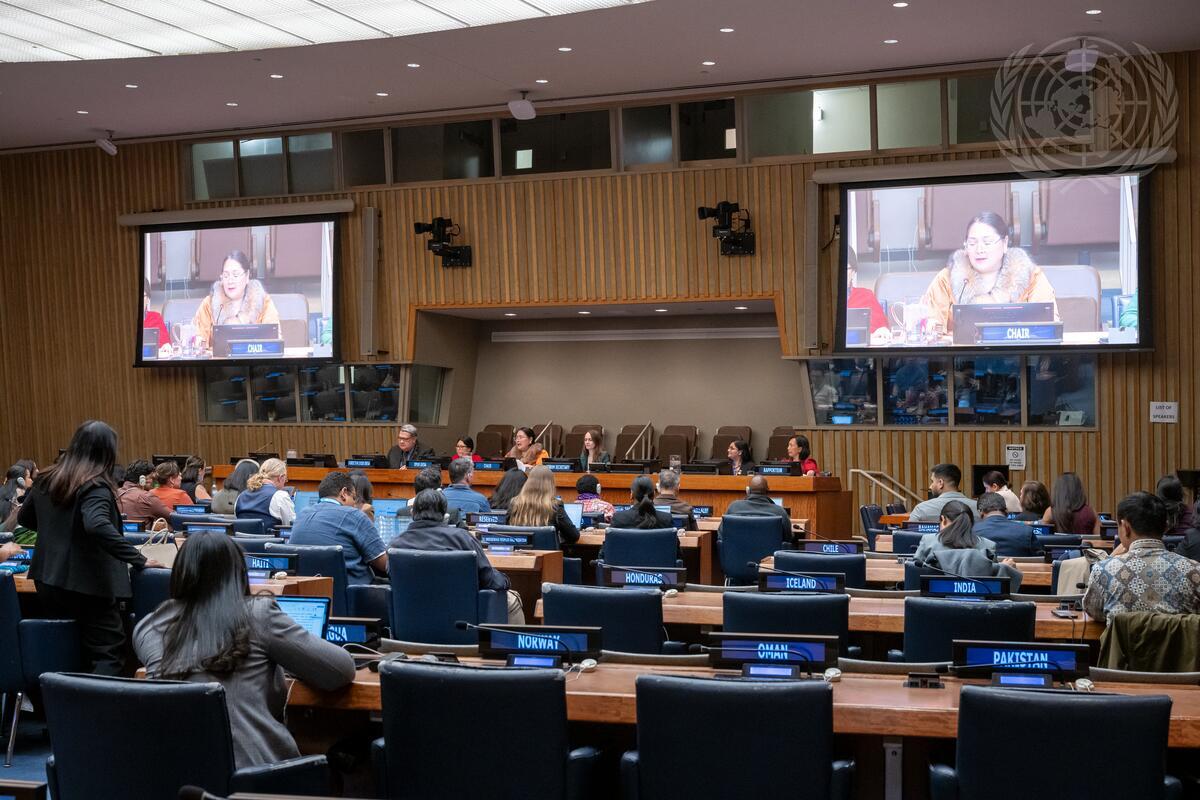
“For us, climate change is not a distant threat. It is a present and lived human rights crisis,” Aluki Kotierk, who is Inuk from Canada and current chairperson of the Permanent Forum, said Friday at the conclusion of the Forum’s two-week annual meeting in New York City.
The Forum’s recommendations reflect discussions and research conducted by hundreds of Indigenous delegates and experts over the past year. They join more than 1,000 recommendations issued by the Forum since it first began to meet, many of which Indigenous advocates deem critical to their survival. But state governments often blatantly ignore them.
A new “Systemic Assessment” report by a group of current and former members of the Permanent Forum underscores this problem. “While UNPFII has succeeded in establishing itself as a visible and legitimate global platform, questions remain regarding its ability to translate dialogue, recommendations, and knowledge production into tangible outcomes for Indigenous peoples on the ground,” the report said. “The proliferation of recommendations has not been matched by corresponding mechanisms for implementation, follow-up, and accountability.”
The report underscores the limitations of the Forum, which makes recommendations on behalf of Indigenous peoples to U.N. agencies and member states, but has been hamstrung by funding cuts and the willingness of other U.N. agencies and global leaders to listen. Annual funding for the U.N. Trust Fund on Indigenous Issues, which helps the Permanent Forum carry out its mission, is at a historic low, falling from more than $300,000 in 2021 to less than $50,000 in 2026. Currently, only three U.N. member states contribute to the fund, down from nine member states in 2006.
The drop in funding reflects a broader liquidity crisis at the U.N. driven in part by late payments from key members like the U.S. and China. Kotierk said the lack of funding has led to staff reductions at the Forum, shorter meeting times, and fewer interpretation services.
That didn’t stop the Forum from issuing bold calls to action on Friday, including urging U.N. member states to seriously consider international court rulings to mitigate climate change by 2027, and to legally protect Indigenous lands, especially land belonging to uncontacted tribes. The Forum published multiple reports Friday with recommendations ranging from asking member states to develop legal protections for nomadic Indigenous communities to urging the Green Climate Fund and Global Environment Facility — multibillion-dollar government-funded global funds — to provide direct funding to Indigenous peoples to mitigate climate change.
Eirik Larsen, who attended this year’s Forum on behalf of the Saami Council, urged Forum members to consider capping the number of recommendations to maximize their effectiveness, and to ask member states and U.N. entities to report back on whether they’ve implemented recommendations from previous years.
Larsen said that despite the need for improvement, he keeps returning to the Forum because it’s an important arena for discussing critical issues at the international level. “It’s a unique venue for Indigenous peoples to interact directly with member states,” he said.
The systemic assessment of the Forum found that many Indigenous survey respondents agreed with Larsen’s appreciation of the Forum, seeing it as “a place of visibility, exchange, and recognition,” the report found. “Yet a large number also characterize it as overly performative, a ‘talk shop,’ or a space in which testimony is heard but not translated into meaningful change.”
To Ghazali Ohorella, international relations and Indigenous rights advisor of the Alifuru Council, the assessment could not have been issued at a worse time. Just a year ago, the U.N. embarked on a process of restructuring, which could lead to U.N. bodies like the Forum being consolidated or eliminated. Today’s Permanent Forum is the result of decades of advocacy by Indigenous peoples for a dedicated space within the U.N., which, by design, privileges the voices of recognized state governments and doesn’t allow Indigenous peoples who remain under colonial rule to vote in the General Assembly. Ohorella is worried that the report — which is based on a survey of 200 respondents, rather than the thousands of attendees over the past 25 years — could give ammunition to the Forum’s detractors. “It allows them to say: ‘See, even Indigenous peoples themselves identified problems with the Forum. Retire it,’” Ohorella said.

One of the most valuable aspects of the Forum is its ability to elevate issues that otherwise might be ignored, like Indigenous health, which was the main topic of this year’s gathering. “There is no health without land. The well-being of Indigenous peoples is inseparable from our lands, waters, and territories,” Kotierk said in her closing speech on Friday. “To restore health, we must advance decolonization.” This year, the Forum’s official recommendations urged U.N. member states to disaggregate health data on Indigenous peoples by 2027, and “to treat prolonged climate-induced displacement of Indigenous peoples as a health emergency.”
Kotierk said that the Forum has been instrumental in influencing global policies. “This Forum has consistently elevated what the world too often ignored. It has brought visibility to the crisis of Indigenous peoples’ languages, affirmed the rights and leadership of Indigenous women and girls, and ensured that Indigenous peoples’ voices are not only present — but heard — in international decision-making,” Kotierk said.
Yet despite its importance, it’s not easy for Indigenous advocates to participate in the Permanent Forum. Structural barriers that limit participation include challenges obtaining visas — which have worsened under the Trump administration — lack of awareness about the Forum and how to register, and the high cost of travel. In the systemic assessment report, survey respondents suggested the Forum consider holding regional, national, and local gatherings “that do not force all meaningful participation through a single annual gathering in New York.”
Mariah Hernandez-Fitch, a first-year law student at Emory University and a member of the United Houma Nation, attended the Forum for the first time as a youth fellow for the Ban Ki-Moon Foundation. Hernandez-Fitch has never been abroad and this was her first time participating in a global Indigenous space. “It was beautiful to see people not all in suits,” she said. “Seeing people in their cultural attire, their formal wear, that was very exciting to me.” She listened to someone from Vietnam speak about how climate change was affecting their community and was moved by how similar their experience was to her family’s experience with rising seas in southeastern Louisiana.
But she also felt overwhelmed by the process, confused by when the side events were happening, and ended up not delivering a planned statement, in part because she was intimidated by the process. “There’s rules, but if you don’t know about them, you do feel out of place even in a space that is for Indigenous peoples,” she said.
Still, now that she’s back in New Orleans, Hernandez-Fitch can see herself returning to the Forum. “I can see myself applying the law and my experience into those spaces,” she said. “I could see myself not being scared of making an intervention.” It helped to meet other Indigenous youth who care just as much as she does about making a difference. “There’s a communal kind of excitement and I feel excited for the future.”
Conversations about how to make the Forum more effective will continue at next year’s gathering, which will be held from May 10 to 21 and focus on global progress on the United Nations Declaration on the Rights of Indigenous Peoples.