Latest Articles
-
Michigan governor on verge of important announcement on coal and clean energy?
For several years Michigan has been pursuing a dual-track energy strategy: more coal plants and more clean energy. But as forecasts show demand slacking, energy imports draining the budget, and power plant costs rising, the calculus may be shifting.
Keith Schneider reports that Gov. Jennifer Granholm is on the verge of a big announcement:
Senior Granholm administration officials declined to be specific about what they said would be a "major statement," but indicated the governor might support a moratorium on approving new coal plants while the state formulates CO2 regulations--something coal opponents around the state have pushed for with lawsuits, petitions to the governor, and a steady barrage of press and grassroots events for more than a year. Or, some officials said, the governor might announce an outright ban on new coal plants.
Putting Rust Belt states in the vanguard of the clean energy shift is a powerful thing, symbolically, politically, and economically. Let's hope Granholm goes big.
-
Some ideas for green resolutions that are achievable, meaningful, and maybe even novel
New Year's resolutions, as we all know, are almost entirely pointless -- made in one breath, forgotten in the next. So in that spirit of general futility, I offer a few ideas for green resolutions that, either through novelty or just ease of use, may inspire more than a passing commitment. Please leave your own ideas below.
Idea #1: help make "livable streets" a reality in your community
All politics is local, said Tip O'Neill, but most of us still don't pay much attention to local politics. Issues at a community level are often driven by the triumvirate of homeowners, business owners and car owners -- good people, no doubt, but narrow in their interests.
This won't change if you don't help make it change. Happily, a thriving network of community organizers is doing great work to promote a people- and environment-centered development agenda, ranging from this new bus system in Cleveland to this bike-sharing program in Tulsa to this massive street festival in New York.
Support their good work! A few ideas for getting involved:
- Get smarter about development issues by spending some time with the great resources at the Livable Streets Network. Subscribe to their blog, subscribe to an affiliated blog focused on your community, watch their films, or read and contribute to their wiki.
- Find or start a local group using the Livable Street Network's online tools.
- Get involved with a local organization like Transportation Alternatives (based in New York). Or support them financially by attending some of their fun events.
Idea #2: eat more plants
-
Scientists and journalists team up to get the climate story straight
What do Weather Channel seductress Heidi Cullen, Steven "wedge" Pacala, former TIME writer Michael Lemonick, soon-to-be NOAA head Jane Lubchenco, and Grist founding board member Ben Strauss have in common?
They're all part of an new project called Climate Central. It was mentioned briefly in this recent post about Lubchenco, but it's so interesting and innovative that it merits further digital ink -- which I was going to provide myself, but Curtis Brainard of the Columbia Journalism Review beat me to it.
Climate Central is a hybrid team of nearly two dozen journalists and scientists -- spread between a main office in Princeton, New Jersey and a smaller one in Palo Alto, California -- who work side by side on stories for television, print, and the Web. Relying upon a non-profit business model that is similar to The Center for Investigative Reporting, ProPublica, and others, Climate Central pitches its work to local and national news outlets, looking for collaborative editorial partnerships. It also makes its various experts, many of who are still affiliated with major research institutions, available as primary sources. The goal is to "localize" the story around regions, states, or even cities, in order to highlight the various and particular ways that changes in climate are affecting people's daily lives.
As Brainard points out, this new effort comes at a time when traditional news outlets are struggling to produce original environment-related content (many, like CNN, have axed their science and environment teams).
Whether Climate Central will be, as communications scholar Matthew Nisbet puts it, "the future of science journalism -- non-profit partnerships providing independent and syndicated science coverage," or whether it will falter under conflicts of interest (real or perceived), remains to be seen.
But it's great to see scientists stepping up to the plate -- or if you'll indulge a double-edged pun -- to the green screen.
-
Obama's radio address, 03 Jan 2008: renewable energy, no transit
Obama's radio address, on the "American Recovery and Reinvestment Plan," mentions doubling renewable energy and energy efficiency renovations; it does not mention public transit. Lots of bipartisan talk, in the runup to the great kickoff of Jan. 20.
-
Despite continued shenanigans, prospects looking up for Mass. wind project
The final environmental impact statement on Cape Wind was supposed to hit the press in December, but it's been put back another month thanks to the delay tactics of the 'antis' in Congress, this time notably Rep Jim Oberstar (D-Minn) who was recently singled out in Grist as an outstanding advocate for progressive stances on energy and transit, but only in Minnesota, I guess. The Providence Journal takes him and those he probably acted on behalf of to task here:
This is another win for the Kennedys, who have summer houses on Nantucket Sound, and Bill Koch, a fossil-fuel billionaire and a hardball political player and paymaster, and the leader of the anti-wind-farm group the Alliance to Protect Nantucket Sound ... That the vast majority of Massachusetts residents support Cape Wind seems not to matter at all ...
The FEIS is expected to be very positive on the proposal, opening the way to who knows what next hurdle the Alliance will erect, 7 years now after Cape Wind was first proposed.
-
Bill Richardson removes himself from consideration for commerce secretary
Bill Richardson has withdrawn his name from consideration for the post of commerce secretary. The New Mexico governor says he is concerned that a grand jury investigation into a company that has done business with his state might delay the confirmation process.
Obama tapped Richardson to head the Commerce Department last month, to the delight of enviros who praised his strong record on climate and energy issues.
"Let me say unequivocally that I and my Administration have acted properly in all matters and that this investigation will bear out that fact," he said in a statement. "But I have concluded that the ongoing investigation also would have forced an untenable delay in the confirmation process."
Obama said in a statement that he is accepting the decision "with deep regret." "Governor Richardson is an outstanding public servant and would have brought to the job of Commerce Secretary and our economic team great insights accumulated through an extraordinary career in federal and state office," said Obama.
"It is a measure of his willingness to put the nation first that he has removed himself as a candidate for the Cabinet in order to avoid any delay in filling this important economic post at this critical time," Obama continued. "Although we must move quickly to fill the void left by Governor Richardson's decision, I look forward to his future service to our country and in my administration."
Obama made no mention of possible new nominees for the post.
-
Markey to replace Boucher as chair of Energy and Air Quality Subcommittee?
Congressional Quarterly Online reported last week:
The two senior House Democrats with jurisdiction over energy and telecommunications policies could swap gavels in the 111th Congress, with potentially dramatic implications for the shape of climate change legislation expected next year.
Since 2007, Rick Boucher of Virginia, the Energy and Commerce Committee's fourth-ranking Democrat, has led the Energy and Air Quality Subcommittee, which has taken the lead role in crafting legislation to address global warming.
But Boucher said in an interview Tuesday that he expects Edward J. Markey of Massachusetts, No. 3 among committee Democrats in seniority, to bid for the subcommittee chairmanship. Boucher said he would "respect that decision" and stake his own claim for chairmanship of Markey's Subcommittee on Telecommunications and the Internet.
"I'm awaiting his decision," Boucher said. Markey has not yet made up his mind, a spokesman said.This would be almost as big a deal as Waxman defeating Dingell for committee chair. Just as Dingell-Boucher co-authored a House climate bill last session, one would expect that if this change occurs, Waxman and Markey would co-author a House Bill in this session. And it certainly wouldn't be as lame (see "Q: Does Dingell-Boucher have meaningful auctioning of CO2 permits before 2026?").
The story continues:
-
-
World's biggest solar power tower to open in Spain
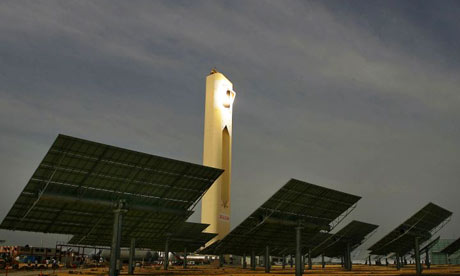
The world's biggest solar tower will open early this year in Spain. The race for leadership in the next generation of solar power is taking off.
The U.K. Guardian reports that in the desert 20 miles outside Seville, the Spanish company Abengoa will be deploying over 1,000 sun-tracking mirrors -- each "about half the size of a tennis court" -- to superheat water to 260°C to drive a steam turbine and generate 20MW of electricity.
Concentrated solar power (CSP) technology, as it is known, is seen by many as a simpler, cheaper and more efficient way to harness the sun's energy than other methods such as photovoltaic (PV) panels.
Spain is placing a huge bet on CSP to meet their renewable energy and carbon targets:
-
Studies show mono-cultures, GMOs, and globalization are problems, not solutions
With the arrival of 2009, the United Nations Food and Agriculture Organization (FAO) notes nearly a billion people a day go hungry worldwide. While India supplies Switzerland with 80 percent of its wheat, 350 million Indians are food-insecure. Rice prices have nearly tripled since early 2007 because, according to the International Rice Research Institute, rice-growing land is being lost to industrialization, urbanization, and shifts to grain crops for animal feed.
