

Latest Articles
-
House Republicans’ magical thinking on oil prices
Wow. House Republicans are now saying that their hissy fit cum frat party on the floor is lowering the price of oil. Not for the first time, I have to wonder: do they believe this? Do they really indulge in this kind of magical thinking? The oil price issue is an interesting political case. It’s […]
-
The shape of the oil crisis
This is the first in a series on how we can build an energy future based on our best science and no longer critically dependent upon exhaustible and polluting fossil fuels.
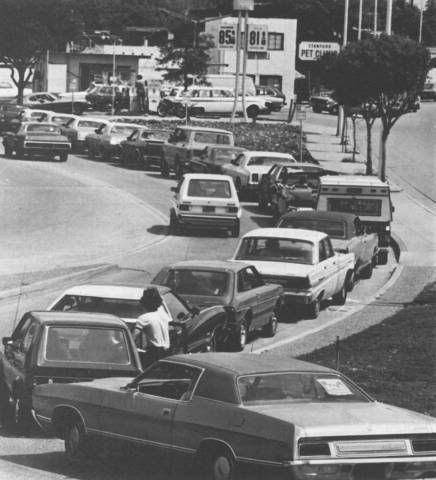 Lines formed at gas stations during the 1973 OPEC oil embargo.
Too often, discussions of our future energy system simply reflect the current array of political forces in Washington or the novelty-hungry attention of the media and not the long-term viability of technologies and proposed solutions. As the price of oil is the most pressing issue from a short-term perspective, I am starting this series of policy briefs with how the energy used in transport on land can be transferred from liquid fossil fuels to cleanly generated electricity; in the second part I will address how we can create the conditions for powering the grid in the post-fossil fuel era.
Oil supply: speculation and long-term trends
We can all now agree that it has been the ultimate in shortsightedness to continue building a society founded upon burning ever increasing amounts of easily exhaustible resources. Not only is it highly visible, petroleum at the pump, but, behind the scenes, the vital energy for agriculture and freight transport that now depend upon the output of oil wells, mostly located abroad. In the U.S. in particular, we have had a 25 year hiatus in facing this reality through political, cultural, and corporate resistance to change, which means that Americans are starting the race far behind the starting line. In addition, as it turns out, the burning of these fossil resources alters the global climate and creates local pollution and health problems. There are other ills and challenges in our world but currently fossil fuel addiction is one of the most pressing but also, fortunately, soluble problems.
-
Stars align for Edge of Darkness
Mel Gibson: Hey, De Niro, you wanna star in an eco-thriller with me? Robert De Niro: You talkin’ to me? Gibson: Yes, I’m talkin’ to you. It’s called Edge of Darkness; it’s based on that BBC miniseries. Are you familiar with it? De Niro: You talkin’ to me? Gibson: Yeah, it’s about this homicide detective […]
-
Big Auto backs off support for tighter fuel-economy standards
New fuel-economy rules coming down the pike are likely to displease pretty much everyone, if a public hearing held Monday is any indication. In the current proposal from the National Highway Traffic Safety Administration, auto manufacturers must achieve a fleet-wide average fuel economy of at least 31.6 miles per gallon by 2015 — a jump […]
-
The beginnings of a continentalized global economy
Your faithful blogger was surprised to find himself representing part of the environmental blogosphere in a New York Times article on Sunday, "Shipping Costs Start to Crimp Globalization." It's very much worth reading, and prior to writing the article the reporter, Larry Rohter, talked with me about my first installment in this series, "Globalization death watch, Part I."
In his article, after noting the recent collapse of global trade talks, Rohter writes:
Some critics of globalization are encouraged by those developments, which they see as a welcome check on the process. On environmentalist blogs, some are even gleefully promoting a "globalization death watch."
Now, look at the dictionary.com definition of "gleeful":
full of exultant joy; merry; delighted.
Well, maybe the births of my sons called forth such feeling, but I'm not usually full of exultant joy, particularly when I think about global crises.
However, Larry Rohter may be forgiven his choice of words, considering the title of the blog post. I and, if I may be so bold as to speak for some other environmental bloggers, others think that the decline, even death of globalization would be a good thing. But just as the rise of globalization led to much suffering, so will its decline, and that's certainly not something to be "gleeful" about. To paraphrase Barack Obama's pithy phrase about getting out of Iraq, "we've got to be as careful getting out as we were careless getting in."
I'd like to go over some of the points Rohter highlights, and then explain later in the post why there is a better alternative to globalization.
-
Enviros unhappy with Obama’s offshore-drilling shift, but pleased with his energy plan
Many in the environmental community are annoyed by Barack Obama’s change of position on offshore drilling, even while they applaud his comprehensive energy plan. The Democratic candidate had staunchly opposed new drilling on the outer continental shelf, but then shifted his position on Friday to say he would be open to some drilling if it […]
-
Gorilla census finds 125,000 more western lowland gorillas than expected
A new gorilla census in the Republic of the Congo has found about 125,000 more western lowland gorillas than expected living in the northern part of the Montana-sized country, effectively doubling the known population of the species. Western lowland gorillas are one of four gorilla subspecies, all of which are in danger of extinction. “These […]
-
The Washington Post’s Joel Achenbach doesn’t understand basic climate science
Repeat after me, Joel: "Global warming makes the weather more extreme." If even the Bush administration accepts that basic fact of climate science, shouldn't you?
I used to like Achenbach's cutesy science pieces, but his knowledge of climate science is about one or two decades old, as evidenced by his major story in The Washington Post, "Global Warming Did It! Well, Maybe Not." It is a typically uninformed journalistic "backlash" piece whereby a reporter creates a straw man and then sets it on fire.
Achenbach is trying to seem reasonable by complaining that the next time we get a big hurricane, "some expert will tell us that this storm might be a harbinger of global warming." Uhh, I hate to break this to you Joel, but global warming doesn't need a "harbinger." It has been here for decades.
In that sense, your article is not a harbinger of global warming denial, since deniers have been pushing back against the "global warming causes extreme weather" story for years, browbeating the media into downplaying the connection. You really should read your fellow journalist Ross Gelbspan's long discussion of this in his great 2004 book, Boiling Point. Achenbach writes:
-
‘Major discovery’ from MIT unpractical, and ignores present advances in solar baseload
I have gotten bombarded by too many people asking me if the story headlined above is true. It isn't. Not even close.
Science magazine, which published the supposedly "major discovery" by MIT's Daniel Nocera, headlined their story, "New Catalyst Marks Major Step in the March Toward Hydrogen Fuel" ($ub. req'd). Doh! But who needs a major step towards hydrogen?
And Science seems to be having problems with the laws of physics, as we'll see. I thought I had explained this to Scientific American, but given their puff piece -- the findings "help pave the way for a future hydrogen economy" -- I obviously failed. Let me try again.
MIT had the sexier headline on unleashing the solar revolution. Too bad that headline isn't accurate for two mains reasons: The solar revolution already has been unleashed, and if it hadn't been, this technology wouldn't do the trick even if were near commercial, which it isn't. MIT reports:
-
Top heavy?
John Stauber on MoveOn et al: MoveOn has fallen into the same top-down rut that all the big national public interest and environmental groups are in. MoveOn raises millions and millions of dollars each year, but the dollars go into marketing, advertising, and candidates, and not into empowering the 3.2 million people on their list. […]
