Latest Articles
-
Dirty Seeds Done Dirt Cheap
World’s 10 largest seed sellers control half the global market Seeds are at the core of almost everything humans eat — that’s why the tightening grip of seed-selling corporations is so worrisome. The world’s 10 largest seed-hawkers now control about half the global market, and its top three are among the world’s largest pesticide purveyors […]
-
Tar Nation
Canada’s oil sands boom for business, bust for environment We have seen our energy future, and it’s very, very dirty. By some estimates, the oil sands of northern Alberta, Canada, contain 175 billion barrels of crude, reserves second only to Saudi Arabia’s. Problem is, getting usable oil out of the tarry, sticky sand requires clearing […]
-
Why the Bush Administration looks set to jettison the farm-subsidy program, beloved of industry and
Long the bane of environmentalists and sustainable-agriculture proponents, the U.S. agriculture-subsidy system has drawn some unlikely new critics: top Bush administration officials.
Speaking before a food-industry trade group last week, USDA chief Mike Johanns, the reliably pro-Big Ag former governer of subsidy-rich Nebraska, complained that in fiscal year 2005:
92 percent of commodity program spending was paid on five crops -- corn, wheat, soybeans, cotton and rice. The farmers who raise other crops -- two thirds of all farmers -- received little support from current farm programs.
Later, he deplored what he called "trade-distorting subsidies. "
And Monday, U.S. Trade Representative Rob Portman published an op-ed in the Financial Times offering to slash farm support, so long as Europe and Japan follow suit.
The U.S. subsidy system, rooted in the Great Depression and most recently ratified by the 2002 Farm Bill, rewards gross output. The farms that churn out the most product -- so long as the product in question is one of the Big Five commodities mentioned above by Johanns -- grab the most cash. And from 1995 to 2003, reports the stalwart Environmental Working Group, that cash averaged a cool $14.5 billion per year.
Now, the subsidy system is beloved of politically powerful grain-processing giants like Archer-Daniels Midland, because it pushes down the price of the stuff they buy and then resell at a profit (or "add value" to, as in the case of high-fructose corn syrup). Environmentalists tend to hate the system because (among other evils) it encourages farmers to maximize production through the use of fossil fuel-derived fertilizers, which in turn foul up groundwater. (In his 2004 Harper's essay "The Oil We Eat," Richard Manning elegantly teases out the environmental impact of government-funded industrial agriculture.)
Why, then, is the Bush Administration, generally friend of industry and foe of environmentalists, breaking ranks?
-
The dirty truth about Canada’s famed oil sands.
[W]hen Canada announced in 2004 that it has more recoverable oil from tar sands than there is oil in Saudi Arabia, the world yawned. There is estimated to be about as much oil recoverable from the shale rocks in Colorado and other western states as in all the oil fields of OPEC nations. Yes, the cost of getting that oil is still prohibitively expensive, but the combination of today's high fuel prices and improved extraction techniques means that the break-even point for exploiting it is getting ever closer.
--From "The Oil Bubble," Wall Street Journal editorial, Oct. 8, 2005Actually, with oil prices nestled comfortably above $60 per barrel, the oil giants are tapping Canada's famed tar sands, as this interesting NYT piece by Clifford Krauss shows.
"Deep craters wider than football fields are being dug out of the pine and spruce forests and muskeg swamps by many of the largest multinational oil companies," Krauss reports. "Huge refineries that burn natural gas to refine the excavated gooey sands into synthetic oil are spreading where wolves and coyotes once roamed."
Note well: They're burning natural gas to get at this stuff.
Krauss adds:
About 82,000 acres of forest and wetlands have been cleared or otherwise disturbed since development of oil sands began in earnest here in the late 1960's, and that is just the start. It is estimated that the current daily production of just over one million barrels of oil--the equivalent of Texas' daily production, and 5 percent of the United States' daily consumption - will triple by 2015 and sextuple by 2030. The pockets of oil sands in northern Alberta--which all together equal the size of Florida - are only beginning to be developed.
Be sure and click on the article's multi-media link comparing the environmental depredations of producing a barrel of artificial oil from sands with those of conventional crude production.
The only way this process can make economic sense for the oil giants is if they succeed in externalizing these costs -- i.e., shuffling them off of their balance sheets.
-
Post-Katrina floodwaters are dirty, but so are other U.S. waterways
Last month, “toxic gumbo” entered the American lexicon with the speed and force of the floodwaters it describes. A LexisNexis search of major U.S. publications doesn’t return a single hit for the phrase in the year before Hurricane Katrina. But in the 30 days after the storm’s landfall, 66 articles contained the phrase. Measure twice, […]
-
Confessions of a sustainable mind
Former Grist intern Jocelyn Tutak has written a short but interesting piece for the Sustainable Style Foundation's SASS Magazine in which she describes her love/hate relationship with Dansko clogs:
My paying job keeps me on my feet - literally - for eight hours a day. At about a mile an hour (oh yes, I clocked it with a pedometer), I put in forty miles a week just at work. My feet were no longer happy with me and quite vocal about it. I needed arch support, and I needed it bad.
Enter Dansko's Professional clog, the shoe of choice for doctors, nurses, chefs, and nearly anyone else whose job requires more than a bit of standing. This shoe carries the "Seal of Acceptance from the American Podiatric Medical Association." So I do a little research. My coworkers swear by them, and I even get a deal on buying them for work. The website promotes peace and earth-friendliness, and began as a mom-and-pop business. By looking at the site, the shoes, and those I know who wear them, you'd think they were helping save the world with each pair sold, with each step taken with their anti-skid tread. All is well until I check the specs on this Danish wonder-clog: The inner frame of this happy little shoe is made with PVC.
For those of you who don't know (and really, who can keep all these plastics straight), #3 PVC, or polyvinyl chloride, has been deemed the worst of the bunch. Bill Walsh, founder of the Healthy Building Network wrote in Grist that "the weight of available evidence tells us that ... it may well be the single most important source of many of the worst toxic chemicals plaguing the global environment today."I can just picture it: Umbra on one shoulder and a tired, sore Jocelyn on the other. Who won out in the end? Find out.
BTW, to all you in the Seattle area on Tuesday ... the Sustainable Style Foundation will be hosting Green Drinks. There's a rumor some Gristers will be attending.
-
Personal virtue is not enough for environmentalists
A point I try frequently to make: If you want real, substantial, lasting environmental change, it is not enough simply to recycle or drive less or shop at Whole Foods or buy organic cotton t-shirts. It is not enough to advocate that others do so. The kind of environmental change we need will never happen solely through personal virtue. There just aren't enough virtuous people.
What's needed are structural changes -- changes in gov't policy and regulation at every level, changes in the way we build and run our communities, changes in the practices of large corporations, changes in international norms and treaties. Political advocacy, in the broadest sense, is the obligation of any true environmentalist.
Now, why do I pound on this point, even at risk of being a big downer for all the chipper eco-strivers who so love Umbra?
Look no further than this headline: "Environment High in Personal Values, Low in Political Priorities for U.S. Voters"
Grrr ...
-
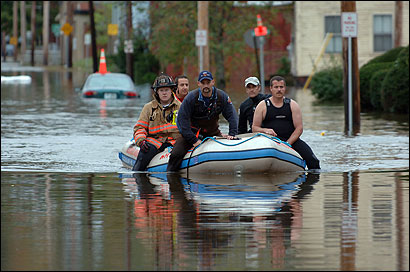
Wet
Is this image from post-Katrina New Orleans? A burly American rescue team dispatched to Mexico?
No, it's...
-
Hurricane Stan not as friendly as name might indicate
Mexico and northern Central America are still staggering from the aftermath of the latest Gulf Coast tempest, Hurricane Stan. Some are already calling Stan's impact worse than 1998's Hurricane Mitch.
Stan hit along Mexico's southern Veracruz coast on Tuesday as a Category 1 hurricane, and was downgraded to a tropical storm shortly thereafter -- but it's the landslides and flooding from the resulting rains that have been devastating. In Guatemala, storm-induced rains only ended on Sunday, and the army began evacuating people stranded in remote towns and villages. As many as 1,400 are feared to have died in villages inundated by mudslides; the government says it will declare them hallowed ground, as mass graves. Thousands are displaced and many fear their livelihoods have been destroyed.
In Mexico, Costa Rica, El Salvador, Honduras, and Nicaragua, more than 100 have been reported killed and thousands displaced from flooded areas. In Mexico, the storm destroyed key crops including coffee, and about 300,000 people -- primarily in the country's poorest regions -- were evacuated to shelters. About $1.85 billion will be needed to rebuild the hardest-hit areas, according to President Vincente Fox.
The Grist staff are taking the rest of the day off to go home and hug their kids and puppies.
-
Slam debunk
So, there's a buzzed-about new book called The Weather Makers: The History and Future Impact of Climate Change, by Aussie scientist Tim Flannery.
Naturally, it's brought the flat-earthers out of the woodwork.
And when the flat-earthers come out, Tim Lambert follows. Read his delightfully compact, action-packed festival of debunkery, in which he makes typically quick work of the skeptics. Like skeet shooting ...