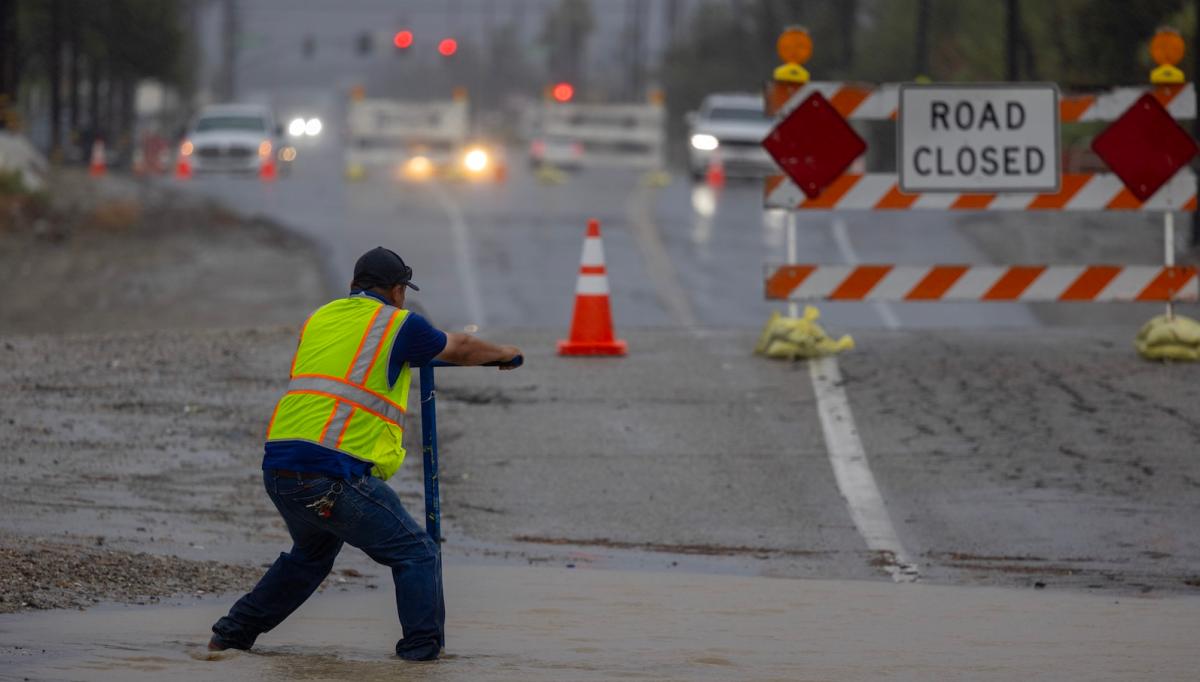
Something ominous just hit California: rain.
The life-giving water that normally hydrates people and crops brings an aura of dread this autumn, thanks to the strongest El Niño ever recorded. While the phenomenon causes severe drought and heat in many parts of the world, historically it’s brought extraordinary rainfall to the Golden State. The monstrous El Niño of 1997 and 1998, for instance, caused widespread flooding and debris flows (made not just of water and dirt, but big chunks of rock), destroying property and killing residents.
The state can’t stop rain from falling, so in the last few decades it has been renegotiating its relationship with precipitation. As climate change makes California whiplash from years of intense drought to years of intense rain, water agencies have been capturing as much H2O as they can to reduce reliance on using canals to bring it in from afar. That’s set the state up to avoid at least some flooding as this El Niño takes hold and bank the bounty for the dry spells to come.
“Heavy storms can affect regional infrastructure, construction schedules, and areas vulnerable to debris flow or power disruptions,” said a spokesperson with the Los Angeles Department of Water and Power in a statement provided to Grist. “However, these rain events also present a significant opportunity. Stormwater capture is a critical pillar of LADWP’s long-term plan to reduce reliance on purchased imported water.”
The threat isn’t just more rain overall, but the way it arrives. If one storm hits, water can build up and flood, but some of it will soak into the ground, preventing further inundation. But if a succession of storms rolls through, the soils get saturated. “Even one can be very big and impactful,” said Steven Springhorn, supervising engineering geologist in the California Department of Water Resources’ sustainable groundwater management office. “But if they start to come in a series, that’s where you start to get into some situations where you have a lot of excess water.”
Water, like any material thing, moves through time and space, but brings unique challenges in both realms. For one, it’s heavy, so channeling it requires using pumps or gravity, like when draining water out of a reservoir. And for humans, at least, the rain’s timing isn’t always ideal: A lot can fall at once, or it doesn’t fall for months on end.
To address the timing problem, California operates nearly 1,500 reservoirs. But that creates a challenge with space, as the dams can only hold back so much water — during especially wet winters, the reservoirs occasionally release water to keep from overfilling or even breaking apart. That’s to say nothing of the plethora of environmental harms that come from damming rivers, like destroying migratory routes for fishes.
So in recent years, California has been turning its attention underground, to its sprawling aquifers. In 2014, the state passed the Sustainable Groundwater Management Act, which requires local water agencies to tackle the crisis of dwindling subterranean supplies. California has long been extracting an unsustainable amount of groundwater, due in part to droughts exacerbated by climate change. The issue is particularly acute in the agricultural Central Valley, where farmers have drawn so much groundwater that aquifers have been collapsing like empty plastic bottles, causing the land to sink by nearly 30 feet.
But that problem is also an opportunity. Whereas the state’s major reservoirs currently hold around 21 million acre feet of water — that is, the amount it’d take to cover an acre in a foot of the stuff — its land could hold something like a billion acre feet underground, according to Michael Kiparsky, director of the Wheeler Water Institute at the University of California, Berkeley. “So the potential room for storage is immense,” Kiparsky said. “The enticing question is: Is there a way to grab those flood flows before they flow out to sea, and hold them underground, and therefore expand our capacity?”
That strategy is known as managed aquifer recharge, which tweaks how water moves through space and time. California water agencies, for instance, have been diverting excess rainfall into big dirt bowls on the landscape. This slows it down, allowing it to seep into the underlying aquifer. “If that fills up, then they go and talk to the growers in the area and see if there could be opportunities to put that water on agricultural land,” Springhorn said.
Whether it’s in basins or on fields, the water moves underground where, as a bonus, it’s not lost to the evaporation that inevitably occurs in a reservoir. When summer rolls around, water managers and farmers can pump that groundwater back up. Indeed, in an average year, this subterranean stash provides about 40 percent of California’s supply. “But in a drought, it makes up even more,” Springhorn said. “So that’s why we want to use the wet years, and the excess water that might be there, to replenish the aquifers so that there’s more there year to year.”
As a bonus, managed aquifer recharge can boost biodiversity. California has lost 95 percent of its wetlands, which used to mitigate flooding and provide critical habitat, especially for migrating birds. To help restore them, a Nature Conservancy project called BirdReturns incentivizes farmers in the Central Valley to flood their acreage, replicating the erstwhile ecosystems. “The local landowners can make a profit off doing a service for this really valued part of ecology,” Kiparsky said, “and it functions also as a groundwater recharge project.”
But what about the state’s cities? Like metropolises the world over, California’s were designed to move water into sewers and out of the built environment quickly. But as climate change intensifies rainfall — a warmer atmosphere by default holds more moisture — wastewater systems are struggling to keep up. “The gray infrastructure that we built in the 20th century was really built for a climate that is no longer here,” said Edith de Guzman, a water equity and adaptation policy cooperative extension specialist at the University of California, Los Angeles. “We can’t just engineer our way out of the problems — we need to actually kind of reverse-engineer a little bit and think about the way that nature does things.”
Simply put: Gray infrastructure like concrete is a liability, whereas green and brown spaces are assets. So in 2018, Los Angeles County voters passed a tax of 2.5 cents per square foot of impermeable land, like driveways, raising nearly $300 million annually. That finances preserving local watersheds and developing stormwater capture projects, helping the region pioneer a better way to manage urban water by getting “spongier.” As it develops roadside gardens and retrofits public parks, Los Angeles creates more spaces for the liquid to soak into the ground. It’s also built several spreading grounds, a series of bowls where water accumulates.
All told, the Los Angeles Department of Water and Power said that in the 2025-2026 water year, it captured around 37 billion gallons of stormwater. (The average resident uses around 100 gallons a day.) “While intense downpours require active management, they allow us to maximize local groundwater replenishment and capture as much precious rainfall as possible when it arrives,” said the spokesperson for the LADWP.
By building out as much spongy infrastructure as possible, California cities like LA better prepare themselves not just for the aquatic ravages of El Niño, but for the hotter summers ahead. Green spaces significantly cool the neighborhoods lucky enough to have them, while urban farms go a step further in producing nutritious food for residents. “The psychological and societal benefits,” de Guzman said, “are really not something to be ignored in this era of ever-increasing needs for us to have more connection and more reasons to celebrate where we live, rather than reasons to stay on our phones indoors with our air conditioning on.”