Climate Climate & Energy
All Stories
-
And Squad Said, Let There Be Blight
Judge orders dam spills in Northwest; critics may call on higher power Just two weeks after ruling that the Bush administration plan to protect Northwest salmon was inadequate, on Friday U.S. District Judge James Redden issued an order for large-scale spilling of water at a number of dams that are hindering the ability of juvenile […]
-
Don’t Be Such a Prudhoe
American oil supplies well past peak America’s domestic oil supplies are tapping out. At Alaska’s massive Prudhoe Bay field, output has dropped nearly 75 percent since 1987 highs. With mega-developing nations India and China gobbling up the world’s spare oil supply and U.S. demand still rising, engineers are now going after poorer grades of oil […]
-
Puh-lease Academies
Science academies from 11 countries say global warming is, yes, real Yesterday, national science academies from 11 nations cosigned a letter to the world’s leaders, making an unprecedented joint statement: Global warming is almost certainly caused by human activity; it’s the biggest risk we’ve ever faced as a species; please #$&!*% do something about it. […]
-
Bush dodges question about whether climate change is caused by humans
After making kissy-face in front of the press corps at the White House today, Bush and Blair took a couple of questions. One reporter asked Bush whether he believes global warming is an anthropogenic problem (without using any big words, of course):
And, Mr. President, if I may, as well, on climate change -- you didn't talk about climate change -- do you believe that climate change is manmade and that you, personally, as the leader of the richest country in the world, have a responsibility to reverse that change?
Naturally, Bush dodged the causation issue:
In terms of climate change, I've always said it's a serious long-term issue that needs to be dealt with. And my administration isn't waiting around to deal with the issue, we're acting. I don't know if you're aware of this, but we lead the world when it comes to dollars spent, millions of dollars spent on research about climate change. We want to know more about it. It's easier to solve a problem when you know a lot about it. And if you look at the statistics, you'll find the United States has taken the lead on this research.
[More blather ensued; check it out in the transcript, if you're the masochistic sort.]
As it turns out, even as Bush was bragging about the millions the feds are spending on climate-change research, The New York Times was posting an article by Andy Revkin alleging that the administration is doctoring that very same research to jive with the oil industry's preferred version of the "science":
A White House official who once led the oil industry's fight against limits on greenhouse gases has repeatedly edited government climate reports in ways that play down links between such emissions and global warming, according to internal documents.
Wouldn't want those millions of taxpayer dollars to result in any too firm conclusions, now would we?
-
![]()
![]()
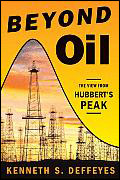
Kenneth Deffeyes’ Beyond Oil forecasts a fast-approaching petroleum peak
Mark your calendar: annual world production of crude oil will reach its peak this coming Thanksgiving, Nov. 24. At least, that's the tongue-half-in-cheek prediction of Kenneth Deffeyes, who starts his latest book by suggesting that readers stop and give thanks for a century of plentiful supplies.
-
Why can’t we change our oil-sucking land-use preferences?
 The other day I expressed disappointment at Kevin Drum's fifth peak oil post -- the one where he lays out his recommendations for oil policy. In my inimitably oblique and unfocused way, I was simply trying to say that I wish he'd been more imaginative.
If nothing else, peak oil is going to be a major inflection point in our collective history. It's a sharp turn in the road, and we can't see clearly around the bend. The stakes are huge, and call for a commensurate greatness of mind and expansiveness of thought.
What Drum did is basically gather the conventional wisdom in one place, without considering at all the myriad ways that the CW might be constricted and warped by the vested interests of society's current power brokers. Nor did he deign to consider things that might seem, in the current sociopolitical scene, impossible, or at least out on the fringe.
One example: U.S. suburbia, as Kunstler never tires of telling us, is built on cheap oil. It takes lots of oil to transport goods around the world to a Wal-Mart, and lots of oil for suburbanites to drive back and forth to it bazillions of times. The dominant land-use paradigm in this country is oil-sucking. If oil's running out, it's got to change, right?
Drum doesn't bother to mention the many innovative thinkers out there pondering how we can make cities greener and more attractive (the very subject of World Environment Day). He doesn't consider how we might refashion our remaining farm land and open spaces in more ecologically friendly fashion. He doesn't consider how we might encourage people to buy locally grown food and locally made goods.
Instead, we get this extraordinarily banal post on why people don't like mixed-use developments. (See also the Atrios post that preceded it and the Jim Henley post responding to it.)
It's late, so I'll just make two brief points:
-
Lights, Climate, Action
Schwarzenegger declares war on global warming “I say the debate is over. We know the science, we see the threat, and the time for action is now.” With those words, California Gov. Arnold Schwarzenegger (R) yesterday defied Bush administration orthodoxy, announcing ambitious plans to reduce his state’s emissions of greenhouse gases. The Governator issued an […]
-
Japanese dress down to save 81 million gallons of oil in summer
What do you do if your country needs to meet targets under the Kyoto global warming protocol? You dress down.
Yup, the Japanese government is encouraging public workers to wear less in order to use less oil. Since many in Japan don dark suits in summer, they crank up the AC to maintain an average temperature of 77 degrees. Someone figured out that Japan could save 81 million gallons of oil in one summer by setting the temperature at 82. To make the warmer workplace more bearable, employees now have the okay to wear short sleeves and go sans tie.
However, one possible unintended consequence of this move is that shirt sales are up. I'm guessing that they are not organic.
-
Everything New Is Old Again
Wisconsin power-plant expansion could have long-term eco-consequences The fate of a Wisconsin coal-fired power plant could augur poorly for the environment, say its opponents. At issue is what does and doesn’t count as a “new” power-generating facility: Under the Clean Water Act, new facilities are subject to strict regulations on cleaning technology; an addition to […]
-
Salmon and Denial-Ah
Federal judge calls Bush admin’s salmon plan fishy In a strongly worded opinion, U.S. District Judge James Redden yesterday ruled that the Bush administration’s salmon-protection plan for the Columbia and Snake rivers in the Northwest is “contrary to law” because it doesn’t take into account how dams affect the fish’s chances of recovery. This is […]