A dystopia. Henry Block is trapped in a dystopia.
Admittedly, it’s his own fault. When he’d signed his name on the Conservation Corps’s dotted line, the recruiters had given him a duty stations preference form, and while you were probably supposed to list specific bases, in each of his four slots he’d just written BEACH. If he was going to be stuck doing this for the next two weeks, he’d figured at the time, he could at least treat it as a research trip for his Empyrean builds.
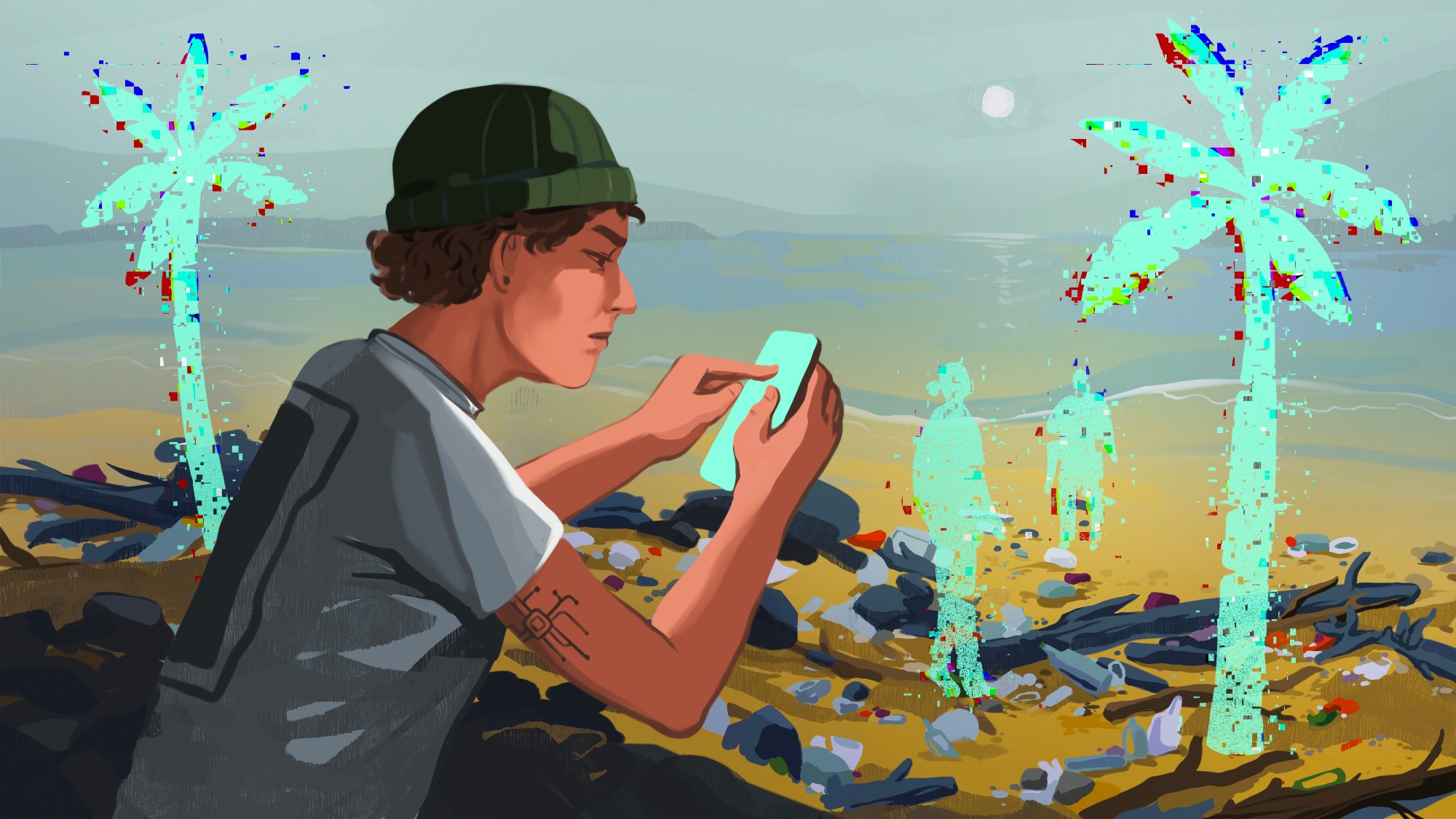
Now, standing on the Cameron, Louisiana, coastline, Henry desperately wishes he’d added at least a couple of descriptors. White sands. Palm trees. Tourists. This beach has none of that. The sand here is clumpy and gray, sharp with rocks and broken seashells. Scraggly grass rises out of the uneven dunes like scrotum hair. Instead of quaint seaside bungalows, there are trailers on stilts that some previous hurricane has left looking like they’ve been passed halfway through a paper shredder. There’s trash everywhere.
And it’s cold. Forty-nine degrees. Which is maybe why all the other recruits — a stunning line of characters that look like they’d been dredged off a public bathroom floor: Meme Stock Bag Holder, Strip Mall Chiropractor, Temu Hagrid, Home Birth Gone Wrong, Manic Pixie Meth Head, and Angry Virgin Soy Boy — are wearing overshoes and beanies and gloves along with their ugly pseudo-military fatigues.
Henry isn’t. Beaches aren’t supposed to be cold.
“There are almost 200 trillion microplastic particles in our oceans.”
The woman standing before the line of them, yelling above the ocean’s roar, is short and stocky, her hairstyle by way of buzz guard number three. She’s obviously in charge, though Henry hasn’t bothered to learn rank insignias. Or read nametags. Two weeks, in and out. He and Commander Ratched over here don’t need to get acquainted.
“After this week, many of you will be reassigned to more complex projects like tagging migratory bird species, dune stabilization, or invasive species management. But for now, we’ll start you off easy, with our most fundamental challenge.”
Commander Ratched gestures behind her, to an ancient flatbed truck. Its bed is overflowing with bagged soil and industrial-sized buckets full of what look like weeds. A handful of other, older corpsmen sit on the cab and the hood of the truck, watching the line of them like crows on a wire.
“The soil in these bags has been specially treated with genetically modified microbes that break down PET microplastics. Beaches are like banks for the ocean, and the tides are what they use to make deposits and withdrawals, so eliminating microplastics in beach sand is the first, most logical step to cleaning our oceans. So today, corpsmen, you will be burying this sand.”
Henry glances from the piles of sandbags to the scrotal-hair dunes to his already-soaked shoes.
Nope. Not happening.
She keeps going.
“However, to prevent a Jurassic Park-style unintentional evolutionary disaster, these microbes have also been modified to die if fully immersed in sea water for an extended period of time. Which brings us to the second part of your task. Every year, Louisiana loses around 30 square miles of coast to erosion. Native grasses help prevent this erosion, reverse beach decline, create habitat, and will keep these microbes from washing into the Gulf. So as the second part of your task, you will anchor the microbial soil by planting native grass shoots over top of it.”
Absolutely not.
Even if his feet were dry and the wet wind hadn’t frozen his bare hands into claws, he’s a 25-year-old grown-ass man with better things to do. More importantly, he spotted the opportunity to do those better things on the pre-beach truncated tour of their nearby home base. Said base is mostly a dizzying carousel of suck — barracks instead of private rooms, communal showers with mosquito-swarming drains, composting toilets, which basically means shitting in a bowl and carrying it out yourself to dump in a special tank —
(He’d texted pictures of each to his mother with the crappy little flip phone she’d given him to replace the real phone she’d stopped paying for. I hope all the other mothers in your shitty parenting group are proud of you, he’d sent, but all she’d replied back was, You’re going to do so great.)
— but he had seen a small library with three sad little desktop computers, and he thinks Empyrean might just run on them. It’ll be a pain in the ass to do VR tactile asset management without a headset or palp gloves, but it’s better than nothing. If he can work it right, he can spend the whole two weeks holed up toasty warm and dry in the library, get a couple of builds done, and still get his paycheck without having to do any of this stupid shit.
He shoots his hand up.
Commander Ratched stops her spiel and turns to regard him with a stare like she can see all of his bones.
“Question, Corpsman Block?” she says, in a pleasant tone the precise level of iciness that would make more fragile men commit themselves to Jesus.
Joke’s on her.
“I need to go to the infirmary,” Henry says. “I twisted my ankle. Getting off the bus. It really hurts. Oh, ah.” He winces a little, hops on one foot to demonstrate. “I don’t think I can do the whole grass sand thing. Sorry.”
She stares at him.
Oh, right. “Ma’am.”
Her expression doesn’t change. “Anyone with an injury will report to the infirmary and remain there until cleared by the nurse practitioner,” she announces to the line.
“No. Uh, no.” He grins winningly at her. “I’d prefer to recuperate where I’m most comfortable. Ma’am.”
“Corpsman Block,” Commander Ratched says evenly, “if you are injured, any time not spent incapacitated by various tests or treatments will be spent reviewing our extensive collection of informational binders, which cover the region’s history, current ecological challenges, and best practices for habitat restoration. In the infirmary, until you are medically cleared to return to service.”
“That’s not—”
“Alternatively, if you are to discover that you are in fact mistaken about your injury, or have suddenly experienced a miraculous recovery, you may instead participate in ‘the whole grass sand thing’ with the rest of your class. Those are your choices. Your only choices.”
A snicker ripples up the line. Annoyed, Henry glances from Manic Pixie Meth Head to Strip Mall Chiropractor to the rest of them, like they hadn’t gotten off the same bus as him five minutes ago, like they’re not thinking the exact same thing as he is, how do I get out of this crap —
But maybe they aren’t. Maybe they’re a bunch of honest-to-God true believers.
Oh, God.
This really is a dystopia.
Henry puts his foot down slowly.
“Corpsman Block?” Commander Ratched says, one perfectly manicured eyebrow rising. “Have you experienced a miraculous recovery?”
“Yes,” he grinds out, blushing so hard his neck boils. More laughter. It scuttles up and down his spine like bullying hands.
Commander Ratched looks at the rest of the recruits sharply. The laughter stops.
“I thought so,” she says.

Henry is ushered into the bed of a second truck with the other new recruits, and they take off down the beach. The ride is bumpy, jostling, the trucks stopping every half mile to drop them off. Ten minutes exposed to the sharp, damp wind and Henry’s lips are chapped. His ears ache. Finally, it’s his turn to get out. A few of the older corpsmen lob out a pile of sandbags and grass buckets with the ease of machines, which should be impossible, because this shit weighs approximately eight thousand pounds. They give him a shovel and wagon. Loaded up, the wagon’s fat tires sink into the damp sand.
With that, Commander Ratched and her flying monkey crew leave him with a trainer. Said trainer is an old man with a thin grey beard and an expression of perpetual, pained bafflement. This bafflement grows as Shutterstock Sweater Guy eyes Henry’s lack of overshoes and gloves.
“No one told me,” Henry says. He waits patiently for the man to strip off his own gloves or beanie and hand them over. Instead, Shutterstock Sweater Guy stoops down and picks up the shovel.
“All the sand goes on the wrack line to the foredune — that’s the area between where ocean debris gets deposited at high tide to the first ridge of dunes that run parallel to the water,” he says. “The microbes will bloom downward, towards the water line, but that should happen on its own if the microbes take. Today, we’ve got three endangered species to plant: Suaeda linearis, Panicum amarum, and Schizachyrium maritimum. Colloquially, sea blight, bitter panicum, and gulf bluestem. They’re native to this area and, once established, provide habitat for — ”
Henry sighs loudly. Shutterstock Sweater Guy breaks off.
“Problem?”
“You guys really are a cult.” At Shutterstock Sweater Guy’s incredulous look, he continues, “I mean, you’re all just like, sipping your paper straws and planting your grass sprouts and thinking that’s gonna save the world. Like it isn’t 90 companies making 99 percent of the carbon emissions or pollution or whatever.”
Shutterstock Sweater Guy shakes his head and holds out the shovel. “Let’s get started.”
“Seriously?”
Shutterstock Sweater Guy wiggles the shovel insistently. Henry takes it and, sucking his teeth, halfheartedly flings up a couple of spadefuls of beach sand. Shutterstock Sweater Guy doesn’t help. He only says, “The holes should be about a foot deep, and about two to three feet long. The microbe sand needs to be fully covered with regular beach sand to make sure it doesn’t blow away while the grass takes root.”
Henry flings up a couple more shovelfuls and calls it good. Shutterstock Sweater Guy looks pained but doesn’t object. He hands Henry a bag of sand. It’s packaged, hilariously, in plastic.
“It’s a different kind of plastic,” Shutterstock Sweater Guy says when Henry notes this aloud. “It’s made of orange peels. Compostable.”
“Right. Sure.” Henry says, ripping off the top of the bag and dumping out the contents into his uneven hole. The sharp wind snatches the bag out of his hands, and Shutterstock Sweater Guy runs after it, because of course he does, because apparently it’s not that compostable. As Shutterstock Sweater Guy runs after it like a moron in a parking lot trying to pin down a loose receipt, Henry nudges the seeded sand around in the hole with the side of his wet shoe.
“But like, none of this matters. You know that, right?” Henry says when Shutterstock Sweater Guy returns, bag in hand, panting. “Once Empyrean transitions from VR into digital consciousness uploads, me and every human alive that isn’t into this Mother Gaia tofurkey bullshit is going online permanently. Half the population vanishing is basically a wet dream for you guys, right? The earth is gonna heal itself?”
The hole isn’t big enough. The excess sand Henry sort of swooshes around with his foot. Done. He looks up at Shutterstock Sweater Guy, expecting at least some approval, and meets only more pained bafflement.
“Why are you here?” Shutterstock Sweater Guy says.
Henry hesitates, wiping his hands absently on his pant legs. He doesn’t want to be here. But his mom cut him off and kicked him out because he hadn’t done the dishes or cleaned the cat box or whatever. It wouldn’t be a problem if his Empyrean subscription didn’t eat up all his basic income, but it does, and since he’s a two-time college dropout with no work history, the Conservation Corps was the only place that would take him, other than the regular military. He figured he could endure Peace-Corps-but-for-trees for two weeks until his first paycheck comes in. Once it does, he’ll buy a bus ticket to Empyrean HQ in Phoenix. Go AWOL, technically, but even if the woo-woo cops follow, what can they do? The digital upload announcement is due any day now, and he’ll be a string of code by the time they track him down.
Not that he’s going to tell Shutterstock Sweater Guy that.
Not that he even gets the chance.
“You know Faber is one of those companies,” Shutterstock Sweater Guy says.
“What?”
“Faber is the parent company that runs Empyrean. It’s one of those 90 super polluters.”
“So what?”
Shutterstock Sweater Guy’s baffled smile grows in size and bafflement. “Faber isn’t a super polluter just because. One week of an average player’s use produces the same amount of carbon as a transatlantic flight. If half the population goes digital permanently, everything gets worse Earth-side, not better.”
Henry flushes. He looks down at the filled-in hole of slightly mismatching soil and swooshes it around with his foot again. Blending. “Well, hey, look, if you and the other Scooby Doo crew want to stay here and be boiled frogs, that’s not really my problem.” And then, when Shutterstock Sweater Guy only shakes his head resignedly, Henry snaps, “So, what, I’m supposed to not have a life? We’re all just supposed to stop playing games and taking showers and live in mud huts and eat bugs from now on?”
Shutterstock Sweater Guy plucks a grass shoot out of the bucket and hands it to him.
“Now, we plant,” he says.
They work until noon, making it no more than 200 yards down the beach — Shutterstock Sweater Guy keeps stopping them to correct Henry’s planting. These shoots are too close together. These are too far apart. That hole is too deep. That hole is too shallow. Henry thinks that if the grass is this finicky, it probably deserves to go extinct.
Lunch comes by way of paper bags packed by the base’s chow hall: two sweet potato and chickpea mash sandwiches, roasted broccoli, apple slices, what is probably supposed to be a brownie but looks like a turd, and a water box. Prison stuff. Worse than prison stuff. Shutterstock Sweater Guy doesn’t complain, which just convinces Henry that he must be on some kind of felony diversion program.
Henry texts his mother: They have me working with mass murderers and rapists.
She replies, I’m glad you’re meeting new people.
“You know,” Shutterstock Sweater Guy says thoughtfully between apple slices. “When you upload your consciousness, you’re just replacing your physical body with a server. Climate change isn’t going to spare the servers.”
Henry takes a tentative bite of the sandwich, and then spits it out between his feet. Vile. He wipes his mouth on his sleeve. “All the server farms are underground,” he says. “It’s always 60 degrees underground.”
“But they need power. Didn’t forest fires just kill a 300-acre solar farm out by Dallas?”
Henry actually hadn’t thought of that.
“There’s backups,” he says uneasily. “You know. The cloud.”
He shoves the rest of the disgusting sandwich into his mouth and promises himself that when they get back to camp, he’ll request a new trainer.
Empyrean does indeed run on the library computers, though it’s laggy enough that “run” isn’t exactly the word he would use. Nevertheless, Henry bums a few bags of chips and energy drinks out of the common room and settles in for a long night.
The librarian kicks him out at 9 p.m.
“You can’t do this,” Henry cries. “I’m halfway through a build.”
The librarian doesn’t argue. She just shuts the door in Henry’s face.
Day two, and every joint in Henry’s body feels like it’s rusted shut overnight. The pain is bad enough that holing up in the infirmary reviewing ancient binders on coastal tidewater patterns strikes him as preferable to going out again. But the nurse only hands him two Tylenol, says exercise will help, and sends him on his way.
At least he remembered all of his winter wear this time. He walks out to the cold beach to collect his wagon of sandbags and his bucket of weeds and meet his new trainer.
It’s Commander Ratched.
Of course it is.
However annoying Shutterstock Sweater Guy’s constant lecturing was, Commander Ratched is ten times worse.
“Does this look like foredune to you, corpsman?”
“The hole should be a foot deep, corpsman. This is America. We don’t use the metric system.”
“Ten to 18 inches apart, corpsman.”
“Plant in a staggered formation, corpsman.”
“Why don’t we have robots doing this?” Henry grouses as he tosses aside a glittering half-crushed soda can and then shoves the end of his shovel into the soft sand.
“Corpsman.”
Henry sighs and looks up.
“What?”
Commander Ratched points at the can next to his foot. “Pick up that can.”
“No offense, but you told me to bury dirt and plant grass,” he replies, gesturing at the shovel. “Trash collection isn’t my job.”
“Pick up that can.”
“You know, I don’t really respond to the tough love approach.”
“Pick up that can.”
“You really should let me take the lead on my personal development. Otherwise, I’d just be doing it because you tell me to and not because I want to.”
“Pick up that can.”
They stare each other down.
Finally, Henry snatches up the can. Commander Ratched pulls a trash bag out of her pocket and flaps it open.
“There’s no point,” Henry says as he drops the can inside. “The waves are just going to wash up more trash tomorrow.”
“When you take a shit, corpsman, do you wipe your ass after?
An hour before, the truck had dropped the recruits off at half-mile intervals, but thanks to Commander Ratched’s micromanaging, the two of them have hardly made it past their drop-off point. Another pair of planters have already caught up — Temu Hagrid and his trainer. Now, the two stop their own work and watch, not even hiding their grins. Henry flushes.
“You don’t have to embarrass me,” he mutters.
“You’re embarrassing yourself,” Commander Ratched says. “Now answer the question.”
“Yes, I wipe my ass after I take a shit.”
“Why bother? You’re just going to shit again tomorrow.”
The clever replies he should have shot back at her only come to him later, when he sits hunched over one of the library’s desktops, adding bright coral to the shallow waters of his Empyrean beach build.
At some point Meme Stock Bag Holder and Strip Mall Chiropractor filter in and Henry waits for them to come over and be interested in what he’s doing, or at least start complaining about this place loudly enough that he can segue in with his own grievances. But they’re only talking about someone called Sandbag Squidward, which tickles Henry immensely — apparently he isn’t the only one fond of apt nicknames, and Sandbag Squidward isn’t god tier, but it isn’t bad, either, considering the work they’re doing. Henry is about to ask if they’re referring to Home Birth Gone Wrong or Angry Virgin Soy Boy when the two catch sight of him, break off their conversation, burst into a round of nervous laughter, and then awkwardly move away.
Humiliation rushes through him, quickly followed by anger. So that’s what these people think of him? He’s just, what? Bitchy dead weight? Well, so what? What are they even? A bunch of fucking … grass nerds? Why should he care what they think?
He texts his mother: I was wrong, friends aren’t for people with low self-esteem, they give you low self-esteem.
She texts back, It’s great you’re making friends.
He returns to his game, moving on from adding coral reefs he can’t touch to palm trees he can’t feel the shade of. In a fit of what will later strike him as insanity, he dots a few of his spotless, powder white dunes with beach grass.
It’s ugly. Of course it is. He deletes it.
In a fit of what will later strike him as insanity, he dots a few of his spotless, powder white dunes with beach grass.
Four days in, and January is rapidly becoming February. With the weather warming and some of the trash cleared, this beach is looking more like it could be a research opportunity. So, after finishing his hideous lunches, Henry spends the last minutes of his break writing notes to himself about the texture of the salty wind or the smell of the damp sand on his crappy little dumb phone. He can do this because, save for an unending litany of corrections and criticism, Commander Ratched isn’t exactly a fount of conversation; any downtime is spent mostly in silence. So when she says, “We tried robots,” Henry nearly jumps out of his skin.
His eyes jerk up from his phone’s screen. “Sorry?” he says.
“We tried robots. The people here destroyed them.” Commander Ratched isn’t looking at him, but at the ocean’s rolling bank of gunmetal waves. Idly, she scrapes at the gray sand with her fingertips. “Do you know why?”
“Because they’re inbred, illiterate swamp people?”
“You know, almost all of your fellow recruits are from here,” she says. “Their parents worked in oil, their grandparents worked in oil, their great-grandparents worked in oil, and their great-great-grandparents were poor Cajun and Creole dirt farmers. Oil made these people prosperous. It’s their culture, their community. It gave them purpose and dignity and a good livelihood. When we took away oil, we took away that, too, even if it wasn’t the intent. And then we spent a lot of time berating them for objecting and arresting them for destroying the robots we told them they were too stupid to appreciate.
“But not everyone is happy to give up working and rely on Uncle Sam to pay their bills. For some people, that’s a spiritual injury. It took us too long to learn that if you take someone’s livelihood away, you have to at least try to replace it with something that’s meaningful, that connects them to their land and their communities the same way those old industries did. Having a robot do this does none of that.”
” … so this is all a make-work tax-suck for inbred, illiterate swamp people, is what you’re saying,” Henry says.
She fixes him with a look that he expects to be reproachful but isn’t. Instead, her gaze holds a strange weight.
“You asked for ‘beach’ instead of a state or a city on your duty assignment form,” she says. “Why is that?”
Henry doesn’t think she’d understand Empyrean, and doesn’t really feel like explaining it, so he just shrugs. “Why not?” he says.
She doesn’t press. But for some inexplicable reason, the question bothers him for the rest of the day.
Before he knows it, his first week of training is up.
On the morning of day eight, Commander Ratched calls recruits to step out of the lineup and receive their new assignments and equipment: rolls of wire fencing, traps for tagging native beach birds, complicated soil collection and testing equipment to make sure the microbes have properly transplanted.
Not him, though. Henry is handed the handle of a familiar wagon full of modified sand and a bucket of grass shoots and driven back out to the dunes.
“We believe in you, Henry,” Commander Ratched says before dropping him on a stretch of beach. Alone. Henry flips off the truck’s retreating taillights, but only after it’s far enough away she won’t see.
Their mistake here is leaving him here by himself.
He hooks one foot under the wagon’s side and tips it like he’s tripping a person. The sandbags dump out unceremoniously, in a pile. Gleefully, he hauls the bucket of beach grass down to the waterline and upends it into the waves. Then, he settles against the slope of the microbial sandbags, pulls his beanie down over his eyes, and tries to nap.
Fuck ’em.
But the temperature still hasn’t moved out of the 50s, and the air is as clammy as a toilet bowl, the sand underneath him about as comfortable. He didn’t dump the grass shoots far enough into the water, either. Now soaked and clumped together, they wash back onto the beach like a corpse he can’t get rid of.
Cursing, he fishes them out and sticks them back in the bucket and drags it back up the shore.
Fifteen minutes later and he’s digging holes and dumping dirt and planting the soaked grass. It isn’t like there’s anything else to do. He barely even has service on his shitty flip phone out here.
An hour later, mid-sandbag dump, he spots a bright orange sack of something caught on the swollen wood struts of a dilapidated pier. He tries to ignore it. But these people must be putting something in the awful food, or their not-at-all-subtle attempts at brainwashing are working, because he can’t.
He tramps out into the frigid, thigh-high waves to haul it in.
It’s the tattered remains of an inflatable polyester kayak, bogged down with sand and water and seaweed, making the thing weigh about a hundred pounds and stink like dead fish. Cursing, Henry untangles it from the pier and starts pulling it back to the shore. He slips twice. The ruined kayak tries to drag him back into the water like they both belong there. Waves crash over his shoulders. By the time he makes it back to land, he’s drenched to the bone and his shoes are so wet it feels like he’s walking on soaked kitchen sponges.
“Bullshit,” he mutters as he drops the kayak on the shore, then sits down hard to pull off his shoes. One week. One more week and he’ll never have to do any of this shit again.
“Ayy!”
Henry ignores the sound at first, thinking it’s a bird. He pours a cup of seawater out of one shoe.
“Ayy! Sandbag Squidward!”
He looks up.
There are two recruits further back on the dunes, small enough that they look like toy army men. A length of fence is stretched out between them. They aren’t installing it though — they’re dancing around like idiots, waving at him, giving him enthusiastic double thumbs up.
“Ayy! Way to go Sandbag Squidward!” They shout.
Despite himself, Henry grins and, after a second, he raises a hand and waves back. He dumps his other shoe out, then puts them both back on. Laboriously, he drags the kayak to his wagon and piles it inside.
Six days until payday. Eight soil bags seeded and 200 stems planted. Two pounds of trash recovered.
Five days until payday. Nine soil bags seeded and 261 stems planted. Four pounds of trash recovered.
Four days until payday. Thirteen soil bags seeded and 471 stems planted. Nine pounds of trash recovered.
Something weird is happening with his game.
The beach he’s building has started subtly changing, for one, to more closely resemble this place. Henry assumes his subconscious is playing a joke on him and renames the file Shitbox_beach_1. He makes it an active goal to incorporate the destroyed trailers and the ragged dunes with their mangy grass and the storm wrecked piers; after, he sprinkles it all with a fine patina of plastic bottles and cigarette butts and Styrofoam coffee cups. He uploads it, sends out an all-call, and waits for the carnage.
Carnage never comes. Instead, in a 24-hour span, he picks up 10,000 players. None of them are doing beachy things like frolicking in the waves or diving for coral shards or having raunchy sex on limited edition beach towels. Instead, they appear to be trawling the dunes, picking up trash. While you technically need trash for some of the crafting recipes, something about seeing avatars with trash bags in hand unsettles him.
But he can’t argue with the results. He renames the file Apocalypse_Beach and picks up another 10,000 players in the span of an hour. Even more disturbed, he shuts the game down early for the night.
Walking back to the barracks slowly, his hands shoved into his pockets, his back hunched against the ubiquitous wind, Commander Ratched’s question occurs to him again: Why beaches?
Easy. There’s a big market for them in Empyrean, since most of the real life once-touristy ones are under two feet of permanent climate tide or have been destroyed in some other catastrophic fashion.
So why does the question bother him so much? Henry doesn’t actually care about beaches. In fact, before this, he’s only been to one beach in his life — a family vacation to Hawai‘i before the flight carbon caps came down. Not a Waikiki tourist trap, but a place his dad knew about because he’d been a local, once upon a time. Sure, the coral had been mostly dead, but there were still sea turtles and the water itself was the color of the sky. It had been a good trip, the rare childhood memory of his parents getting along. Maybe he’d have appreciated it more if he’d known that his dad had orchestrated it as a preemptive “You won’t see me again” consolation prize.
Henry lets out a short and unhappy laugh. So he builds imaginary beaches because he misses his dad? That’s pathetic. Surely, he isn’t so psychologically uncomplicated as that.
Three days to go. Twelve soil bags seeded and 457 stems planted. Thirteen pounds of trash recovered.
Two days to go. Fourteen soil bags seeded and 544 stems planted. Eleven pounds of trash recovered.
One day to go. Fifteen soil bags seeded and 601 stems planted. Twelve pounds of trash recovered.
On the afternoon of his last day, just after lunch, three texts arrived on his crappy flip phone in rapid succession. The first is one he’s been longing for, the one he’d never expected to come, not really. But his builds have gone from a few thousand players to over 200,000 thanks to Apocalypse_Beach, and while it isn’t an impressive number compared to a lot of other builders, that 1,900 percent increase in a week has apparently caught someone’s attention:
Congratulations Henry Block! We here at Empyrean are foraging a new, more perfect future through our innovative digital consciousness uploads. We want to give our most talented creators, influencers, and architects a first look at the game from inside. This is your exclusive invitation to participate in an upload suitability evaluation at our Phoenix, AZ location.
The second text informs him that his Conservation Corps paycheck has been deposited into his account. It isn’t quite enough to get to Phoenix, but it’ll get him as far as West Texas, and he can hitch rides the rest of the way. Or walk. Already, the two weeks spent planting has given him a surprising amount of strength in his legs.
The third is from his mother: I am so proud of you.
Day 14, done.
Finally.
Sneaking out isn’t hard. After finishing their duty hours, everyone else heads back out to the beach. Henry has never followed, too busy with his builds, too perplexed by why would you inflict more shit beach on yourselves, a sentiment he’s not been shy about sharing. No one expects him to come along. He has the barracks to himself. It will be hours before he’s missed.
He packs quickly. It’s dark by the time he steps outside, and the night is cold and quiet. The ocean sounds strangely far away, its waves crashing in whispers.
“So long, suckers,” Henry mutters, and then hates a little that he’s said that. This place hasn’t been that bad, right? In retrospect?
Impulsively, he glances towards the beach, and there he can just barely make out the red glow of–is that campfire light? Music, too, carried by a low breeze. Guitar, it sounds like.
Is this new? Or has it been like this every night, and he’s just never noticed?
He hesitates in the middle of the dark gravel road lit from above by a dull yellow streetlight, listening. He maybe knows this song. There’s talking, too, though far enough away he can’t really make out words. Laughter.
Well, maybe he should make an appearance. A kind of alibi for when he goes missing later. That makes sense, right? Ten minutes won’t make a difference. Phoenix isn’t going anywhere.
He steps off the road and picks his way carefully up over the dunes and through the grass, past the foredune, to the flat gray pan of the beach face.
The other recruits are lounging around a small campfire in an uneven circle, their smiling faces illuminated by the flickering firelight. Marshmallows roast on skewers over the flames. Not very carbon neutral, Henry almost says, and then doesn’t.
Meme Stock Bag Holder is the one with the guitar. He stops playing and grins, the palm of one hand falling to rest on the neck of his guitar like a hand over a heart. “Hey, welcome to the club, Sandbag Squidward. Take a seat.” He moves his hand and strums out the first few chords of Billy Joel’s “Angry Young Man.”
“Oh my God, don’t call him that,” Home Birth Gone Wrong groans. “Sorry, Block,” she says. She and the others scoot to make room for him in the circle.
The waves, black with night, lap the beach. On the dunes, the newly planted grass shivers in the wind. Henry stares at that open space in the circle.
He says, “I’m not staying,” and then drops his bag, and sits.
“I’ve never had a nickname before,” he says.
This story was first published in Tractor Beam, the soilpunk quarterly.
Ashlee Lhamon earned her MFA in Fiction from McNeese State University in Lake Charles, Louisiana. After marrying a Cajun and enduring two hurricanes within a month of each other, she figured she could start calling herself a native. When she’s not writing or dodging natural disasters, she’s chasing her toddler, who is inevitably chasing her two cats. Her work has previously appeared in Nightmare, Apex, Lightspeed, Flash Fiction Online, Radon Journal, and Salamander Magazine, and her debut novel will be released next year with Grand Central Publishing. For more, visit ashleelhamon.com.
Nicole Xu is a freelance illustrator who was born in Shanghai, China, and grew up in Vancouver, Canada. She graduated from Rhode Island School of Design with a BFA in illustration and is now based in the Seattle area. She uses both classic and digital watercolor techniques, producing editorial illustrations at the highest level for clients such as the New York Times and NPR.
Read more Imagine 2200 climate fiction
-
![Stylized illustration depicts a silhouette wearing headphones with sound waves radiating around. Below their feet is a bright world of mushrooms and fungi.]()
The Case of the Missing Lake
Lake Ballona goes missing, and only the mushrooms can help.
-
![Illustration shows a man standing in an overgrown river delta, wearing an orange backpack, locs blowing in the wind. He is looking at a public telephone box standing alone among the undergrowth.]()
The Seed Dropper
Decades after flooding drove his family from their Louisiana home, June returns to replant the land, and grapple with its legacy.
-
![Illustration shows a young woman and an older man sitting near each other, surrounded by vegetation and insects. Their expressions and pose suggest worry or tension.]()
This View From Here
As a young woman prepares to leave her small town, a fight with her father sheds light on their fears for the future.