Imagine 2200, Grist’s climate fiction initiative, celebrates stories that invite us to imagine the future we want — futures in which climate solutions flourish and we all thrive. Discover more stories. Or sign up for email updates to get new stories in your inbox.
By that morning, Ma and Dad had been missing for ten days.
And seven days had elapsed since they’d received that letter — not by email, but printed on real paper, sent by post and all — informing them of their imminent transfer to Wicker Secondary.
Dee wasn’t entirely convinced that the two events were unrelated.
They wouldn’t have believed that Ma and Dad weren’t coming home, except their parents never went nowhere without letting Dee know when they’d be back. And Dee wouldn’t have believed the invite to Wicker either, except it came printed on hefty card stock, adorned with that gleaming seal. And the uniform, of course. Free of charge, they wrote. They’d sent the girls’ one. It soured Dee’s stomach.
But Wicker was just about the only ticket out of the Near. They had promised themself long ago that over their dead body would Nita and Ori spend their lives in the city rundowns. They would have left the house in a clown costume if that’s what it took.
It was early March, so the sun wouldn’t be up for another hour. They could barely see, but this was the coolest it would be all day, so they had no choice but to savor it. In the dim and bluish light, Dee styled their tight, dark coils with a sparing amount of water. It would have to do.
They spent a luxurious moment doing absolutely nothing, staring down into the sink basin. Without noticing, they held their breath. Dared they hope for a quiet morning, today of all days?
A shrill cry pierced the morning stillness. Dee briefly considered curling up in the cabinet beneath the sink.
“DeeDee!” A child’s whine harmonized with the crying. “DeeDee —”
Dee was flying through the doorway of the small bedroom before Nita could finish. It was a sight to which they could not become accustomed, even after nine mornings just like it. Nita, bounty of curls in endearing disarray, had stumbled from the bed that she and Dee shared. The girl stood at the crib, her chin just able to rest on the top bar. “Baby’s cryin —”
“I heard him.” Dee took the baby into their arms and bounced him. Ori was inconsolable — straining in vain to catch sight of Ma and Dad. Too small to understand.
In those ten days, Dee had done their best to make the weekday mornings as efficient as possible. Sending Nita to do her own hair (she was more than old enough, Dee decided), they prepared a hasty breakfast. Things must go as planned, today of all days.
But even with the Wicker uniform sticking subtly to their warm brown skin, they could rally no buzz of excitement. They looked across the table at empty chairs, and the coffee pot by which no one stood.
Nita skipped out of the bathroom with her hair in two puffs, vastly uneven. Dee glanced at the oven clock, and let it be.

The kids were blessedly quiet on the short walk down the street. Past the small and narrow houses that mimicked their own, past the empty lot on which a series of duplexes were to be constructed, past the lawn signs and other bulletins: Do your part! Timing your AC saves the Earth! and Enjoy your light! Sunset to 10PM.
It was on about the third day of their parents’ absence that Dee decided it was not worth the trouble to make Nita go to school.
Auntie Janae and Aunt Imani had known them all since birth. If they weren’t keen on leaving their kid siblings alone in a house on a hot day, the Aunties were Dee’s only option. Nita claimed to learn a lot at their place, anyway.
At the prospect, Dee’s stomach turned. They recalled Ma and Dad’s talk of self determination, of the tragedy of wastefulness, of guerrilla gardens, wetlands, machinery, the worth of that which was endangered. They recalled the empty chairs.
The ride on the commuter rail was a little over 90 minutes, but Dee had a life’s worth of staring to do. The walls of the train were more window than structure, allowing them a view of the city below that was almost alien.
The only constant in the ever-shifting view were the far waters of the ancient Lake Michigan. Distant though she was, she expanded as far to the north and south as Dee could see. Deepest of blues in the budding daylight, a gem in the eye of a titan.
Even a century after the flooding, one could still make out the fossils of the wreckage — pointed brows of once-proud skyscrapers, jagged bones of shredded highways, all cresting just above the surface. Dee reeled to think about the sheer scale of it, and of the secrets the Lake must still keep to herself. Small, flat and weary houses became brick three-flats became towering apartments, and the Lake cradled the edges of it all.
Above, the sun crept higher. Dee wondered if Ma and Dad could see the sunrise from the inside of whatever prison cell they occupied now.
For Dee was under no illusion as to their parents’ whereabouts. Against the glass, memories danced by: Cutting stencils from the cardboard of old storage boxes; stolen glances at schematics of machines larger than life; laying awake at night to whispers that danced their dissident way down the hall from the kitchen. And Ma and Dad had gone the way of dissidents, shuttled off to nowhere.
Dee released a trembling breath, and the train shuttled them on and on into the arms of the Heights.
All things considered, the most uncomfortable thing of Dee’s new school was the temperature. The flesh of their arms prickled with enduring goosebumps. Focus eluded them in period after period. Dee never thought they would miss the daytime heat. No one else seemed to mind much.
No one seemed to mind much of anything. An air of relaxation pervaded. The lights never went out. The water fountains always provided. Dee began to realize that the foreign world of Wicker was but a slice of the average day for a youth of the Heights. The more Dee listened, the more their head spun. Their classmates spoke of future vacations, of flying, of day trips to zoos, aquariums, conservatories.
Dee remembered styling their hair in the dark, and the crying of their baby brother. The Do your part!s scattered by sidewalks.
After lunch, their history teacher introduced a guest lecturer for the day, a perky woman, arrestingly blue-eyed.
“I will start today with a land acknowledgment,” she said with a smile, then read the words from her presentation, projected on the Smartscreen.
“We work and learn today on the site of the ancestral homelands of the traditional stewards of this land, the people of the Council of Three Fires — the Ojibwe, the Potawatomi, and the Odawa … “
Dee soon lost the voice of the lecturer beneath the hum of the AC that never shut off.
As the afternoon dragged on, Dee realized almost too late that they were in desperate need of a break.
The noises of the side-conversations in class and the tapping of fingers on tablets grated against their ears the way the material of their stupid yellow shirt grated against their skin. It was all so bad.
So they excused themself under the pretense of a bathroom break. They wandered through the quiet until they finally came to rest in a bright rectangle that the afternoon sun cut across the sleek tiles. It was the first time all day they’d felt neither too warm nor too cold. They relished the silence.
It was all so much. They would without question do this again, day after day for this year and the next, for as many as it took. But it was all so much.
Somewhere down the hall, a door slammed open.
“The dress code is non-negotiable, Peschel!” A stern voice — an administrator. “Yes ma’am.” A smooth reply, a verbal eyeroll. A student.
Dee kept their eyes down, fixing their gaze on the point where the sunlight ended and the shadow of the wall began. Behind them, they heard the door slide shut. The slick click click of fine shoes on tile — someone came their way. Dee listened to the sound of the steps as they grew closer, waiting for them to start receding as the person moved by.
They didn’t.
Years later, Dee would often recount what it was like to encounter Ashwiyaa for the first time. No retelling would ever fully capture the truth of it. Not with any amount of romance, anyway. For the reality was less that Dee had been struck by Cupid’s arrow, and more that they were being tumble-dried in Cupid’s laundry.
The girl was tall, lanky. Her teeny-weeny afro was dyed an unabashed blonde-and strawberry. She wore an easy smile — a smile that knew something that Dee did not. Their eyes found the girl’s hands as they dipped into the pockets of her uniform pants, navy as Dee’s skirt. She produced an arrangement of beads, which, after a moment, Dee recognized as a pair of dangling earrings. The bane of some incensed administrator down the long hallway was a pair of two artful teardrops, decorated with bold stripes of pink, blue, and white.
Dee watched the contraband beads shine cheerily beneath the sun, and thought again of the land acknowledgment from that afternoon lecture.
“If you keep at this kinda thing,” the girl said as she inserted them into her ears, “eventually the will of the people prevails.”
What?
Dee’s mouth hung open as they wracked their brain for something to say. They’d been muttering pleasantries all day, and their supply was exhausted.
The girl tilted her head. Dee fixed their eyes on the earrings as they swished slightly. They could feel the intensity of the girl’s gaze, and if they were to look directly into those deep brown eyes, surely they would sear Dee like the sun.
“Are you okay?” she asked. For all the mirth and sarcasm Dee had only just heard from her, she now sounded genuine. “You look beat.”
“It’s my first day here,” they answered.
“Oh.” There was a lilt to it — understanding, Dee would later realize.
A silence stretched between them. Dee’s gaze found rest just below the girl’s eyes, at her lips pursed in thought. And then, suddenly, they were open.
“Your parents gone too, then?”
“What?”
“Nobody can just transfer to Wicker in March.”
“But — what does that — ”
“And you’re clearly not used to a place like this. Which means you’re probably not from the Heights. Which means you’re probably from a public school.” The girl went on. And on. “And the, like, two public school kids that get into Wicker every year start in fall, like everybody else. And they’re always from the Park. Are you from the Park?”
Dee was thoroughly disoriented. “Well — no — ”
“So you’re from the Near. So, under what circumstances would a place like this —” The girl paused to gesture to their surroundings. ” — let in some kid from the — ” All at once, Dee found their voice. “I worked for this,” they said. “I worked hard.” Their hands rested on their arms. For comfort, not warmth.
The girl snorted. “That’s rich. You really wanted this?”
Their cheeks burned. They knew what they did not want — an empty bed down the hall, a wailing toddler, dark and hot mornings. And the saving, and the waiting, and the surviving.
“Yes,” they said.
They turned on their heel and started walking off — not back to class. To anywhere else. “Wait!”
Dee heard the girl’s nice shoes click urgently against the tile as she followed on long legs. She slid in front of Dee, forcing them to look at her again.
“Hey, I’m sorry. What I meant is — ” The girl paused, then shook her head, as if she had elected to say something else entirely. Finally, she extended her hand to Dee. “I’m Ashwiyaa Peschel.”
“Naedeen Moreira. Dee.”
“Dee. I think we’re in the same boat.”
“You asked if my parents were gone.”
Dee had let Ashwiyaa lead them to the school rooftop — she liked to steal a break, too, now and then.
Ashwiyaa did not respond immediately. Eventually: “A year or so back, my moms got in trouble for — y’know, blowing up an excavator.” She hesitated. “A few excavators. And they got hauled off to — I dunno, and then I get this letter in the mail saying I’m being transferred to Rich Kid Playground. Like I was being rewarded while my parents got shunted underground, probably . ..” she trailed off, glancing at Dee out of the corner of her eye.
“Okay.” They kept their face even.
“You know why they do that, don’t you?”
Dee frowned. “Literally what are you talking about?”
“Tell me if they got your parents, first.”
A twist in their stomach had Dee holding themself again. It felt unwise to reveal such a thing, even to someone who seemed to have it all figured out. The burden they’d been carrying for ten days —
“Yeah.”
Ashwiyaa sat up a little straighter, and looked Dee in the face. Dee kept their eyes lower, on the girl’s chin.
“I think they’re trying to woo us,” she said.
What?
Dee leaned back, staring at Ashwiyaa as if she had sprouted a second head. “What does that even mean?”
“I mean really — a free pass to Wicker?” Matching Dee, the girl leaned forward. “We’ve been handed a ticket to Perfect Life Forever, out of nowhere. Isn’t that weird to you?” “It’s not out of nowhere. Not for me,” Dee huffed. “I studied hard — ”
“Don’t be stupid.” There was a growing heat in the girl’s voice. “No one studies their way into the Heights. They just don’t want another generation of ‘radicals’.”
“That’s — ”
“The truth. That’s the way they operate.”
“Like you would know.”
“I do know. If you weren’t naive, you would know too.”
For a moment, Dee said nothing. Then, with no small hesitation: “What if I want a Perfect Life Forever? Over being broke. Over two hours of AC on hundred-degree days.” “So you don’t think the world our parents went to prison over is worth actually working for?”
“I didn’t say any of that.” Dee was already standing.
“I mean, if you’d rather end up in a fancy office building while they pave the wetlands into a giant parking lot — “
They turned away. “Girl, shut up — “
” — or maybe a mall!” Ashwiyaa called after Dee’s retreat. The rooftop door slammed behind them, shielding them from further taunts.
For the remainder of the school day, Dee could think only of Ashwiyaa.
Staring down at a tablet worth more than anything in their entire house, they could not focus. Their thoughts were on the rooftop, out in the trees, in the bog.
In part, they fumed — Ashwiyaa didn’t know them at all. She knew the pain of having her parents torn from her, yet acted as if Dee were a traitor for wanting to keep their head down. She should understand. She was the only one who could possibly have understood.
When one final bell chimed the end of the school day, Dee couldn’t be out of the front doors quickly enough. They wove their way between throngs of students bound for the parking lot, or for unseen drivers in shiny electric cars.
Dee jumped clear out of their skin when they felt the hand on their shoulder. Ashwiyaa took a step back when they whirled around, her hands raised in a peacemaking gesture.
“Hey,” she said. The derision was gone from her face. A kind of sheepishness was left in its wake.
“Hey.”
They were two stationary stones in the river of ambling teens.
“I wanted — ” Ashwiyaa looked around, as if seeking the right words, ” — to ask if you, um, wanted to take a ride with me.”
“A ride.”
“Yeah — I like to head out to the Slough sometimes, after school. You ever been? It’s a — ”
“I know what the Slough is.” It came out more forceful than Dee had meant it, and they felt renewed warmth in their cheeks. “I mean — my parents used to take me.” Ashwiyaa’s face lit up. “So you’ll come?”
Dee made a face. The idea of another one more departure from routine sent their heart pounding. “The train is my only way home — ”
“I’ll take you home after.”
They could almost feel the familiar winds tugging through their hair.
“Okay,” they heard themself say.
As Ashwiyaa peeled out of the lot, Dee couldn’t entirely tell if they were following their gut or letting themself down. They could not quiet the voice in their head cautioning them against the ride, against Ashwiyaa.
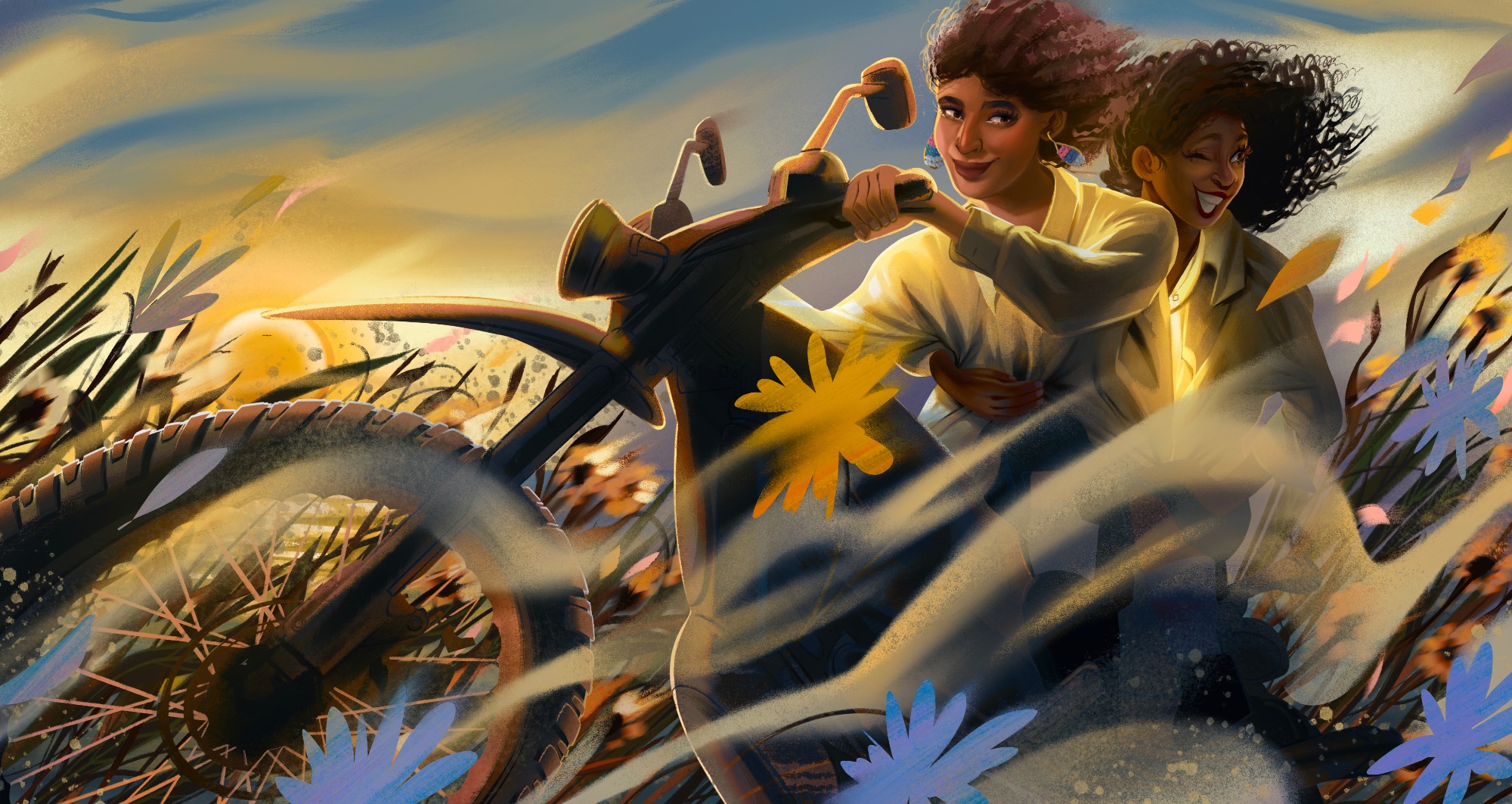
They hadn’t ridden an e-motor in years — their parents’ had been the last. Ashwiyaa’s was, at first glance, an ugly chimera of parts of different make. The word ‘ATOM’ was emblazoned on one side. When she told Dee, with no small pride, that she’d built it herself, they did not mention how unsurprised they were.
But it rode like a dream, even if they did have to stop and take turns winding the crank every twenty minutes or so. They took the shoddy bike lane that lined New Sea Drive. With their arms holding Ashwiyaa’s middle, their eyes looking out over the water, Dee felt alone with their somber thoughts.
The wreckage of the Old City peered back at them from the lake. Dee thought of what Ashwiyaa had said earlier. The world our parents went to prison over. Guilt gripped their stomach, but they weren’t certain what for.
They peeled off of New Sea. If Dee craned their neck, they could see the skyscrapers receding, the Lake and her grudges. Far from the Lake, extending to the west, the mega highways pumped blood in and out of the New City. The land in these parts was flat, so the haze that haloed the highways was visible even from where Ashwiyaa’s patchwork e-motor hummed along.
She wove them along roads that grew skinnier and skinner, guiding them with the ease of a frequent visitor. It comforted Dee, yet invoked a longing they’d spent the last ten days quelling — a longing they could not afford.
They dismounted the e-motor at the next fork. Through path and undergrowth, they walked for a time. It was hot, especially after spending the day in an air-conditioned cocoon. But the trees provided blessed shade. It smelled like earth here. Dee had almost forgotten.
They caught sight of the first cluster of yellow blooms out of the corner of their eye. They turned their head in the other direction. They weren’t in the mood to cry. A silence had sprouted between the two of them, but the air vibrated with the swaying of boughs, the rustling of leaves, and the song of birds. With a pang, Dee could almost hear their parents’ lighthearted debating:
“Heron? Honey, that’s a cormorant. Listen … ”
The path took them over a small rise, on top of which they could see tucked away, far beyond the other side of the water, the temporary fences and tarps that had gone up, the machinery that slumbered in the late afternoon. The machines whose guts Dee had seen in glances stolen over Ma’s shoulder. They held themself.
Ashwiyaa slowed to a stop. “You okay?” she asked, for the second time that day. Dee opened their mouth. How could they express the totality of their feeling? Their parents were in a dark box, and their siblings were counting on them, and they were evidently being bribed by the state with access to wealth and opportunity, and looking at the trees stoked an unspeakable guilt, and whatever they decided for their future was a betrayal of some part of themself, and —
“Yeah.”
They walked on.
At the edge of the water, a small, aged dock jutted out across the surface. Green life dotted the water and the wood both.
And the yellow flowers abounded.
In another life, Ma beckoned Dad over with a gentle wave. Beneath the watch of the tallest sunflowers, they shared a quiet smile. She said something. He laughed. The swamp flowers swayed along.
Did they know how precious they were?
Close to the far shore, to the west, the shallows allowed waterfowl, large and small, to stalk the waters on slender legs. The chatty cormorant floated across the surface without a care. Dee envied it.
Ashwiyaa heaved a sigh and dropped down to sit at the edge of the dock, her nice shoes swinging nonchalantly above the water. The sun was near setting, and could only barely be seen glaring from behind the tops of the oaks and cedars on the far shore.
They were quiet. Long enough for Dee to feel themself retreat into their thoughts once more. Try as they might to focus on anything else, like the birdsong or the scuttling critters, they were paralyzed by the guilt slowly growing roots in their torso. Until, finally — “What’d they get your parents for?” Ashwiyaa asked
“For those machines,” Dee said flatly. “Same as yours.”
“Yeah?”
“They also liked to rile up folks in the neighborhood. Park, too.”
“What’s that?”
Dee paused to sit by Ashwiyaa’s side, to let their legs dangle as well. “I used to hear them talkin’ about how they’d get people to come protest at the offices downtown or the demolition sites with them.”
Memories played out across the speckled surface of the water. “Who they thought they could convince, who they could at least get to be sympathetic.” Dee looked down at their hands. “Who they thought would help with the machines.” Their nails dug into the back of their hand. They had known since they were small the dangers their parents had chosen to face. Again and again. “The world is home for us all. We have to hope for something better than right now. We have to do what we can to make it happen.” They had said this, and many things like it. Lessons for Dee to learn. The oldest child — the example. And now that Ma and Dad were gone, the lifeline.
The roles felt mutually exclusive.
“It’s not right,” Dee said, suddenly. Out of the corner of their eye, they saw Ashwiyaa perk up. They went on, words tumbling out with little thought. “They always talked about hoping for something better. For us. And their hoping got them taken away.”
After a moment, Ashwiyaa gestured out towards the water. “But hope is action, isn’t it? Without action, what is it? It’s nothing, right?”
“It’s not nothing.”
“It’s nothing,” Ashwiyaa insisted. “Would you rather they hope for nothing? Do nothing?” “I would rather have my parents back.”
Neither spoke for a while after that.
The minutes dragged on and on. The sun finally sunk in its entirety below the trees, adorning their silhouettes with an orange glow. Crickets came to life in the encroaching twilight. When Ashwiyaa next spoke, it was with a gentleness Dee had not heard in a long time. “I miss my moms every day.” Her voice was quiet. “It hurts. I want to hug them. I want to hear their stupid jokes. I wish they could see who I am these days.” She paused, and Dee turned to see her toying with her beaded earrings. “But they believed in what they did. They hoped. They acted. And they did it for me. Even if it cost. Y’know?”
Ashwiyaa glanced over at them, then, and Dee almost jumped. It was the first time they had made direct eye contact.
Her eyes were a lovely brown.
Dee looked away, back to the tree line.
“I know.”
Another silence blossomed in the space between them. It was different than the last.
Dee apologized profusely to Auntie Janae and Aunt Imani for being so late to pick up the kids. Dodging questions with one-word answers, they let the Aunties send them on home with leftovers, as they always did.
On the way, Dee’s head was far gone. There was that telltale tugging, that call to act. The knowledge of what to do, once dormant beneath fear and rigidity, rousing to life. Resisting the hope felt like fighting back tears, or hiccups, or vomit. Hope meant change in priorities. Hoping was risk. Hoping was —
“You got mud on your shoes!” Nita chirped.
“I do.”
“Where you went?”
“The Slough.”
“Slew?” Nita tilted her head, and swung the hand clasped in Dee’s, no care in the world. “It’s like a swamp.”
“Oh. Can I go?”
Dee felt as if something had stabbed them right in the heart. They knew what to do, and they were terrified.
“I’ll take you both sometime.”
That night, Dee nearly forgot to eat. And when the kids were asleep, and the lights went out at ten, Dee continued to stare into the dark. And when they dreamed that night, it was of Ma and Dad, laughing quietly beneath the swaying sunflowers.
It took them weeks to work up the nerve to tell Ashwiyaa their idea. Even the intent felt dangerous.
In that time, they grew accustomed to lunching on the rooftop, to driving out to the Slough every so often on Ashwiyaa’s ATOM. They kept up with their studies where they could, but performance in school was no longer the most important thing. It had been replaced by something bigger and better and worse.
It was a cloudy Monday on which Dee decided to talk to Ashwiyaa about their plan. The day crept by—they couldn’t stop checking the time.
At lunchtime, they waited on the rooftop. But Ashwiyaa didn’t come.
They waited until lunch was long over. Their text went unreceived. Minute by minute, the pit in their stomach grew.
They knew it was because of their idea. Because of their trips to the Slough together. Somehow, for some reason, they’d gotten Ashwiyaa, like they’d gotten Ma and Dad.
On the rooftop they remained.
Another hour.
When the door flew open, Dee damn near screamed. There Ashwiyaa stood, uniform wrinkled and eyes weary. She was panting.
“Sorry,” she huffed. “I woke up late — my phone was dead, my alarm didn’t — ” “Ashwiyaa — ” Dee shot up from where they sat. Hearing their voice break, they stopped in their tracks, and held a hand to their mouth. Something was brimming and boiling over. “Dee?” Her voice was gentle.
Through blurring vision, Dee saw Ashwiyaa’s hand reach out, and felt it rest on their arm.
It was too much. With trembling shoulders, Dee tried in vain to stifle the sob that came out. By then, it was far too late — tears flowed hot and incessant down splotchy cheeks. “I thought they got you — ”
Dee felt themself pulled into an embrace. Their crying only intensified at the tenderness of it. The pain, the stress, the fear of the past few weeks — all of it bled out in the sobbing. They shed themself of the world’s heaviest burden.
The pair stood like this for a time before Dee could find words.
“They’re gone,” they whispered. “They were supposed to take care of us.” They felt a hand stroke their coils. Voice trembling, they went on and on. “I’m scared all the time. I want to help — I want to make things better. I always have. But it’s terrifying — ”
“Yeah.” The cracking in Ashwiyaa’s voice made Dee look up. They locked teary eyes.
“Scary as hell,” she said.
They shared a smile.
Suddenly, Dee found themself awash in the humor of it all.
“You remember,” they asked, “the first thing you ever said to me?”
Ashwiyaa paused, then joined them in laughter.
“Yeah.”
They stood together in their shared joke and shared tears until the next period’s bell rang below.
“I was thinking,” Dee said, quiet, “that we don’t have to do what they did. But we should do — ”
” — something.”
“Right. But not just us,” they said, terror beginning to cede to something greater. “I had an idea.”
Ashwiyaa took them to the Slough, and they talked it out beneath the flowers.
The work would be hard. Work worth doing often is.
The Aunties would be their first allies. Dee would let themself listen to the knowledge and the stories. The fear would be there, but that would be okay.
As their first task, they would zip around on ATOM. They would plaster the flyers up and down the Park and Near with their water-and-flour adhesive, the way Ma and Dad used to do it. They would spread the idea in all of its beautiful dissidence:
Do your part!
Protect YOUR Earth!
Now until forever!
It would be their second date.
It would be a gamble — there was no guarantee that people would care, no guarantee that anything would come of it if they did.
But summer would come again to the New City, as always. And between their e-motors, Dee and Ashwiyaa would tote along a wide-eyed Nita and Ori. Between the hikers, families, and dreamers that would meander along the trails, Dee would watch their siblings take their first steps onto the dear earth.
For now, they beheld that temporary fence from afar. And those machines that lie beyond, awaiting the word of distant someones with more money than God. Those someones didn’t know — and how could they have known? — that one day, on the ground where massive tires now rested, sunflowers would grow.
It was a promise, one that Dee mouthed silently. The wind would carry it where it needed to go.
They would always fear going the way of Ma and Dad. They felt the ghost of the unknown, its weight and chill. But then, Ashwiyaa beckoned them over. They sat among the flowers and the grasses together, and watched the world turn for a while.
Lyrra Isanberg, raised in Vermont, is a visual artist, hobbyist writer, and marriage and family therapist in Chicago. She is interested in exploring the interplay between environmental change and interpersonal relationships. She loves video games, theatre, romance novels, and long walks on the beach.
Violeta Encarnación is an award-winning Cuban illustrator illustrator based in New York City, known for her vibrant, storytelling-driven visuals across traditional and digital media. Her work has appeared in publications like The New York Times, Sports Illustrated Kids, and The Washington Post. Her latest illustrated picture book, Together We Remember, published by Penguin Random House, is currently available for preorder. Violeta’s art often explores our connection to nature and each other, inviting viewers to reflect on these relationships.
Read more Imagine 2200 climate fiction
-
![Illustration shows a group of young people sitting on the ground of a lush greenhouse filled with fruit trees, listening to a man standing in the center.]()
The Hunger and the Hunger
“Visitor, what is hunger?” A former guerilla fighter struggles to explain his past when he finds himself in a land without poverty or want.
-
![Illustration shows a man standing in an overgrown river delta, wearing an orange backpack, locs blowing in the wind. He is looking at a public telephone box standing alone among the undergrowth.]()
The Seed Dropper
Decades after flooding drove his family from their Louisiana home, June returns to replant the land, and grapple with its legacy.
-
![Illustration shows an Asian woman and a Latino man wearing dirt-covered work clothes, looking into each other's eyes. They are standing in a shed filled with round trays of green leaves and white worms, and white moths fly around their heads.]()
The Ones Left Behind
In the backroom of a Sichuan restaurant, Grace tends to the family’s legacy and discovers a new beginning.