Climate Food and Agriculture
All Stories
-
![]()
![]()
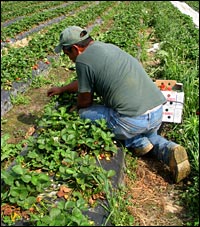
Workers on organic farms are treated as poorly as their conventional counterparts
When Elena Ortiz found a job on an organic raspberry farm after working for nine years in conventionally farmed fields, she was glad for the change. The best part about her new job was that she no longer had to work just feet away from tractors spraying chemical herbicides and pesticides. An added bonus was […]
-
Vegetarians Are Ruining the Planet
Cargill pushes soy farming that’s obliterating the Amazon Soy production has overtaken logging and cattle ranching as the main source of Amazon rainforest destruction. In the past three years, nearly 27,000 square miles of the Amazon have been destroyed, nearly three-quarters of it illegally. Much of the acreage was sold to soy producers, financed in […]
-
![]()
![]()
Sustainable and vegetarian cuisine is on show in Sin City
Quick: Where can you eat vegan doughnuts for breakfast, vegetarian Chinese for lunch, and 13-bean soup for an afternoon snack? Hint: In the same city, you can feast on sustainable fish for dinner, prepared by one of the country’s celebrity chefs, and Kind Apple Cobbler for dessert — the “raw” version. New York? Maybe. Seattle? […]
-
USDA will soon decide how much pasture time organic dairy cows should get
With demand for organic milk soaring, the stakes are high in the debate over what exactly "organic milk" is -- and that debate will soon be settled, at least from a legal standpoint, by the USDA's National Organic Program.
-
Aw, Shucks
Ethanol ain’t all it’s cracked up to be, new study says A new study casts serious doubt on ethanol’s status as a green wonder-fuel. In the Proceedings of the National Academy of Sciences, researchers lay out a series of grim findings about corn-based biofuel. Runoff from large-scale corn cultivation contaminates waterways with nitrogen, phosphorus, and […]
-
Outstripped
Demand for organics outpacing local supply With demand for organic food soaring in the U.S. and U.K., manufacturers of organic products are struggling to find adequate supplies of organic ingredients and are increasingly looking and buying abroad. While exporters like Australia welcome the trend, it creates a dilemma for many organic enthusiasts, who also tend […]
-
Olive Twist
“Climate-change farmer” plants England’s first olive grove Britain’s first olive grove has been planted in Devon in southwestern England — made possible by global warming. Traditionally an iconic crop of Mediterranean regions, the olive may soon be able to flourish in more northerly climes, some specialists believe, thanks to rising temperatures. Olive entrepreneur Mark Diacono […]
-
Seedom Is on the March
Millions of seed varieties to be secured in new Arctic vault Construction kicked off yesterday on a high-security vault to be dug into a frozen mountainside on a remote Norwegian island in the Arctic, to protect that most precious of commodities: seeds. The vault will be sized to hold 3 million seed varieties, the source […]
-
AZM Grace
EPA will phase out highly toxic pesticide If you’ve been avoiding Brussels sprouts because of pesticide contamination — as opposed to the grossness — you’re in luck: by next year, the U.S. EPA plans to phase out organophosphate azinphos-methyl (AZM) on the odiferous buds, as well as on nuts and nursery stocks. By 2010, AZM […]
-
Could the battle for South Central Farm be coming to a close?
The scene at South Central Farm would look familiar to anyone who’s ever attended a multi-day protest: there’s a makeshift kitchen to feed the masses, a small sound stage, a tent for banner-making. But the kitchen is preparing nopales quesadillas instead of vegan stew, the stage features a Norteño band replete with cowboy hats, and […]