This story is published through the Indigenous News Alliance.
Indigenous communities around the world face mounting, and colliding, impacts from climate change, violence, rising threats from artificial intelligence, and many other crises. Their leaders are demanding that the world take action, and they’ve given the United Nations a 12-point plan for what they say it must do.
Simply put, their proposal calls on the U.N. and governments around the world to take sweeping and rapid action to protect Indigenous land, rights, and lives.
“Our communities — our women, our children, our families — they have a right to action and that’s what we’re not seeing globally,” said Cora McGuire-Cyrette, who is a member of the Bingwi Neyaashi Anishinaabek and spoke on behalf of the Ontario Native Women’s Association. “We’re looking for action.”
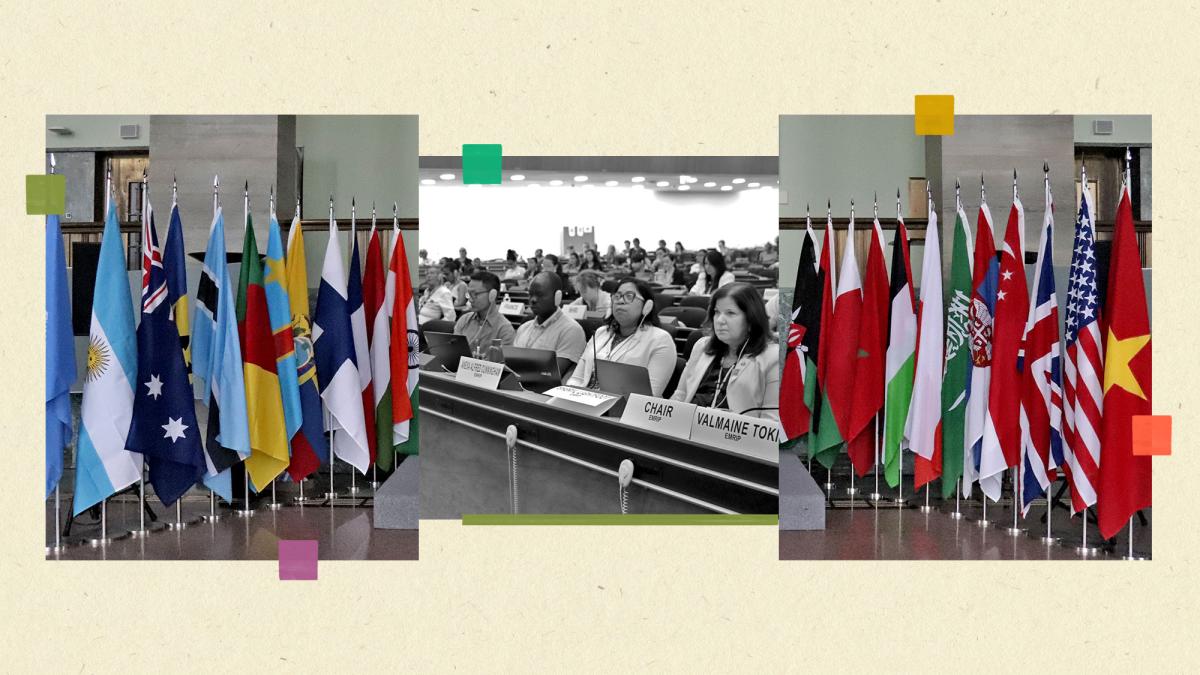
Last week, the seven Indigenous members of the United Nations Expert Mechanism on the Rights of Indigenous Peoples, or EMRIP, finalized the proposal it will present to the U.N. Human Rights Council. But even as the recommendations generated hope for change, the financial crisis facing EMRIP cast a shadow over the proceedings. Many delegates expressed concerns about the future of the forum, and other hard-won international platforms for Indigenous voices.
Given the scale of threats Indigenous peoples face, these forums are more important than ever, said Sheryl Lightfoot, who is Anishinaabe and serves as EMRIP’s North America region expert. “There’s clearly no shortage of work,” she said.
The breadth of the 12 recommendations reflects that urgency, calling for stronger protections for Indigenous cultures and rights and a greater voice in global affairs.
One recommendation sought greater protections for remote Indigenous peoples living in voluntary isolation or initial contact. Others stressed the need to preserve Indigenous languages and data sovereignty.
Delegates also argued that the legal standing of Indigenous peoples must be strengthened by recognizing their rights as distinct from broader human rights and by fully implementing the U.N. Declaration on the Rights of Indigenous Peoples. They also called on the U.N. to increase Indigenous participation within the Human Rights Council and encourage member states to engage more fully with EMRIP.
Albert Barume is the U.N. special rapporteur on the rights of Indigenous peoples and EMRIP’s former chairperson. He told the delegates about what he called a widespread trend of “stagnation and regression” for human rights. “In the last years,” he said, “almost no single states have taken a new measure protecting Indigenous peoples’ rights. And states that had legal and policy frameworks are actively dismantling and regressing.”
Macy Duxfield, who is Māori and belongs to the Ngaa Rauru, Te Ātihaunui-a-Papārangi, and Ngāi Tahu nations, described Aotearoa New Zealand’s policies toward Indigenous peoples as regressive. But she reminds herself of the continual work that’s still needed to overcome the challenges her people face. “We exist in this moment,” she said. “We’ve inherited the work from our ancestors, and we pass it on to our descendants.”
McGuire-Cyrette and others also reminded delegates about the importance of greater autonomy for Indigenous women and girls. “We recommend the inclusion of Indigenous women in all decisions that impact our lives, our families, and our nations,” McGuire-Cyrette said.
But even as Indigenous delegates try to use international forums to fight for change, those mechanisms are in danger. EMRIP is among the three U.N. bodies focused on Indigenous peoples — along with the Permanent Forum on Indigenous Issues and the special rapporteur on the rights of Indigenous peoples. All three agencies face an uncertain future due to dwindling financial support.
Marjolaine Étienne, who is Innu from the Pekuakamiulnuatsh community of Mashteuiatsh in Quebec, told delegates the U.N. Voluntary Fund for Indigenous Peoples needs greater support. The program helps Indigenous representatives cover the costs of attending international meetings. The number of representatives the fund supports is already perilously low, she said. Without greater state contributions, fewer delegates will be able to attend those forums, sidelining them from the international stage.
Just eight countries contribute to the fund, and its budget is less than $2 million. Only three countries contributed to the U.N. Trust Fund for Indigenous Peoples. The United States does not contribute to either of them.
“The liquidity crisis must not be used as an excuse to limit the mandate of EMRIP and to reduce the frequency or depth of country engagements or follow-up,” McGuire-Cyrette said.
Lightfoot acknowledged there is widespread uncertainty within EMRIP and all U.N. bodies amid the agency-wide reform effort known as UN80. But she said EMRIP is preparing for whatever happens. “There are a lot of unanswered questions right now” about the reforms, she said, “and what the impacts of that might be for Indigenous-specific mechanisms.”
“I don’t know where we’re going,” she said. “I don’t know what kind of efficiencies the U.N. will ask of us. But I know we are thinking it through because we want to be ready to respond.”